

Katzenberg Declares the End of Marketing’s Black Box with AI Breakthrough
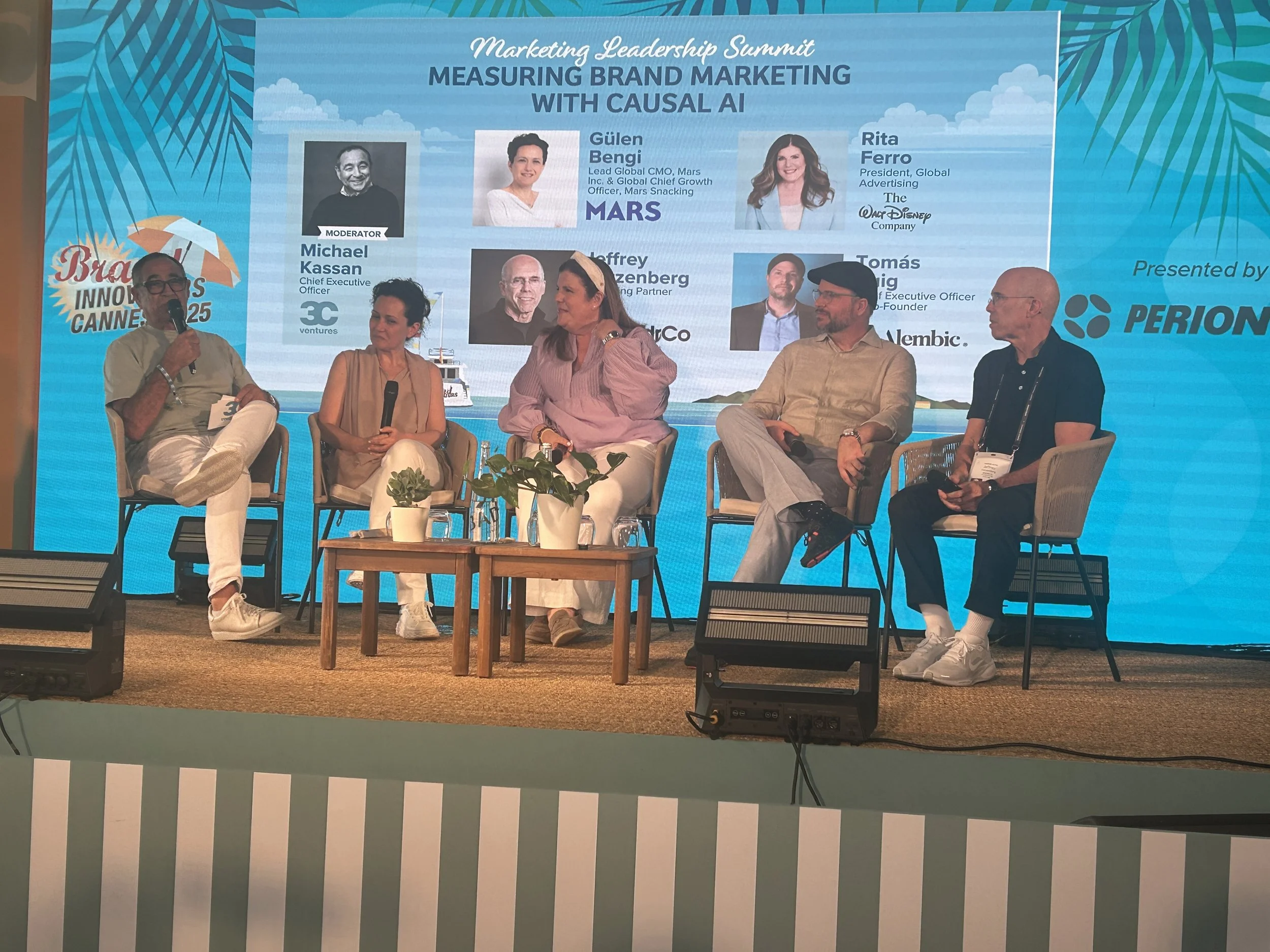
Brand marketing is undergoing a long-overdue reinvention, powered by artificial intelligence. At Cannes Lions 2025, a Brand Innovators panel hosted by Michael Kassan explored how new AI technologies are transforming brand storytelling from a loosely measured art into a precisely attributed science. For communicators, the message was clear: data is now the new language of credibility, and being able to prove impact—not just intent—will be essential in every boardroom conversation going forward.
Kassan, described by many as the “ultimate power broker,” is the founder of MediaLink and more recently 3C Ventures. Known for his ability to see and seize opportunities across industries, Kassan has been instrumental in reshaping tentpole events like CES, Cannes Lions, and Mobile World Congress. His career spans executive roles as President/COO of Initiative Media Worldwide, where he grew billings from $1.5 billion to over $10 billion, and as President of International Video Entertainment (Artisan Entertainment). A member of the Advertising Hall of Fame and the Ad Council board, Kassan brought both gravitas and strategic insight to the discussion.
Facing him onstage was Jeffrey Katzenberg, whose legendary career includes a decade as chairman of Walt Disney Studios and co-founding DreamWorks SKG. Now managing partner at WndrCo, Katzenberg reflected on how marketing has evolved and how far brand marketing has lagged behind. “Performance marketing has become a science,” he said. “Brand marketing has historically remained a mystery. Thanks to AI, we’re finally able to measure what was previously immeasurable.”
That capability is being unlocked by Alembic, a technology company founded by Tomas Puig, who drew inspiration from the data modeling techniques used during the pandemic. “Every other major field—epidemiology, climate, finance—relies on high-speed computation and advanced modeling,” said Puig. “Marketing was still stuck using math from the 1970s. Our goal was to change that.”
For communicators, this shift has real implications. Messaging that once lived in the shadows, like brand lift from organic engagement, influencer partnerships, and cultural moments, can now be measured and optimized. Strategic communications can finally speak the same language as finance and analytics, which opens new doors at the C-suite level.
Alembic’s platform now allows marketers to precisely attribute the impact of brand campaigns, including influencer activity and earned media, using causal modeling and real-time analysis. “We want to turn every marketer into a storyteller again,” said Puig, “but one who knows exactly how and where their story moves the needle.”
This shift has already taken hold at companies like Mars. “We’re redefining how we build brands,” said Gülen Bengi, Mars’ Global Chief Growth Officer. “Fifty percent of brand building now comes from unpaid channels—organic conversations, creators, communities. With AI, we can measure the value of these engagements and link them directly to business outcomes.”
Bengi cited a recent Alembic-powered pilot involving Snickers. When Justin Timberlake posted about Snickers ice cream, the social conversation rippled across sports and celebrity channels. “In the past, we’d know that was good for the brand,” she said. “Now we can show it led to real sales uplift at major retailers. That’s the difference AI makes.”
For PR and communications professionals, this means a powerful new argument: authentic, community-driven storytelling works and you can prove it. “Creative used to be a job title for a few. Now it’s a verb for the many,” Bengi added. “With attribution, we can connect millions of creators to business value. That supercharges growth.”
Rita Ferro, President of Global Advertising at The Walt Disney Company, underscored how AI-powered attribution is reshaping conversations with media buyers. “We’ve moved from a one-to-one or one-to-many model to what I call ‘one-to-outcome,’” said Ferro. “Brands don’t just want impressions, they want proof of performance. And with tools like Alembic, we can now offer our partners customized, outcome-based measurement across our entire ecosystem of live sports, streaming, even Disney parks.”
Communications teams should take note: outcome-based metrics will increasingly be expected by both clients and internal stakeholders. Ferro added that this transformation also affects Disney’s own marketing decisions. “It’s not just about selling media anymore. It’s about understanding whether using inventory to promote our own products drives more value than selling it to a partner. We can finally close that loop.”
As the conversation wrapped, Katzenberg and Kassan reflected on how far marketing has come and how AI may be its most revolutionary leap yet. “This wouldn’t have been possible two years ago,” said Katzenberg, crediting breakthroughs in AI and computing from companies like NVIDIA. “Now, marketing is catching up with science. It’s not just creative, it’s accountable.”
And accountability is the operative word for communicators going forward. Whether shaping narratives, driving earned coverage, or launching new campaigns, the ability to tie messages to measurable impact will separate the strategic leaders from the noise-makers.
Ferro closed with a note of optimism: “We are the storytelling company for the ages. And this technology will only help us tell better, more valuable stories.”
Puig echoed that sentiment, referencing Arthur C. Clarke’s famous quote: “Any sufficiently advanced technology is indistinguishable from magic. That’s what we’re building for marketers, for storytellers, for the future.”