

PR Professionals Need to Adapt as AI Is Reshaping the Newsroom

Artificial intelligence is no longer just a behind-the-scenes newsroom tool. Increasingly, it is influencing editorial decision-making.
The fundamentals of storytelling have not changed. Credibility, clarity, and relevance still matter most. What has changed is how those qualities are discovered and amplified. AI is not replacing earned media. It is rewarding the communicators who understand how to make it discoverable in the answer economy.
Our 2026 TV News Producers Report: AI and the Newsroom found that nearly 70% of TV news producers are more likely to air a story if it is optimized for AI search. That means generative engine optimization, or GEO, is already shaping what gets attention in local television newsrooms.
The message for communicators is clear: if your story is not structured for how AI platforms surface information, it risks being overlooked before it ever reaches an assignment editor.
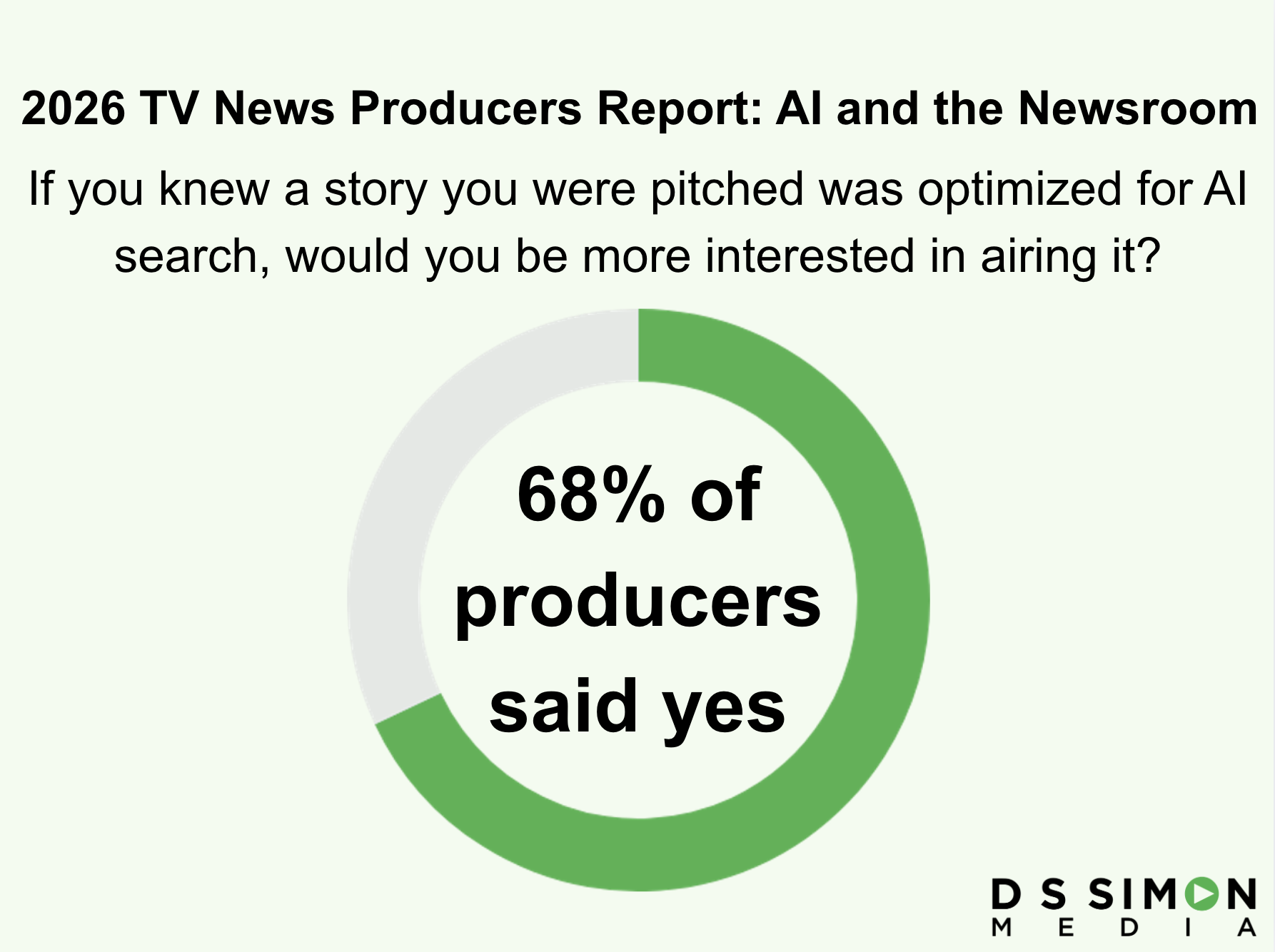
We surveyed producers and reporters at local TV stations nationwide, and the results show how rapidly newsroom practices are evolving. 37% of producers said they are already using AI to identify stories to cover. 60% reported their stations are optimizing online content for AI discoverability. And when given two similar pitches, 68% preferred the one optimized for AI.
This marks a shift from traditional search engine optimization to generative engine optimization. GEO is not just about keywords. It is about authority, structure, relevance, and alignment with the questions audiences are asking AI platforms. That evolution has major implications for earned media.
Our Satellite Media Tours are now AI-Powered Broadcast Media Tours™. While they remain one of the most efficient tools for broadcast coverage, now they’ve also become an effective tool to enhance GEO for the participating organization.
Broadcast segments now live far beyond their original airtime. They appear on station websites, YouTube channels, social platforms, and increasingly within AI-generated search results and summaries. As generative AI search becomes a primary way people find information, nearly every interview has a much longer digital lifespan.
That means communicators must think differently about how stories are framed. Pitches, interview questions, and supporting materials should not only work for live television, they should also anticipate how information may later be surfaced, summarized, or cited by AI systems.
Some critics worry that AI optimization could compromise editorial integrity. I see it differently. Producers today are under-resourced and operating in a demanding multi-platform environment. A pitch that signals authority, relevance, and digital amplification helps producers identify stories aligned with audience interest. It does not replace editorial judgment; it supports it.
Importantly, local television news remains one of the most trusted sources of information in America, according to research from organizations like Pew Research Center and Emerson College. That trust gives earned media even greater value in an AI-driven media ecosystem.
After four decades helping clients get covered on television, one thing is certain: media strategy never stands still. The organizations that adapted to satellite distribution and digital transformation gained an edge. AI is the next inflection point.