

Communications, Content Authentication, and Building a Trust Stack in the AI Age
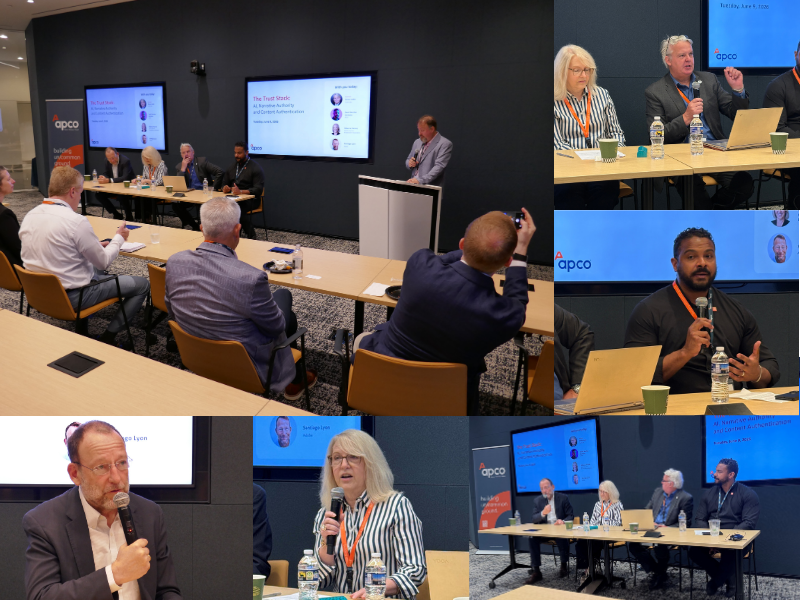
Narrative authority is key to discoverability in the AI Age. The challenge facing communicators is to generate content that is trusted both by humans and machines. This requires a multi-layered approach to the multi-dimensional problem of declining trust in digital content or put another way a “Trust Stack.”
This was one of the key takeaways from a CommPRO, Capitol Communicator, Tauth Labs, and APCO roundtable breakfast in Washington, D.C. on June 9 - “The Trust Stack: AI, Narrative Authority and Content Authentication.”
The “Trust Stack,” a concept developed by David Sánchez Carmona, Director of AI and Intelligence at APCO’s AICommsLab, is based on the idea that brand safety and discoverability requires both communications and technology solutions.
Narrative authority reflects what is said, how it is said, and structured, and the quality of communications channels. And, as Santiago Lyon, Head of Advocacy and Education, at the Content Authenticity Initiative/Adobe, and Rebecca Hanson, Director General of the North American Broadcasters Association, both underscored, content authentication is a technology layer that serves to underpin trust.
Simon Erskine Locke, cofounder and CEO of Tauth Labs, who moderated the conversation, shared that content authentication helps audiences differentiate between authentic and shadow content (malicious content designed to look like it is from companies or organizations created with the intention to misinform) to protect brands. He added that it is also a powerful “trust signal,” which is already being used by search engines and LLMs to prioritize authentic content and screen out scams at an infrastructure level.
Lyon shared the origin story of the global standard for content authentication developed by Adobe with a coalition of the worlds’ leading technology and media companies – C2PA. He highlighted its role as a form of nutrition label for digital content that can be used by audiences to know both where it is from and how it was created.
The discussion highlighted the growing adoption of content authentication across a range of use cases including in the communications industry, as well as supporters of the standard including LinkedIn, OpenAI, and Google.
The media and broadcasters are at the forefront of adoption. As Hanson shared, trust in the media is currently a significant issue for media organizations. She noted that the BBC, Canadian and European media are leading the way, with the authentication of the user-generated content a particular priority and challenge.
C2PA is being incorporated into cameras from Leica, Canon, Sony and others as part of glass-to-glass implementations of authentication technology to provide broadcasters the ability to incorporate provenance into content and audiences to be able to validate it on a screen. Hanson highlighted a specific challenge for the media around the importance of identity, while noting the growing focus of North American broadcasters on the technology.
Locke discussed the range of use cases for the technology, making the point that while the initial focus has been protecting audiences from fake content, authentication is a path to build trust into content and is expected to put communicator-generated content on a fast track for journalists. He added that AI models will focus on ingesting authenticated content and authentication of published content in ways that will enhance the quality of input and outputs.
In the context of the “Trust Stack,” Sánchez Carmona shared perspective around how APCO’s AICommsLab is working with clients to use AI to both identify narratives being communicated, misinformation and disinformation on the internet in ways in which its team would be able to work with clients to both detect and correct reputational issues with technology and communications solutions.
APCO is building groundbreaking AI tools that draw upon its consulting experience and expertise to support its team and clients. These new tools leverage the latest cutting-edge AI concept of skills-based platforms that will enhance the capabilities of communicators to build effective narratives to both grow and protect brands.
To address a question that came up in the roundtable discussion about the potential risk of the fraudulent use of authentication by bad actors, Locke cited the latest in a series of Tauth Labs white papers on communications and content authentication: “Kintsugi, Content Authentication, and Rebuilding Trust in the Internet.”
Both he and Lyon reiterated the idea that content authentication is not a silver bullet, and it does not prove that what is authenticated is necessarily true. What is does is build accountability into content through the robust cryptographic proof of provenance. When combined with narrative it provides a foundation for trust that it is from who it says it is from, that is the basis for engagement by audiences.
In an upcoming CommPRO/CommunicationsMatch Town Hall, we’ll be building on this discussion. Make sure to subscribe to the CommPRO Executive Newsletter for more information.
For more information contact slocke@tauth.io, contact@nabanet.com or visit the Content Authenticity Initiative or APCO website.