

AI Adoption Is Rising — But Consumers Want Control
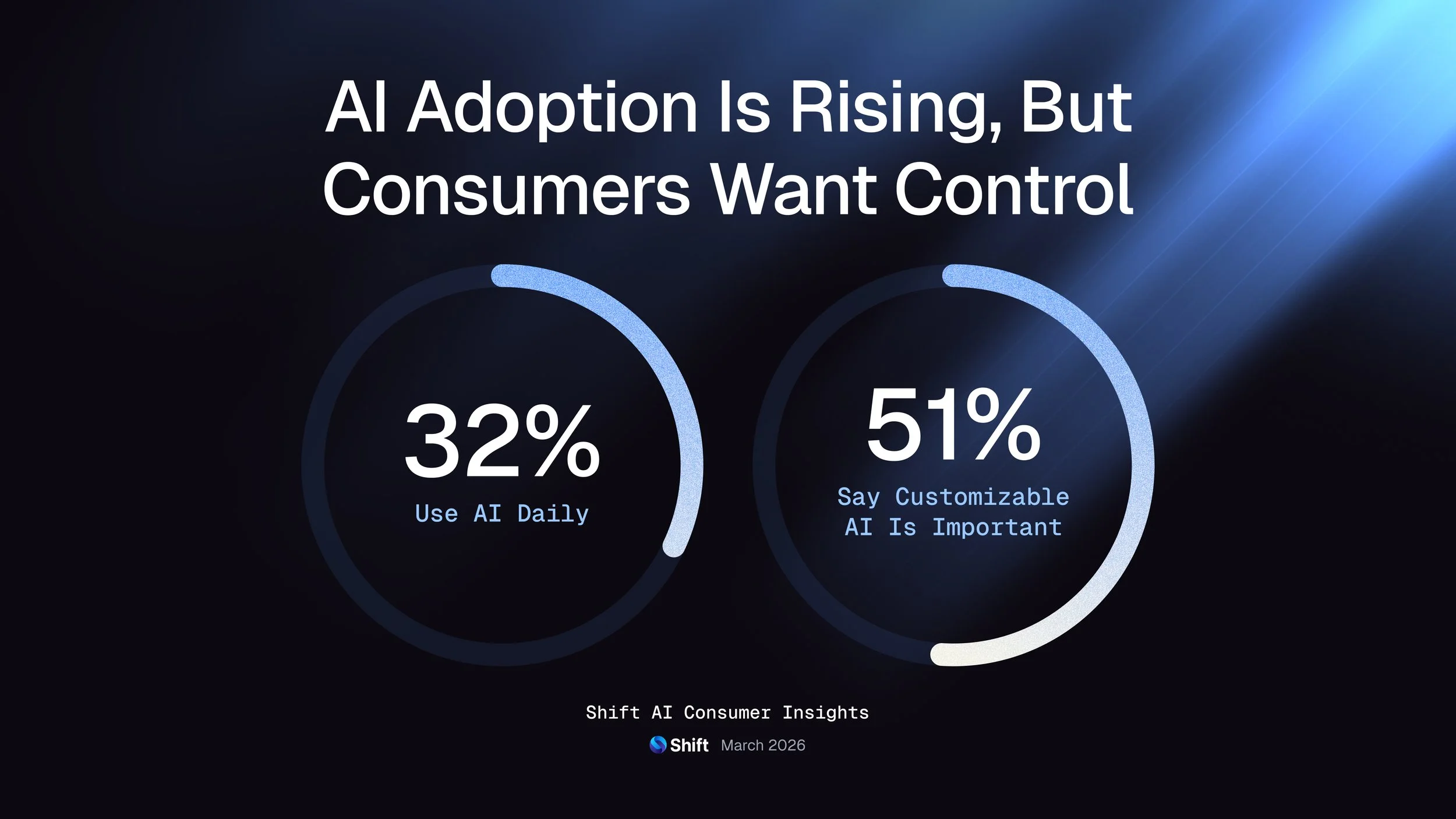
AI is no longer a future trend. It is embedded in daily workflows, search behavior, and content consumption. New data from Shift Browser’s 2026 AI Consumer Insights Survey shows that 32 percent of consumers use AI every day and more than half believe it improves their online experience. But rising adoption is matched by rising expectations. Consumers are signaling that performance alone is not enough. Control, clarity, and accountability now determine whether AI earns their trust.
For communicators, this is the real story. The conversation has moved beyond novelty and acceleration. We are entering a phase defined by governance, visibility, and user authority.
The Control Imperative
Consumers are not rejecting AI. They are asking for guardrails.
Fifty-one percent say the ability to customize or limit AI features is important. Forty-four percent worry about AI taking actions without approval. Twenty-six percent report difficulty managing or turning off AI features.
At the same time, 48 percent say they are comfortable with autonomous AI features when oversight is present. Acceptance is not binary. It depends on transparency and control.
For brands integrating AI into products, communications, or customer experience, this reframes the strategy. Adjustable settings, explicit disclosures, and meaningful opt-outs are no longer enhancements. They are baseline expectations.
Trust is increasingly built through system design, not messaging alone.
Influence Without Full Trust
The survey reveals a layered relationship with AI. Sixty percent say they trust AI engines at least somewhat. Fifty-eight percent say AI-generated answers have influenced their opinions at least occasionally.
Consumers may not fully trust AI systems, but they are allowing them to shape perception.
Communicators should be asking:
How does our brand appear in AI-generated summaries?
What signals are influencing those outputs?
Where do we retain authority, and where is it mediated by machines?
Accuracy, transparency, and explainability are emerging as core reputation factors. Privacy ranks as the top concern at 48 percent, followed by accuracy at 36 percent and lack of transparency at 32 percent.
Trust in AI is layered. It is shaped not only by performance, but by clarity around how data is used and where the answers are coming from.
Regulation Moves Into the Mainstream
Support for oversight is broad. Seventy-nine percent favor some level of government regulation for AI answer engines. Thirty-five percent support strong regulation. Only 12 percent believe no additional regulation is needed.
For communications leaders, this signals that regulatory positioning will increasingly influence brand perception. Silence may be interpreted as indifference. Proactive alignment around transparency and responsible development can strengthen credibility.
AI governance is becoming a reputation issue, not just a policy discussion.
Adoption Is Growing, but It Is Practical
Usage remains uneven. Thirty-two percent report daily engagement. Twenty percent say they never use AI, with non-use concentrated among adults 65 and older. Daily engagement is highest among 25 to 34 year olds and working professionals.
Consumers primarily want utility. Fifty-four percent prioritize research assistance. Thirty-four percent value article summarization. Thirty-two percent seek task automation.
This suggests the next phase of adoption will be shaped by practical, task-oriented value rather than abstract innovation. Communicators should emphasize tangible outcomes over visionary claims.
Sustainability Enters the Trust Equation
Environmental impact is beginning to factor into evaluation. Fifty-seven percent of respondents express concern about the energy required to power AI systems.
Operational responsibility may increasingly influence how platforms are judged. For brands deploying AI at scale, sustainability messaging must extend beyond product features to infrastructure commitments.
Transparency now spans privacy, performance, and environmental impact.
What This Means for Communicators
The data does not signal an AI backlash. It signals maturation.
Adoption is rising. Influence is real. But permission is conditional.
For communications professionals, the implications are clear:
Center transparency in AI narratives.
Highlight user control and customization.
Monitor how brand information appears in AI-generated environments.
Prepare for regulatory scrutiny as part of reputation management.
Integrate sustainability into AI strategy conversations.
The next phase of AI will not be defined by acceleration alone. It will be defined by accountability. Performance may attract users. Control will keep them.