

When Your First Reader Is a Machine
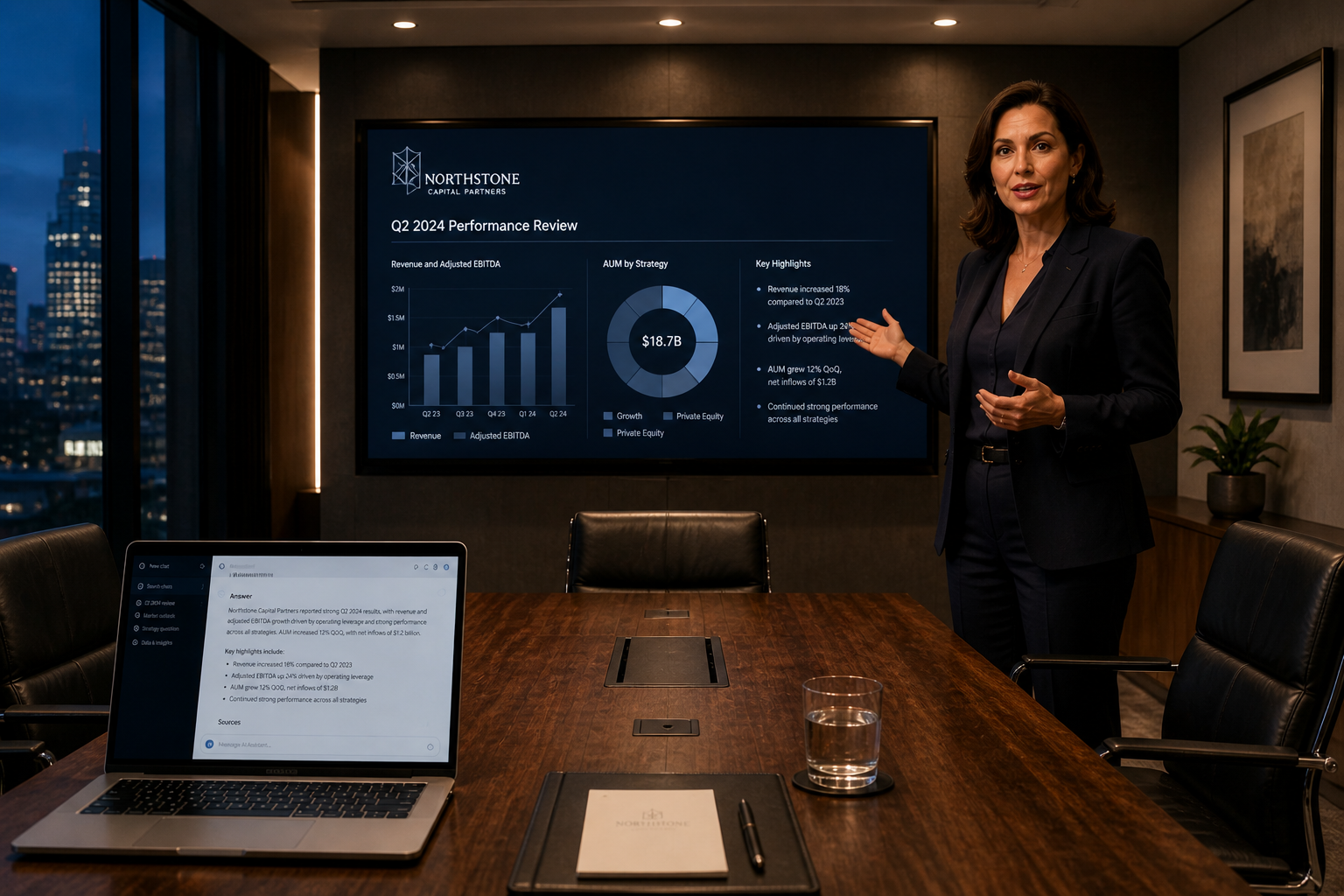
For the better part of a century, communications strategy has been built around a single assumption: that the human reading about your company is forming their impression directly from human-made sources. A journalist's article. An analyst's report. A peer's recommendation. A press release they actually read.
That assumption is quietly breaking.
When a buyer asks ChatGPT about a vendor today, they are not forming a fresh impression. They are reading one that has already been formed, by a model that decided, perhaps long before the question was asked, what your company is, what matters about it, and which sources to trust. The same is true when a recruiter asks Gemini to summarize a candidate, or when an LP asks Perplexity what it knows about a fund. The human is still making the final call. But the editorial work, what to include, what to leave out, what to lead with, has already been done by something that isn't a journalist, isn't accountable, and isn't pitchable.
That changes more than most communications strategies are prepared to admit.
I've been spending a lot of time lately with CCOs and PR firm partners working through what this actually means in practice. The most useful framing I've landed on is a side-by-side: how does a human evaluate a company, versus how does a machine? Because the answer is not "the same things, but faster." It is a genuinely different set of signals, with different weights, and different ways of going wrong.
The first impression is shaped differently.
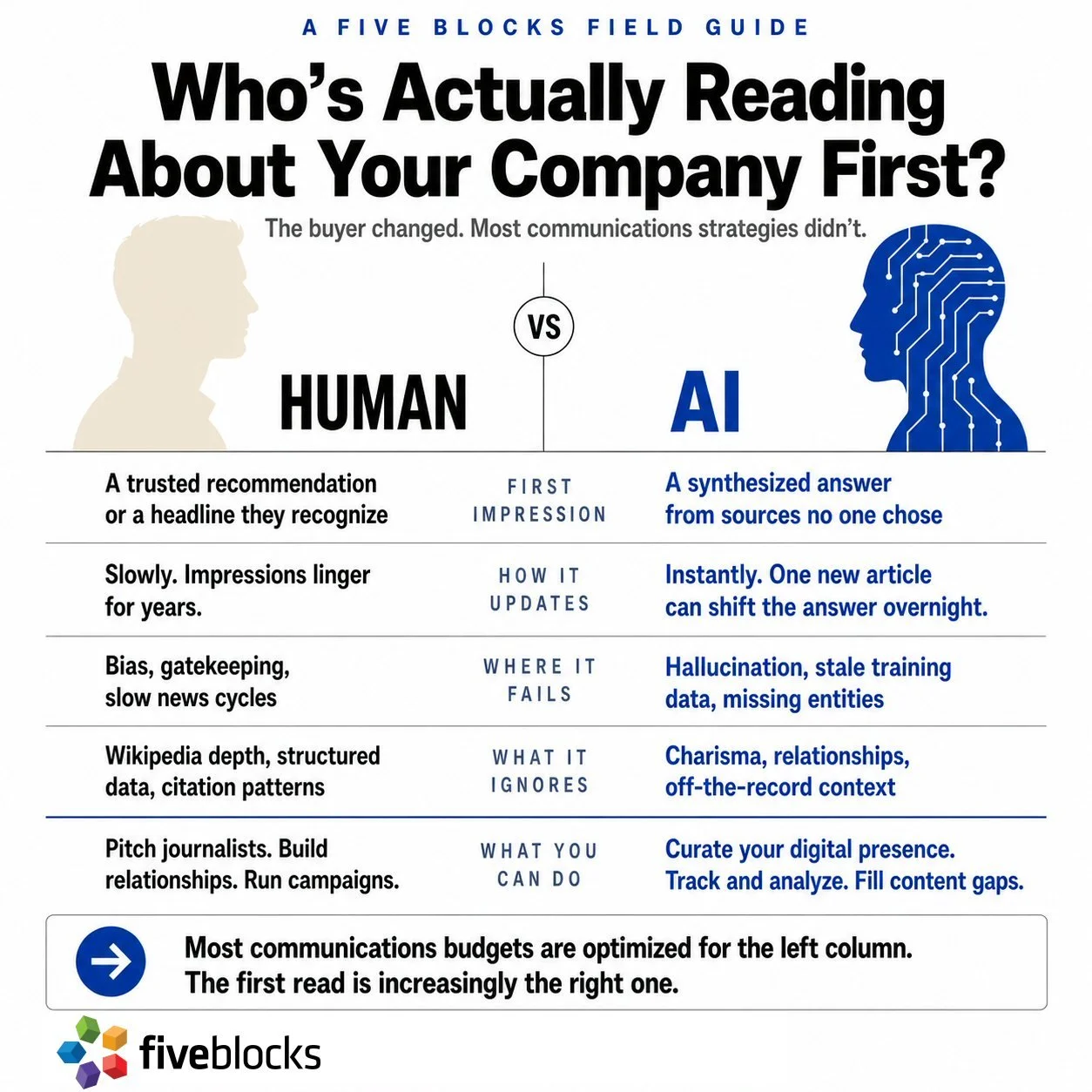
A human's first impression usually comes from a trusted recommendation, a familiar headline, or a brand they have seen before. It is filtered through relationships, memory, and gut. The machine's impression, the one the human now reads before they form their own, is assembled from sources that perhaps no one on your team has audited. Some may be five years old. Some may be wrong. Some may not even be about you. And the human gets it presented as a clean, confident paragraph.
The update cycle is different.
A human's view of your company moves slowly. Impressions may linger for years. A bad story from 2019 still echoes in the back of someone's mind. The machine's view, by contrast, can shift overnight. One new article in a high-authority outlet, one Wikipedia edit, one new earnings transcript, and the answer to "what does ChatGPT say about this company?" can change materially. That is a feature, not a bug, but it means the reputation you are managing is constantly moving.
The failure modes are different.
Human evaluation fails through bias, gatekeeping, and slow news cycles. We know how to manage those failures. We have built an entire industry around it. Machine evaluation fails through hallucination, stale training data, and missing entities. If your CEO does not have a Wikipedia page, or your company's structured data is thin, or your most recent positioning has not been picked up by sources the model trusts, the machine fills in the blanks. And it fills them in confidently.
What each one ignores is the most uncomfortable part.
Humans may ignore Wikipedia depth, structured entity data, and citation patterns. They do not think about it, and they should not have to. Machines ignore charisma, relationships, off-the-record context, and the things you can only convey in a room. The machine cannot be charmed at a conference. It cannot be talked off a ledge by a well-placed call. It cannot be given context that has not been written down somewhere it can read.
This is the part that should land hard for any senior communicator. The skills that built our profession, relationships, narrative judgment, the ability to read a room, are exactly the skills the machine cannot value, because it cannot perceive them. And those are the skills that no longer reach the buyer first.
So what do you actually do about it?
The honest answer is that you do not throw out the playbook. Most of what good communications teams have always done still matters. You still pitch journalists. You still build relationships with analysts. You still run campaigns. The human reader has not gone away.
But you also have to do a second job, and most teams may only now be realizing it. You have to influence the sources the machines actually read. You have to structure your entity data, Wikipedia, knowledge panels, schema, official filings, so the machines can find a coherent story. You have to monitor what the major models are saying about you across ChatGPT, Gemini, Copilot, and Perplexity, because the answers diverge and the divergence matters. And you have to do this on an ongoing basis, because the answer changes whether you are paying attention or not.
This is the work we built tools to do at Five Blocks, to give communications leaders a measurement layer for the machine's reading of a company, the same way they have always had measurement for the human's.
The real shift in our industry is not that AI is "coming for PR." That framing has always been lazy. The shift is that the order of operations has changed. The machine reads first. The human reads the machine. And communications budgets may still be optimized for a chain of events that no longer starts where it used to.The teams that figure this out first will have an enormous advantage. The ones that keep optimizing only for the human reader will still be doing good work. They will just be doing it one step removed from where the impression is actually being formed.