
It’s Show Time for Communicators Living in a Show-Me Economy
Here’s what you’ll learn when you read this article:
Why today’s stakeholders are demanding action over messaging, and how communicators can adapt.
How lessons from “My Fair Lady,” Shakespeare, and Ed Bernays reveal timeless truths about PR.
What it takes to build brand narratives that align purpose with performance in a show-me economy.
Despite being the first to teach a university class in public relations, Ed Bernays — who many consider to be the father of modern-day PR — said he didn’t think public relations needed to be taught in the classroom. Rather, he thought the key skills required of a PR professional could be taught on the job, as long as other criteria like intellectual curiosity, having a broad worldview and being able to maintain confidentiality like a doctor or lawyer were already present.
He was right.
Yes, it’s true that I have a master’s in communications management from the S.I. Newhouse School of Public Communications at Syracuse University. And yes, it’s also true that I’ve been teaching the art of public relations to graduate students at New York University for over a dozen years. Lessons learned and taught in those classes are critically important, but if I’m honest (and I try to be) the most valuable lesson I’ve learned about effective communication wasn’t presented in a classroom. I heard it at the movies.
Bernays would likely not have an issue with that. He considered a love of the arts to be part of having a broad worldview.
A few movies have taught me some valuable PR lessons, but you might be surprised by which ones. For example, “The Sweet Smell of Success” was not one of them. However, the one that’s been on my mind recently is “My Fair Lady.” See, I said you’d be surprised.
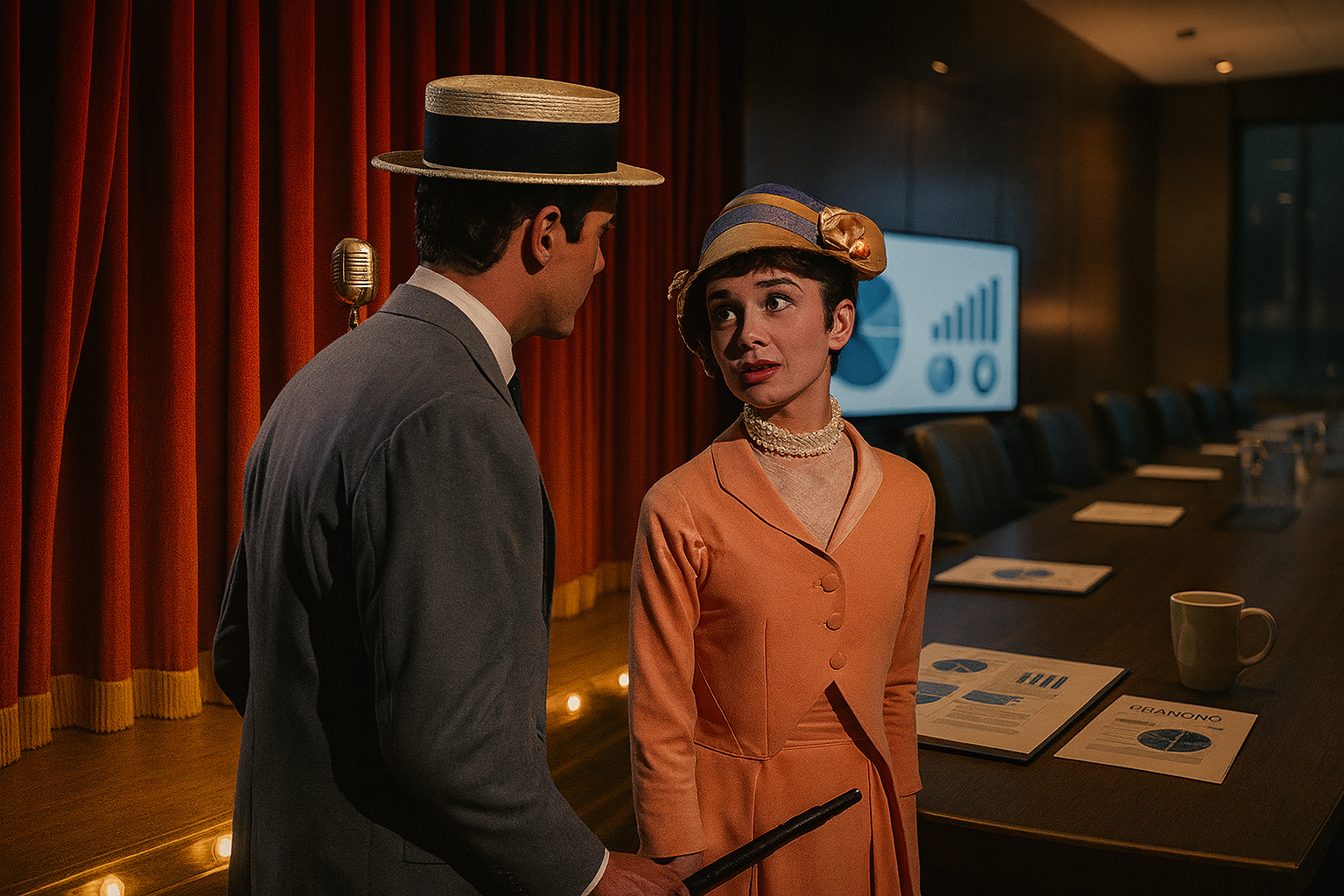
As you may know, the award-winning musical is based on George Bernard Shaw’s famous play “Pygmalion,” a story of transformation whose ending remains uncertain. Does Eliza Doolittle stay with Professor Henry Higgins or venture off on her own? The musical presents a bit more of a presumed happy ending than the play, just like many of us may be guilty of when predicting client outcomes, but if Eliza does leave it will likely be because of the actions of Professor Higgins more than his words.
In “My Fair Lady” — with lyrics by Alan Jay Lerner, often based on Shaw’s own writing — Eliza sings:
Words! Words! Words!
I’m so sick of words!
I get words all day through;
First from him, now from you!
Is that all you blighters can do?
The song that those lyrics come from — for those not familiar with the musical — is called “Show Me.” Eliza sings the song to her well-meaning suitor, Freddy Eynsford-Hill, after suddenly feeling exasperated by all the words being used by men vying for her attention.
How many of your stakeholders may be growing exasperated by the words your organization is using? How many, like Eliza, are simply ready to shout “show me”? In many ways we are operating in a show-me economy. Some call that the attention economy, but whatever phrase you prefer, stakeholders — both internal and external — don’t need to hear more words. They need action. They want you and your brands to show them that you want to earn and keep their business.
Shakespeare put it this way: “Suit the word to the action; the action to the word.” That quote is from Hamlet’s advice to the actors visiting Elsinore before they perform his play “The Mousetrap.” If you haven’t read or seen “Hamlet,” let’s just say that the Prince of Denmark badly needed the actors to use his words to get a very specific response from key members of the play’s audience. Spoiler alert: Hamlet’s uncle.
In a show-me, attention-based economy, earning the mindshare of stakeholders has never been more challenging. Stakeholders — like Eliza Doolittle — are so sick of words. Don’t get me wrong, words still matter, but actions matter even more. Words by themselves, no matter how well constructed, can be nothing more than what Shakespeare would call “dumb show and noise.”
But words tied together with meaningful action often end up creating impactful brand narratives. Many capability decks from leading PR agencies will report that narratives can serve as an organizational North Star. And to write one they’ll charge you more than Professor Higgins charged Eliza Doolittle.
But well-constructed narratives are more important than that. They form the keystone that holds together the framework for the stories we tell about the organizations we work for and with. And stories, far more than corporate messages, are the things we tend to remember and share with one another.
Aside from writing great plays like “Pygmalion,” Shaw penned a few quotes about the importance of reputation. I find one of them particularly pertinent today as we all try to help clients tell their stories to an increasingly disengaged public. Shaw said, “The way to gain a good reputation is to endeavor to be what you desire to appear.” In other words, prove what you say with your actions.
It’s a show-me economy, and if you don’t want to be scorned like the young lover Freddie Eynsford-Hill or abandoned (presumably) like Shaw’s Professor Higgins, then you need to find ways to help your organizations or clients, in transparent and authentic ways, show stakeholders that they are doing what they say. You need to show stakeholders that what you stand for, your purpose, is not simply defined by three letters like DEI or CSR.
We need to help organizations show stakeholders that they are listening and invested in the outcomes that impact their futures as much as their own.
That’s not easy to do, but if done successfully you will have a client show up differently than a competitor. And sometimes that’s half the battle. As Eliza concludes in the aforementioned song, “Show me now!”
That may be exactly what your stakeholders are thinking. Are you ready to tell your story? It’s show time.