

When Rhetoric Turns Radical and PR Firms Become the Next Political Target
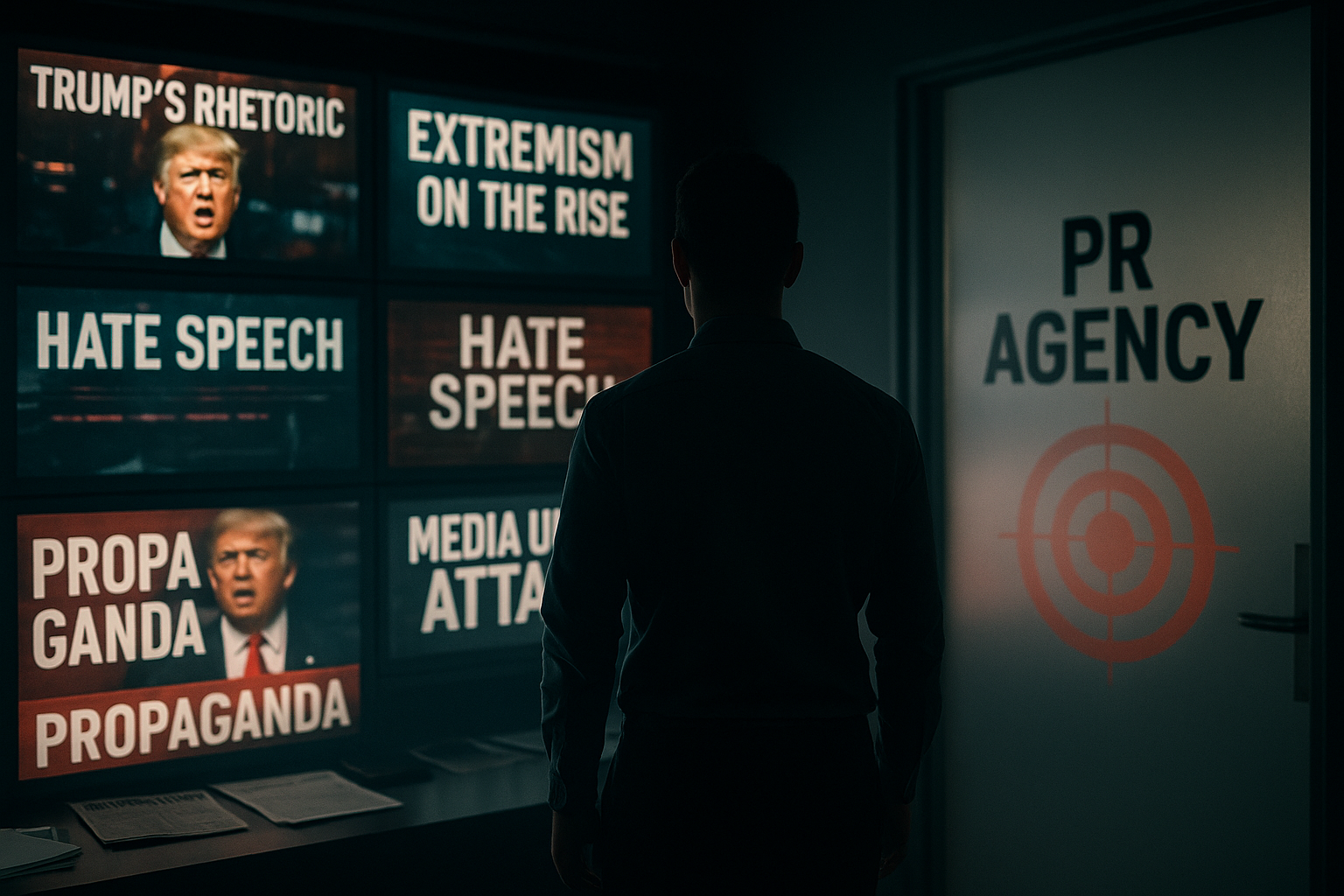
Here’s what you’ll learn when you read this article:
How political rhetoric can legitimize extremism and what communicators must do to prevent their messages from being co-opted by hate groups.
Why media suppression threatens the foundation of public relations, and how PR pros can defend truth and journalistic integrity in disinformation-driven environments.
What risks lie ahead for PR firms and agencies that challenge authoritarian narratives, and how to prepare for reputational and operational retaliation.
On Aug. 8, a Reuters special report was headlined, “American Nazis: The Aryan Freedom Network is riding high in Trump era.”
The report led with the following: “With Donald Trump’s return to power, a neo-Nazi group buoyed by his rhetoric is expanding its reach and changing the face of white extremism in America. Its leaders: a Texas couple, both born to Ku Klux Klan leaders.”
It said, in part, “Several trends have converged since Trump’s re-election, Reuters found. Trump’s rhetoric has galvanized a new wave of far-right activists, fueling growth in white supremacist ranks. Trump’s pardons of Jan. 6 rioters and a shift in federal law enforcement’s focus toward immigration have also led many on the far right to believe that federal investigations into white nationalists are no longer a priority.”
Henry Stout runs the neo-Nazi Aryan Freedom Network with his partner, Jim Urquhart. Stout’s hat bears the skull and crossbones of the infamous “Death’s Head” SS units that oversaw Nazi Germany’s concentration camps – and the initials “AFN,” short for Aryan Freedom Network. According to the report, “From a modest ranch house in Texas, the couple oversee a network they say has been turbocharged by President Donald Trump’s return to the White House.” They point to Trump’s rhetoric – his attacks on diversity initiatives, his hardline stance on immigration and his invocation of “Western values” – as driving a surge in interest and recruitment.
Trump “awakened a lot of people to the issues we’ve been raising for years,” Stout told Reuters. “He’s the best thing that’s happened to us.”
This presents a critical point of reflection for communicators. Language that is politically charged, vague, or designed to signal cultural superiority can easily be co-opted by extremist groups. Strategic communicators must be especially cautious about the ways in which campaign or brand messages may be reframed by hate groups, especially when they invoke concepts like “Western values” or anti-diversity sentiment. Failing to consider these risks can unintentionally validate or fuel radicalization.
Since he has been reelected, many of President Trump’s actions have mirrored those of dictators. A search of the internet reveals that countries ruled by dictators have the following characteristics, some of which reflect actions taken by the president:
Dictators use force and repression to silence dissent. President Trump has engaged in retribution politics.
Dictators restrict the opposition’s ability to campaign and intimidate voters. President Trump has made voting more difficult by his initiatives, instead of making voting easier for citizens.
Dictators undermine the rule of law, allowing the leader to act above the law and make arbitrary decisions. President Trump has disobeyed rulings by federal judges.
Dictators suspend civil liberties, issue decrees and disregard legal procedures. President Trump is ruling by executive orders and has ignored legal processes.
Dictators control the flow of information to prevent citizens from accessing alternative perspectives. President Trump has limited access to nonpartisan news organizations like the Associated Press.
This tactic should not be overlooked by professionals in public relations and journalism. When the credibility of independent reporting is challenged or undermined, the foundation of communications strategy is compromised. Communicators should be proactive in supporting media literacy efforts and defending the role of fact-based journalism. In a world of rising disinformation, the PR industry has a duty to help clients navigate truth responsibly and avoid contributing to the erosion of trust.
Dictators cultivate a cult of personality, portraying themselves as powerful and charismatic leaders.
Dictators violate human rights, including the right to freedom of speech, assembly and the right to a fair trial.
Dictators typically concentrate power in the hands of a single individual or a small group.
Dictators deny due process when declaring that people are guilty.
Dictators love parades showing off the armed forces.
Dictators use their military against protesters.
While some historians argue that it is unfair to compare Mr. Trump’s actions to Hitler, it is clear that many of their tactics are similar.
Hitler conditioned the Germans to hate certain populations, mainly but not only Jews. Mr. Trump has conditioned Americans to hate immigrants since 2015.
Hitler positioned himself as the savior of Germany. Mr. Trump has said that “he alone” can save America.
Hitler relied on non-governmental “soldiers” like the Brownshirts to intimidate the opposition. Mr. Trump backs groups like the Proud Boys and pardoned those who broke into the Capitol, despite the violence and loss of life, and praised the insurrectionists as “patriots.”
Hitler was a master at lying. So is Mr. Trump.
There are more comparisons. Hitler’s generals unsuccessfully tried to assimilate him because they saw him as a danger to Germany. Similarly, many former high-ranking U.S. military officers see President Trump as a threat to democracy.
Gen. Mark Milley, former chair of the Joint Chiefs of Staff, told author Bob Woodward: “No one has ever been as dangerous to this country as Donald Trump … Now I realize he’s a total fascist.”
Gen. John Kelly, former White House chief of staff, has called Trump deeply dishonest and said he has “no idea what America stands for.”
Gen. James Mattis, former Secretary of Defense, described Trump as “dangerous,” “unfit” and a threat to the Constitution.
Anyone paying attention must admit that many of Trump’s actions are unconstitutional, as federal judges – including those he appointed – have ruled. Nevertheless, he continues to ignore those rulings.
During a 2023 town hall in Iowa with Fox News host Sean Hannity, Mr. Trump said, “I’ll be a dictator but only on Day 1.”
President Trump was sworn in again on Jan. 20, 2025.
He is still acting like a dictator.
There’s a famous saying: “If it walks like a duck, and quacks like a duck, it must be a duck.” Donald Trump is a duck, and those who support his dictatorial actions are ducklings.
Politically, I support strong border enforcement. I also believe in calling undocumented immigrants what they are: illegal. But once in our country, they should not be subjected to tactics like being pulled from jobs or homes at night. They deserve due process in immigration court, not politically motivated vengeance.
Sinclair Lewis’s 1935 novel “It Can’t Happen Here” chronicled the rise of an American dictator. It should now be shelved under nonfiction.
Friedrich Niemöller, the German theologian who once sympathized with Nazi ideas and later opposed them, famously warned:
“Then they came for me – and there was no one left to speak for me.”
Every American should take this seriously. Communicators have a vital role in ensuring that due process, freedom of speech and the rights of marginalized groups are protected through messaging, campaigns and influence work. The loss of civil liberties begins not with violence but with silence.
Benjamin Franklin, emerging from the Constitutional Convention, was asked if we had a republic or a monarchy. He replied, “A republic, if you can keep it.”
This era will be remembered either as the time when Trump attempted to end the American republic or when the people and institutions, including the communications industry, stood firm and preserved it.
PR professionals and agencies need to be prepared. If political retaliation has already targeted the judiciary, media and education systems, communicators should not assume they will be spared. Public relations firms that promote clients who oppose the administration’s actions could be next. Strategic planning should include safeguarding freedom of expression and protecting employees from retaliatory scrutiny.
A CBS poll showed that 63 percent of Americans believe noncitizens deserve due process before deportation. And on June 10, the Wall Street Journal published a page-one report on ICE’s tactics, citing warrantless arrests, masked agents and people disappearing into detention with no notice to families or legal counsel.
These are not tactics that past Republican leaders like Eisenhower or Reagan would have tolerated. Not even Richard Nixon ignored court rulings.
Since 2016, President Trump has shown approval for tactics that mirror authoritarianism. As California Gov. Gavin Newsom said, “Trump is not opposed to lawlessness and violence as long as it serves him.” What more evidence do we need than Jan. 6?