

The Trusted Advisor Initiative: The Counselor’s Prime Directive
What does it really take to become someone a CEO or senior leader trusts for advice?
That’s the question at the heart of The Trusted Advisor Initiative on CommPRO.
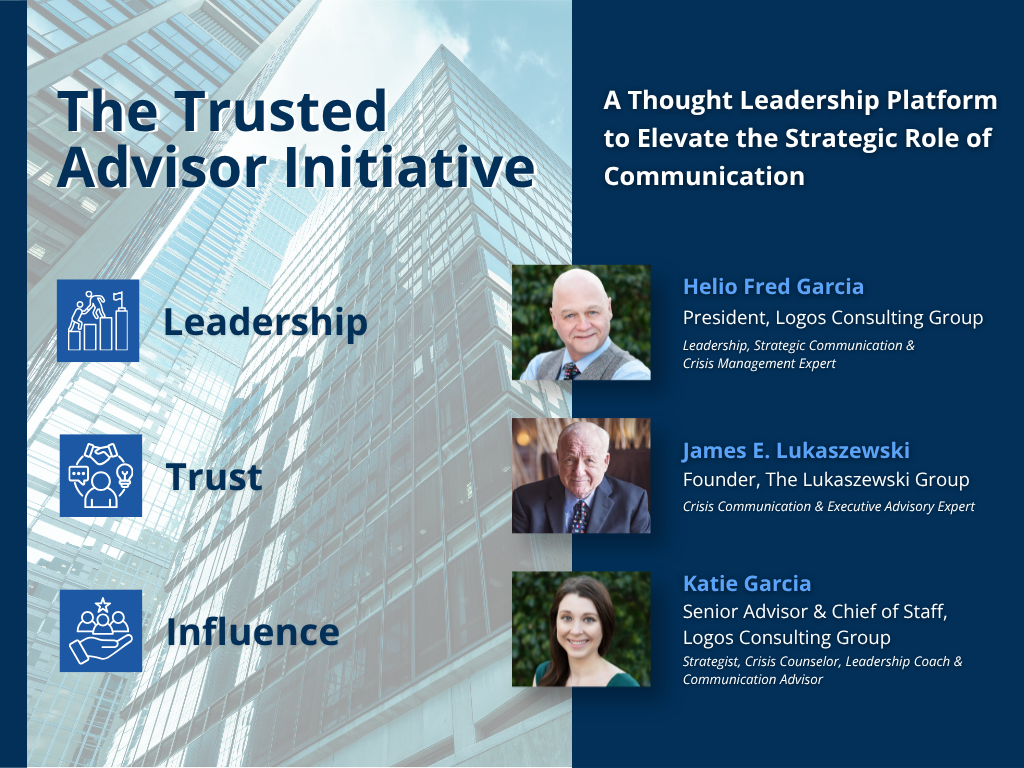
Over the next several months, we’re sharing ideas and insights from Helio Fred Garcia, James E. Lukaszewski and Katie Garcia about leadership, trust, influence and what it really means to become a trusted strategic advisor.
We began with the idea that “the table” is a myth. In this second excerpt from Influencing Leaders: The Seven Disciplines of the Trusted Strategic Advisor, Jim Lukaszewski and Fred Garcia turn to the advice itself: what leaders need from their counselors, how they measure the value of that advice and the commitment required of those they trust.
James E. Lukaszewski, America's Crisis Guru®, and Helio Fred Garcia are co-authors of Influencing Leaders: The Seven Disciplines of the Trusted Strategic Advisor, which was released in August 2026. (Wiley)
Excerpt from Influencing Leaders
The Counselor’s Prime Directive
Having been advisors virtually our entire careers, we have to confess our ongoing admiration for those at the top of the pyramid. Real leaders listen, hear, seek out many voices, and then, from that huge menu of ideas and concepts, they extract key insights or inspirations that will move an organization into the future. This is a crucial and amazing capacity of leadership. Few consultants and advisors have either this skill or temperament.
After watching thousands of consultants and advisors at work, it strikes us that very few actually have the capacity to lead because very few are willing to readily accept the ideas of others or include them in what they are trying to accomplish. This acceptance and willingness to seek advice and inclusion is one genius of leadership. It is about the leader’s ability to sift, to sort, to distill, to stratify, and to prioritize the ingredients of the future and then combine certain ingredients to fuel progress.
The trusted advisor has to be aware that whining, negativity, and competition for the boss’s attention often block the advisor’s ability to influence key strategic decisions. These staff behaviors are among the most irritating, relationship-corroding events between advisors and leaders.
Another relationship-corroding phenomenon is resistance to the presence of an outside advisor. For example, when Fred arrives to advise senior leaders, staff often feel threatened and fear that he is there to displace them and their relationship with their bosses. But pretty quickly they learn that they can truly value his presence. Sometimes Fred even says to them in private, “I want to help you do your job, and help you build your relationship with your boss. My role is to help the boss, and those who advise the boss, including you, to be more successful.” Many are initially skeptical. But when they see Fred living true to this promise, they tend to embrace his presence.
Seeing things from the boss’s perspective means welcoming advice, even if that advice comes from someone else or a competing interest. You understand why the boss needs to have it.
There are five useful types of effective advice:
Practical advice means just that—tasks that are achievable, positive in nature, and that employees and even critics can endorse to some degree. Pragmatic advice recognizes that only certain outcomes are possible, that no matter how spiffy, creative, or exciting your ideas might be, those affected by the advice as well as those acting on the advice will look at it from the perspective of whether it can actually work in their real world.
Purposeful advice has self-evident forward focus and positive momentum. Counselors and consultants are strategic operational assets. When activated, strategic assets are fundamentally positive and energize the organization and its constituencies.
Focused advice means just that, advice that is understandable, shows the way, helps the client or customer think and act in the future tense, and works toward a few (or one) important goals everyone recognizes.
Fair advice means that which is politically acceptable (as opposed to factually correct) and politically useful (as opposed to manipulative or politically disruptive).
Ethical advice, which includes:
Finding the truth as soon as possible.
Raising tough questions promptly.
Teaching by emphasizing wrong way/right way options for vocalized core business values and ideals constantly.
Walking the talk; being accessible.
Helping, expecting, and enforcing ethical leadership.
Preserving, protecting, defending, and fostering ethical pathways to the top of the organization.
Being a cheerleader, model, and teacher of ethical behavior.
Making values at least equal to profits or personal gain.
Valuing everyone and being respectful.
There are lots of distractions in consulting, and many clients have great difficulties, problems, shortcomings, and blind spots. The consultant’s obligation is to identify and provide candid, constructive advice that fills those deficiencies, strengthens the shortcomings, and reduces blind spots while stabilizing or moving the organization toward tomorrow.
How the Boss Measures Advice
Those strategic few who spend a fair amount of time talking with, working with, and counseling CEOs, senior leaders, and other operating executives, quickly learn the strategic expectations of bosses. They understand that the leader values only advice that has a positive impact on the organization.
Before offering ideas, concepts, and recommendations to the senior leaders, ask yourself these five questions:
Does it help the boss achieve their objectives and goals?
Does it help the organization achieve its goals?
If the answers to numbers one and two are “yes,” is the project truly needed?
What aspect of the business will fail or fail to progress if your recommendation is ignored or delayed?
How does this suggestion save money, make money, or conserve money?
If you can keep your focus on these critical questions, your advice will be relevant. This approach puts you squarely in the CEO’s shoes, looking at his/her tasks, challenges, and loneliness from a management perspective.
The Counselor’s Commitment
The chances are you will be sought after, respected, and have important
influence on what the CEO does, what the organization does, and the success
the organization achieves if you live by the principles of The Counselor’s
Commitment.
Those who successfully serve others have a work attitude that says:
When I am here, working for you is number one.
I plan to be here a lot and, if necessary, available the rest of the time as well.
I am committed to extensive independent reading, discussion, issue sensitivity, and personal learning that is of value to those I coach and counsel.
I will take the initiative to help those I coach and counsel move in useful new directions and rely far more on foresight than hindsight.
I recognize that going even a small extra distance will be the difference between mundane and magnificent results. Extra effort, extra sensitivity, and extra focus is what makes the difference from the client’s perspective.