

The New Economics of Advertising, Key Findings From XR’s State of Pay
The U.S. commercial advertising industry has undergone a structural reset since the pandemic, one that is reshaping how brands invest in talent, produce content, and scale campaigns. According to the XR 2025 State of Pay Report, the industry has stabilized, but it has not returned to its pre-pandemic operating model. Instead, fewer productions, higher talent guarantees, and the normalization of creators as core campaign talent now define advertising’s new economics.
The XR State of Pay is grounded in actual payroll and session data processed by XR (Extreme Reach), reflecting nearly 80% of U.S. commercial advertising productions. Because the data is sourced directly from contractual payments and production activity, it offers a real-world view into how brands are allocating budgets, engaging talent, and restructuring campaigns at scale.
Advertising Enters a Talent-First Era
Celebrity pay in advertising surpassed $1 billion in guaranteed payments in 2025, representing a 47% increase since 2019. Brands are increasingly relying on recognizable faces to drive memorability and attention in a fragmented media environment.
“Advertising is entering a talent-first era,” said John Batter, CEO of XR. “Spending on athletes, celebrities and creators isn’t just rebounding, it’s surpassing all pre-pandemic norms with no signs of slowing. Brands are concentrating budgets around recognizable talent that can break through, and the data shows that strategy is now central to the campaign performance of the world’s biggest brands.”
This sustained investment reflects a shift toward certainty. As audiences splinter across platforms, recognizable talent offers built-in awareness and immediate narrative traction, making talent strategy foundational rather than tactical.
Athletes Are the Fastest-Growing Celebrity Segment
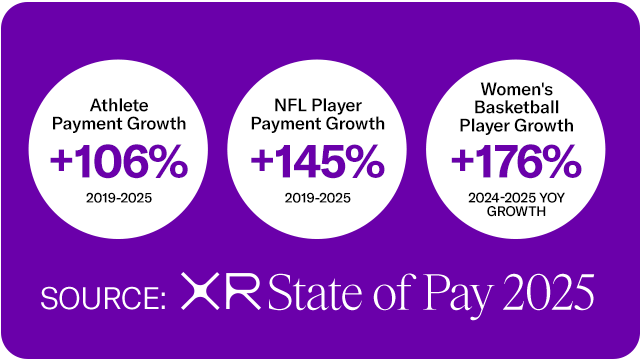
Athletes are now the fastest-growing category within celebrity advertising. In 2025, athlete guarantees reached nearly $250 million, accounting for roughly a quarter of all celebrity payments. Since 2019, athlete pay has increased 106%, with particularly strong growth among NFL players and women’s basketball stars.
The expansion of sports coverage across linear television and streaming platforms has amplified athlete visibility, while their perceived authenticity and cross-generational appeal continue to attract brands seeking trusted voices with built-in audiences.
Creators Have Become Core Campaign Talent
The report also confirms a major inflection point for the creator economy. Influencer and content creator guarantees have doubled since 2022, reaching nearly $45 million in 2025. Top creator categories include social media personalities, lifestyle influencers, food and home creators, fashion and beauty voices, and entrepreneurial creators.
“When social media and lifestyle influencers account for more than half of all creator payment guarantees, it’s clear they’ve become core to commercial talent strategy as well as a key component in cross-media advertising plans,” said Graham McKenna, CMO of XR.
Creators are no longer supplemental to campaigns, they are increasingly treated as foundational talent with long-term roles and premium compensation.
Fewer Productions, More Content per Campaign
While overall commercial production volume remains more than 20% below 2019 levels, activity is stabilizing in a new configuration. Unique productions are down 25%, yet session payments increased 11% year over year, indicating more filming, recording, and versioning per campaign.
Brands are consolidating resources into fewer, higher-impact productions while generating significantly more content from each shoot. Cast sizes have remained stable, but production timelines have lengthened, supporting broader distribution across platforms and formats.
Production Geography Continues to Diversify
California remains the dominant production market, but growth is increasingly distributed. Texas, Florida, and Virginia collectively grew 27% since 2019, with Virginia alone surging 112%, driven by incentives, lower costs, and expanding crew bases.
“California keeps its crown in advertising production, but the map is expanding,” said McKenna. “Utah, Virginia, Florida, and Texas are emerging as serious production hubs, fueled by incentives, skilled crews, and modern infrastructure. The result is a more distributed, more resilient advertising production landscape from coast-to-coast.”
A Rebuilt Industry with New Rules
The XR 2025 State of Pay study illustrates an industry that has rebounded with revised economics and a sharper focus on talent-led storytelling. Guaranteed spending on celebrities and creators exceeds pre-pandemic levels, production is more concentrated yet more productive, and campaigns are increasingly designed as content ecosystems rather than isolated executions.
As brands and agencies plan for 2026 and beyond, these dynamics will continue to influence how advertising dollars are deployed—and how influence itself is defined in a rapidly evolving media landscape.