

The AI Opportunity Many Communications Pros Are Missing
Something important is happening in organizations right now.
Most communication professionals can feel it. But very few are reading it correctly.
The dominant conversation in communication circles is about AI as a productivity tool – generating content faster, summarizing leadership messages, automating channel management. These are real capabilities and they matter.
But that’s not the most important conversation.
What AI is doing to the organizations communicators work for trumps what AI can do for communication professionals. That represents both a serious risk and a significant opportunity – neither of which the profession is adequately addressing.
A Systemic Accelerant, Not Just a Tool
Some big-picture changes are taking place in organizations at the moment:
Performance-agnostic workforce reductions.
Compressed decision cycles.
Flattening hierarchies.
The collapse of the social contract that held together the employer-employee relationship for decades.
These aren’t separate phenomena. They’re connected forces, and AI is magnifying all of them simultaneously. Geopolitical and geoeconomic uncertainty is compounding the pressure further – consuming leadership attention and compressing the bandwidth available for strategic investment at precisely the moment it’s most needed.
At the same time, the conditions that the current model internal communication was built to operate in – stable hierarchies, predictable change timelines, a workforce that believed performance translated into security – are also rapidly being dismantled.
Line Management Under Strain
Consider what’s happening to the management layer that carries most organizational communication.
Managers aren’t disappearing. But they’re being squeezed from three directions at once.
Decision volumes are increasing and decision cycles are accelerating – managers face more choices, at higher speed, with greater consequence.
Spans of control are expanding as organizations reduce headcount and flatten structures – the same manager now coordinates more people with less administrative support.
Employees, operating in more ambiguous environments with less certainty about their own futures, need more clarity from their managers precisely when those managers have less capacity to provide it.
The result is that the top-down relationship that looks intact on paper is degrading in practice. Managers are still at the heart of the org chart. They’re still expected to transmit direction, hold teams through uncertainty, and enable good decisions at the front line. But they’re executing that role under conditions that make it progressively harder to do these things well.
That isn’t a technology problem. It isn’t an HR problem. It’s a coordination infrastructure problem. And it’s getting worse.
What This Creates – and Who Should Solve It
When you add pressure to a cascade that was already imperfect, the output isn’t structural collapse. It’s something more insidious: compounded misalignment.
Priorities get interpreted differently across teams.
Decisions get made in good faith that don’t reinforce each other.
Employees exercise independent judgment without adequate organizational context.
Noise emerges where clarity needs to be.
The question organizations now face is whether they have the infrastructure to sustain coordination at velocity – to ensure that when AI-augmented employees make faster decisions with less oversight, those decisions actually align with what the organization is trying to do.
Most don’t. Not yet.
And here’s what makes this a defining moment for the communication profession: this is a communication-shaped problem.
Not change management. Not HR. Not technology.
The discipline that deals with organizational clarity, message architecture, decision-relevant information, and the infrastructure that enables employees to understand and act on strategic priorities is internal communication.
But instead of stepping into this gap, communication professionals seem still more focused on debating prompt engineering and whether to put AI-use disclaimers on images and intranet posts.
The Mindsets that Get in the Way
There are three prevalent mindsets among communication pros that need to be overcome – either through a collective shift in self-awareness, or from pressure from other stakeholders to wake up to AI’s systemic challenges:
The first is cultural. Communication functions have built their professional identity around content production – the wording of the message, the quality of the channel, the tone of the narrative. That identity is real and not without value. But it positions the function as a producer rather than a strategist. And producers, however skilled, don’t get “seats at the table” where organizational direction is set.
The second is tactical. Most communication work is organized around outputs: what gets made, sent, published, measured by reach. Shifting to a coordination infrastructure role means organizing around outcomes instead – decisions made well, priorities understood, misalignment caught early. That requires a different kind of accountability, and a willingness to be measured against things that are harder to control.
The third is defensive. Faced with AI-driven pressure, the instinct in many functions is to protect what exists – headcount, channels, approval processes, established ways of working. That instinct is understandable. It’s also the surest route to irrelevance. The functions that survive this moment will be those that chose reinvention over protection.
None of these mindsets are immovable. But they need to be identified, confronted, and neutralized before the opportunity is fully missed.
What Needs to be Seen Clearly
The first move is diagnostic, not prescriptive. Before communication professionals can address the systemic implications of AI, they need to see them clearly.
That means stepping back from the content and channel conversation and asking harder questions.
Where are managers overloaded to the point where clarity transmission is failing?
Where are decision volumes exceeding the cascade’s capacity to provide context?
Where are employees making consequential choices without adequate organizational alignment?
Where is misalignment compounding silently across levels?
These aren’t engagement questions. They’re coordination questions.
And they have a concrete starting point. Ask any random group of employees two things: can they name the organization’s top three to five priorities? And can they explain how their daily work connects to those priorities?
In most organizations, the answers reveal coordination gaps that no engagement survey has ever surfaced – and that no amount of content production will close.
That’s the diagnostic entry point. Not annual engagement surveys. Actual evidence of where the coordination infrastructure is holding and where it’s leaking.
This is what the most rigorous consulting practices in adjacent disciplines – reputation management, corporate affairs, strategic governance – have understood for some time: that making communication functions genuinely valuable requires audit, intelligence, and governance frameworks that connect communication performance to business outcomes.
Not activity metrics. Not reach and open rates. Business outcomes.
The internal communication profession has the conceptual tools to make this shift. What it has generally lacked is the frame. AI – not as a content tool but as a systemic accelerant – provides that frame.
The Window Is Open. For Now.
I see a window of about 6-18 months for organizations and their communication professionals to get this right.
Organizations are making decisions right now – consciously or by default – about whether internal communication will be part of the strategic response to AI-driven organizational change, or whether that work will be absorbed by other functions, or treated as an afterthought.
Communication professionals who recognize what’s actually happening have a genuine opportunity. Not to protect their function. To demonstrate that their function is the right answer to a problem organizations are actively experiencing.
That starts with recognizing the actual challenge. Seeing AI not as a tool to adopt but as a force reshaping the organizational conditions that communication professionals are there to support. And being willing to step into a more demanding, more diagnostic, more strategically consequential role than most of the profession has occupied before.
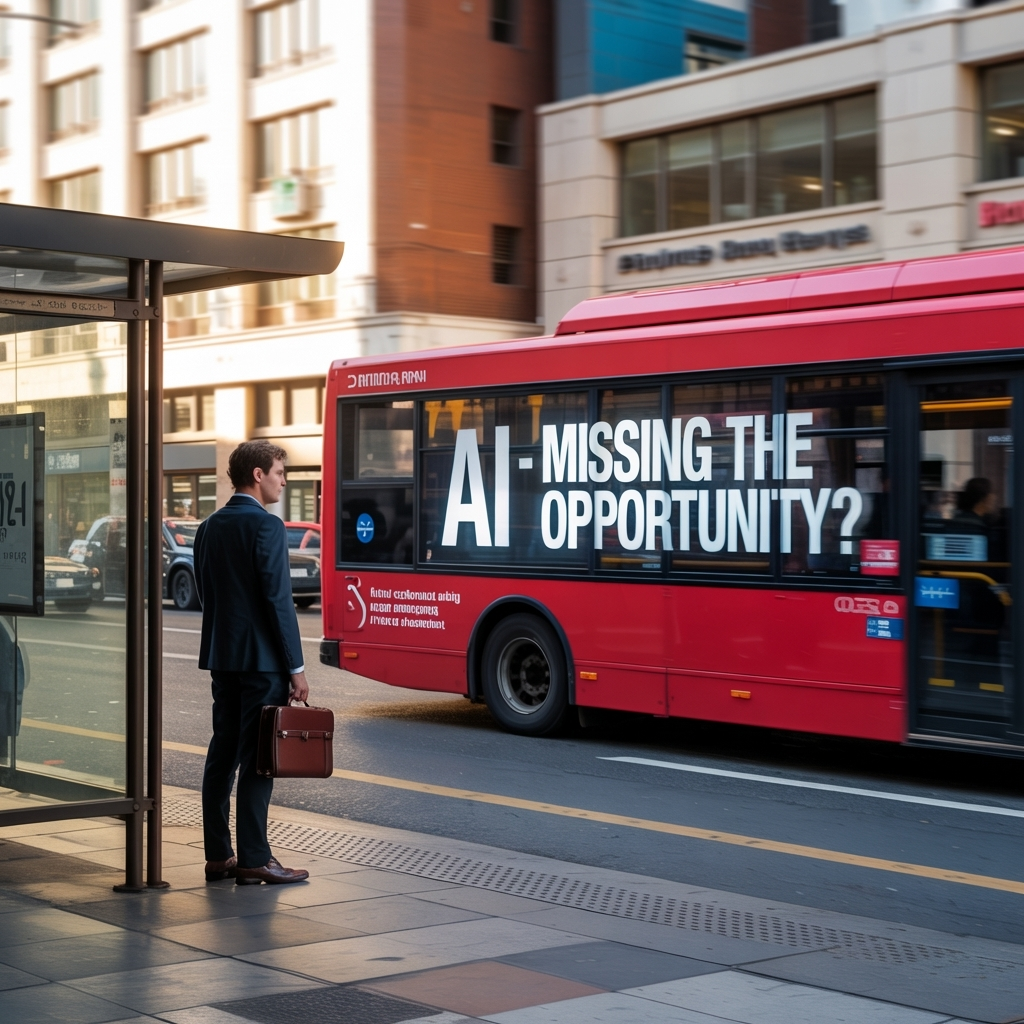
Line management is under strain. The coordination infrastructure is missing or buckling. Organizations need to adjust. The question is whether communication professionals will see this as their opportunity to lead, or double down on trying to protect themselves and miss the proverbial bus.
Editor’s Note: Reprinted with permission from Strategic Magazine.