

PR Daily Conference Teaches Us How to Communicate, Connect and Champion
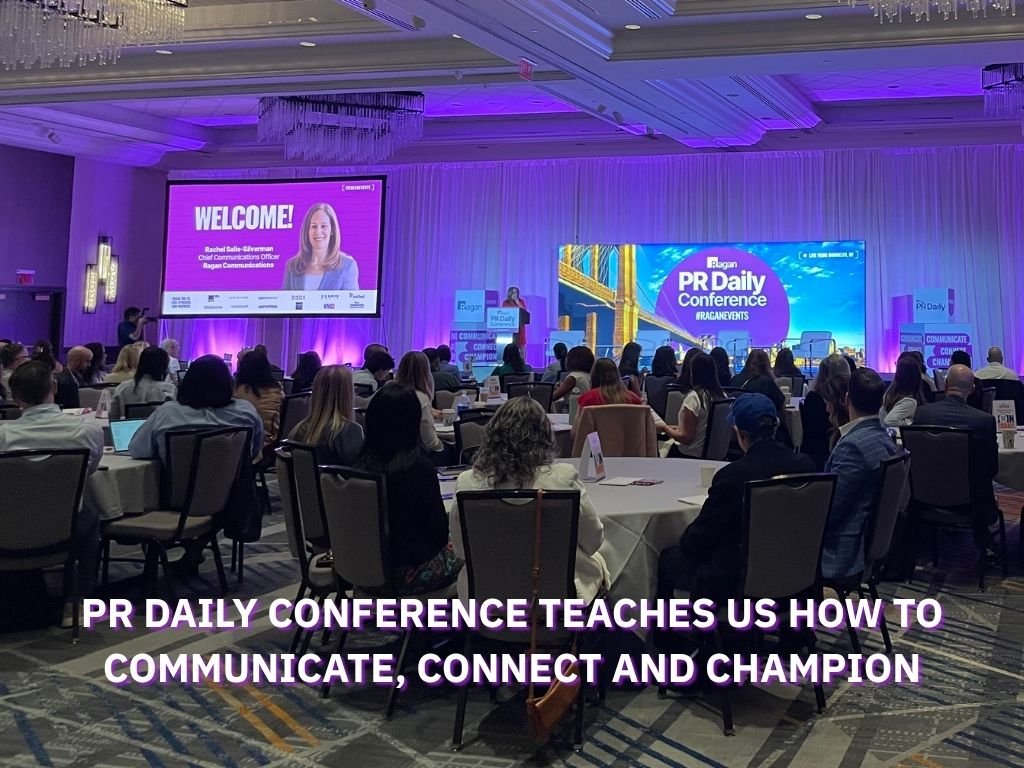
At a time when AI tools are multiplying faster than most teams can pilot them, the PR Daily Conference felt refreshingly human. Tina McCorkindale, PhD, president and CEO of the Institute for Public Relations, joined Mary C. Buhay, chief growth officer and head of councils at Ragan Communications, for an exclusive research presentation on why trust matters in the age of AI and how communicators can build it.
They offered a simple yet powerful framing of three ways in which “trust drives business impact.” Trust is capital because it acts like a shock absorber when crises hit. Trust is currency because it accelerates relationships into powerful networks. And trust is a competitive advantage because it can tip a high-stakes decision in your organization’s favor. For communicators used to defending “soft” metrics, framing trust this way translates reputation into a business asset executives can recognize.
However, their data suggested that trust is not earned simply by knowing how AI works. Instead, they found that communicators self-reported high knowledge of digital communication tools and technologies but far weaker familiarity with financial concepts, risk management and broader business operations. McCorkindale and Buhay’s message was unapologetically focused on the bottom line: in addition to being AI-savvy, communicators must tie messaging decisions directly to business outcomes such as revenue, KPIs and overall business models. Those who take the time to understand how their organizations generate value will be better equipped to build trust with leadership and secure a seat at the strategic table. In an increasingly noisy AI landscape, the communicators who win will be those who navigate emerging technology with strong business acumen and an authentic human connection.
The tone became more expansive when marketing strategist and author David Meerman Scott took the stage to discuss how creating passionate fans is a distinct strategic advantage in a world of digital chaos. Fandom should be treated as a deliberate, measurable business strategy rather than a happy accident. By turning NASA’s history of cultivating public enthusiasm for the space program into a case study, he showed how technical work can become a story millions of people feel personally invested in.
Scott’s “Fandom Playbook” urged brands to “build a tribe of like-minded people” by showing up where their communities naturally gather, both online and offline. NASA’s practice of presenting astronauts as relatable heroes, for instance, helped transform a government program into a narrative that families could discuss at their own dinner tables. That kind of fandom is what turns occasional customers into advocates who defend and extend your story when you are not in the room.
He also challenged communicators to rethink the corporate language they use every day. An infamous “gobbledygook manifesto” slide, packed with overused phrases such as “leading provider” and “next generation solutions,” drew knowing laughter from an audience that clearly recognized the pattern. Scott’s point was that if your copy could describe almost any company in your sector, it is unlikely to spark genuine enthusiasm.
For those hungry for inspiration, he highlighted resources such as ApolloPressKits.com, a digital archive of Apollo program press materials that doubles as a masterclass in consistent storytelling over time. The implicit invitation was to mine history, archives and niche communities for clues about what really fuels long-term devotion.
From there, the conversation shifted from strategy slides to the realities of messy moments. In one panel, Melissa Tizon, SVP and Chief Communications Officer of Providence; Kamian Allen, Head of Reputation and Risk of Audible; Paul Wendel, Senior Director at Cisco and Isis Simposon-Mersha, Reporter/Conference Producer for Ragan Communications, discussed the importance of a “pressure makes playbooks” discipline. They highlighted how teams must set expectations for how they will respond to friction long before a full-blown issue unfolds. That preparation includes defining who decides when to escalate, which tools will track sentiment across stakeholders and how internal leaders will communicate with their own teams when the pressure is on. After all, as Tizon said, “How you handle a crisis is what builds trust.
Throughout the conference, AI sat quietly in the background as a supporting player rather than the lead. One session emphasized the importance of brand sentiment trackers as early warning systems that guide tone and timing. Another session highlighted the importance of leaders knowing when to play cheerleader and when to acknowledge that a situation genuinely feels difficult because those choices often shape how employees remember a company long after the issue itself has faded. As the conference went on, the emerging consensus was to use AI for data analytics, monitoring and scenario modeling, while refusing to outsource final judgment to a model. Technology may change quickly, but trust still takes time.
AI was described as part of the infrastructure that now shapes the information ecosystem, even while the core purpose of communication remains to inform, persuade and build relationships. Five emergent realities were outlined: First, AI is reshaping distribution. Second, human expertise becomes more valuable as technology scales. Third, the media still wants to explain the world through people. Fourth, control over narratives is fading, so preparedness matters more than ever. And finally, direct relationships are turning into the ultimate competitive advantage.
An important insight from Lisa Zlotnick, Head of Brand PR for SHEIN, was that communicators needed to move beyond reporting impressions and clicks and toward connecting communication activities with business outcomes such as employee retention, customer loyalty or policy change. That shift requires pairing analytics dashboards and trend spotting tools with clear hypotheses about how specific messages will influence specific behaviors.
Crucially, data was framed as the beginning of a strategic conversation instead of the final word. In an environment where control is disappearing, the ability to rapidly interpret signals and adjust strategy in real time becomes more valuable than clinging to a false sense of certainty. Once again, human judgment, context and values remained the final filter on every chart and metric. Those aren’t replaceable by AI.
Taken together, the two days in Brooklyn offered a pragmatic roadmap for communicators who are trying to navigate the AI era without losing sight of their core purpose. The expectations on the function are higher and leaders now look for professionals who can read a balance sheet, interrogate data, navigate AI tools and still show up with the empathy and clarity that build trust over time. The encouraging takeaway is that many of the skills that drew people into communication in the first place, such as curiosity, storytelling and relationship building, are becoming even more valuable as technology accelerates.
The PR Daily Conference made it clear that while AI and analytics tools will continue to evolve, the real edge will come from the fans, colleagues and communities who would miss your voice if you stopped communicating. As the great John Wooden once said, “Practice how you play,” so that when the stakes are high, trust is already built into your reflexes. That is the long game of communicating, connecting and championing. The impact of that learning will stretch well beyond any single conference agenda.