

Podcast Advertising’s New Power Play Reshapes Brand Strategy
What you will learn from this article:
How Acast’s Podcast Pulse 2025 data reveals podcasts outperform traditional media in trust, attention, and ROI.
Why measurement challenges—especially around YouTube podcast attribution—are limiting nearly $1 billion in ad growth potential.
How communicators can leverage podcasts’ unique blend of brand-building authenticity and performance marketing efficiency to gain competitive advantage.
Podcasting is no longer a niche format. It’s a high-performance marketing channel redefining influence, resonance, and return on investment. According to Acast’s 2025 Podcast Pulse report, produced with research firm Differentology and surveying 2,600 global consumers, 200 marketers, and 137 podcasters, podcast advertising now commands a level of trust and attention unmatched by most other media.
“Influence used to be measured by follower counts. Today, it’s earned through time, trust, and ideas,” said Acast CEO Greg Glenday in the report’s opening statement.
The resonance effect
Acast defines resonance as the moment when “attention meets trust.” The report found that two out of three global consumers listen to podcasts monthly, and 70 percent say a recommendation from a podcast host made them consider a brand they had never heard of before. In this environment, credibility drives conversion.
Podcasts also dominate across engagement metrics. Compared to other channels, podcasts ranked #1 in perceived authenticity, honesty, and trustworthiness. Nearly 80 percent of listeners say podcasts feel like a one-to-one conversation which is a stark contrast to social or algorithmic feeds.
For marketers, this level of intimacy and focus represents a significant opportunity. “Podcasts aren’t background noise, they feel like a one-to-one conversation,” the Acast report noted. That quality attention, paired with trust, creates the perfect conditions for brand messaging that truly resonates.
Trust drives results
The Podcast Pulse report showed that podcasters and journalists tie as the most trusted sources for product recommendations (33%), far ahead of YouTubers, influencers, or celebrities. Over two-thirds of listeners say they’ve discovered new brands on podcasts that they now view positively, and 67 percent have made a purchase based on a podcast recommendation.
Michelle Fernandez, Director of Creative Partnerships & Strategy at Acast Creative Studios, explained it best in the report: “Brands can’t interrupt their way in—they need to be invited. Podcasting offers that invitation through authentic storytelling.”
For marketers, this reinforces that the value of brand partnerships in frequency and, most importantly, in authenticity which Fernandez describes as the “earned seat at the table.”
From audio to omnichannel
The Podcast Pulse data also highlights a critical industry shift: nearly 95 percent of podcast consumers engage across both audio and video formats, with only 5 percent listening exclusively to audio. This means video podcasting, particularly on YouTube, has become an essential part of the media mix.
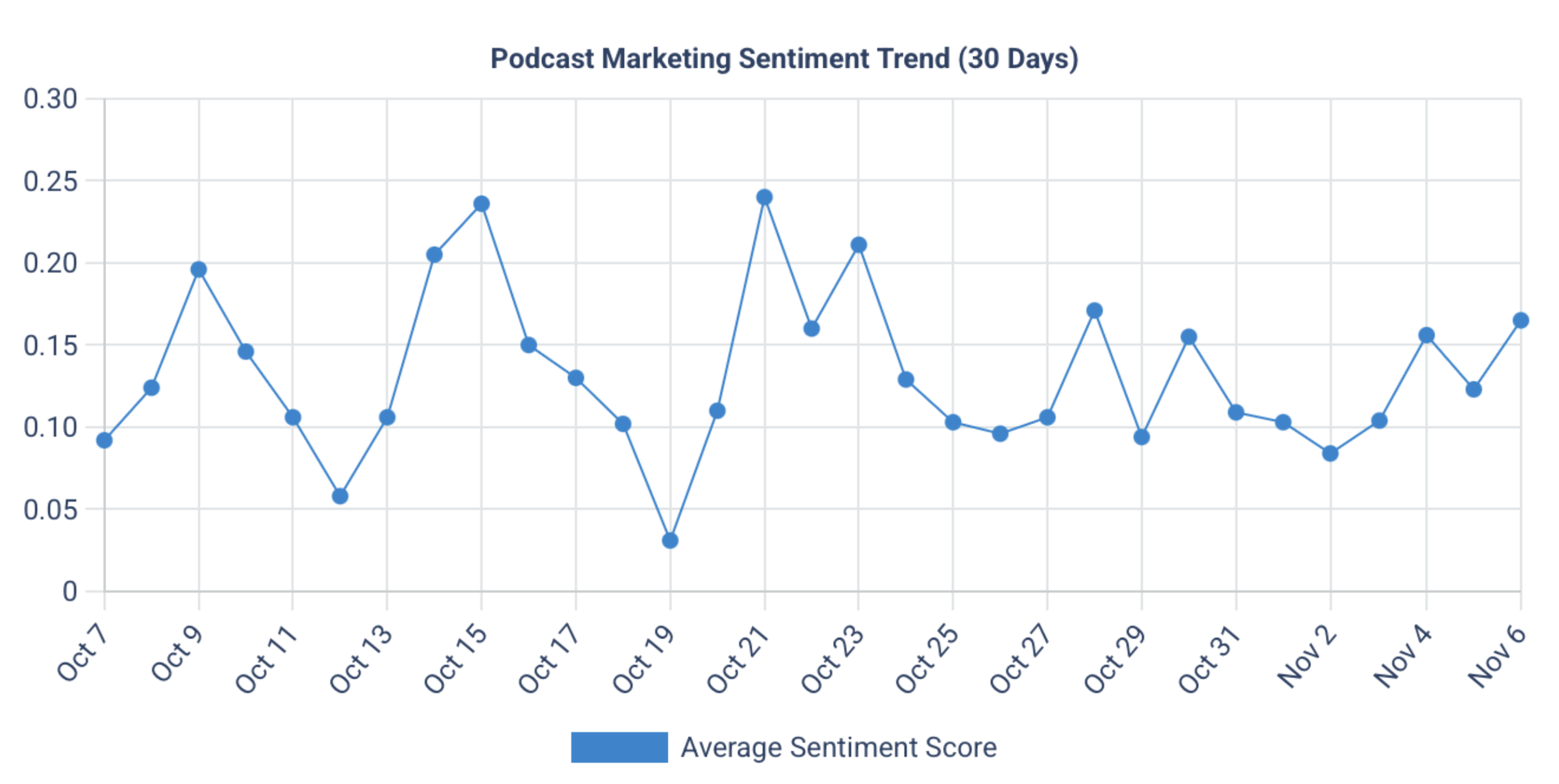
Podcast marketing sentiment trends in the last 30 days (Truescope).
However, media intelligence from Truescope reveals that measurement barriers, especially around YouTube attribution, are preventing podcast advertising from realizing nearly $1 billion in potential revenue. Despite superior metrics for conversion, attention, and ROI, inconsistent measurement frameworks are holding the industry back, a challenge marketers must help solve. This helps to explain the recent waxing and waning of the sentiment towards podcasts as a marketing channel in the media.
“This is the performance-measurement paradox,” the Truescope analysis notes. “Podcasts outperform traditional media, yet lack of standardization in attribution limits growth.”
The brand-performance convergence
The Truescope findings further emphasize podcasts’ unique dual value: they simultaneously drive brand building and performance marketing. The medium’s trusted and personal environment blurs the line between awareness and conversion. The 67 percent purchase conversion rate from podcast recommendations suggests that brand storytelling and direct response now reinforce each other instead of competing.
This integration reflects a broader communications shift. As the industry moves toward unified brand and performance strategies, podcasts offer a single channel capable of satisfying both ROI accountability and long-term reputation-building.
Cultural leadership and credibility
Podcasts have also become cultural drivers. The Acast report found that 72 percent of daily podcast listeners believe podcasts significantly shape cultural conversations, and 60 percent say they are more likely to change their opinion after hearing something on a podcast than on other media. For marketers, this makes podcasts not just a channel for advertising but a platform for narrative leadership.
“Podcasters build influence differently,” writes Acast’s Global Head of Creative Transformation, Nick Palmer. “Over hours of conversation, trust is formed, opinions are shaped, and genuine relationships are built.”
For marketing communications professionals, these findings underscore a strategic imperative: to lead in podcast partnerships, you must think beyond ad placements. Build relationships with creators who align with your brand values, integrate storytelling across audio and video, and invest early in measurement innovation, especially around YouTube podcast attribution.
The data signals that brands embracing podcast ecosystems now, while competitors are still struggling with measurement, will secure a lasting advantage. Podcasts deliver both emotional depth and measurable performance. For marketers ready to bridge the two, it’s a medium built for the next era of marketing trust and transformation.