
No King’s Day Protests Draw Millions as Americans Rally Around a Single Message
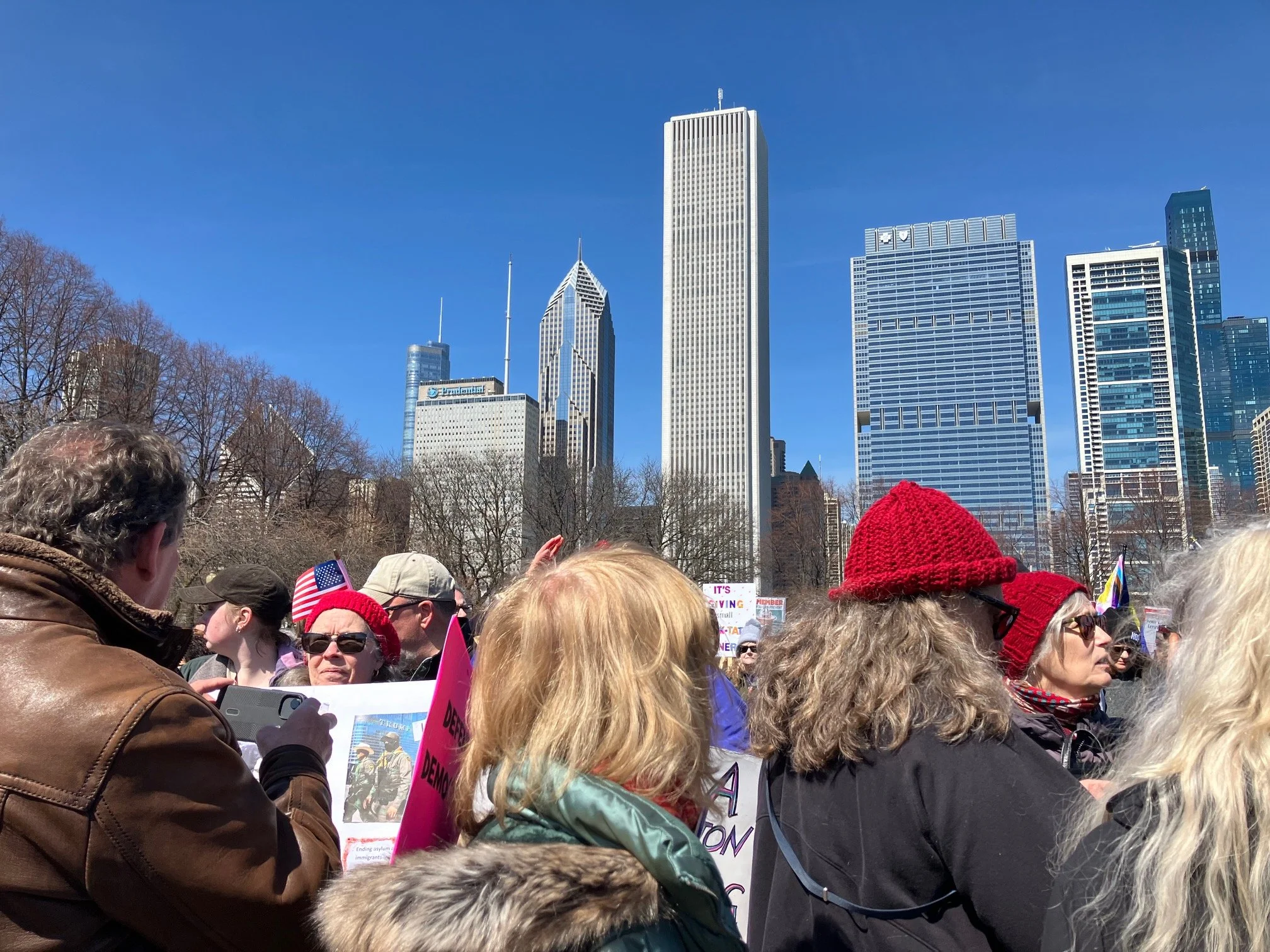
Chicago March — Photo credit: Dominic Calabrese
Their ranks included veterans, ministers, high school and college students, retirees, professionals and blue collar workers.
They were white, African American, Asian and Latino. They were also gay, straight and transgender. They came from big cities, suburbs and rural areas.
Taken together, they represented roughly eight million Americans who participated in No King’s Day protests across all 50 states and Washington, DC on Saturday, March 28. The event marked the third No King’s Day during President Donald J. Trump’s second term and was the largest to date.
While their backgrounds were diverse, protesters focused on a singular message.
“Americans will not stand for an authoritarian takeover of our democracy,” said Sue Masaracchia-Roberts, a longtime Chicago area writer and public relations professional.
Masaracchia-Roberts, who participated in the No King’s rally in Highland Park, Illinois, said Trump and the Republican Party would be wise to listen to public sentiment, particularly around domestic concerns and the war in Iran.
“This administration is growing the seeds of discontent and Republicans in Congress will not remain in power while GOP presidential candidates will be doomed in 2028 unless Trump drastically reverses his decisions and starts to listen to the people,” she said.
She noted that the Highland Park protest, like others across the country, was peaceful and drew people of all ages.
“As one speaker acknowledged, this was truly an event that shows our children by example that democracy demands participation to sustain it and is not something we can take for granted.”
Ellen Ferrera, a contributing writer for the Moultrie County News-Progress and founder and past president of the Illinois Association of Non-Profits, echoed that sentiment, urging Congress to “Make America great again, impeach Trump now.”
Pointing to rising costs for food, gas and utilities, along with the financial impact of the Iran conflict, Ferrera said lawmakers need to focus less on politics and more on everyday challenges facing Americans.
“Turn this precious country around before it’s too late,” she said.
The crowd reflected a wide range of voices and perspectives. Among them was Anne White, a member of the Unity Temple Unitarian Universalist Congregation in Oak Park, Illinois.
“As Unitarian Universalists, we show up in the public square to demonstrate that we are protecting what we love: justice and the inherent worth and dignity of each person,” she said.
For critics of No King’s Day, Ernest Wiggins, professor emeritus at the University of South Carolina’s School of Journalism and an independent scholar, said they overlook the nation’s long history of protest and its role in shaping progress.
“Common refrains we hear from MAGA supporters are that America does not have a king and that rallies won’t change anything because Trump will still be president,” Wiggins said.
He argued that those responses dismiss the long-term impact of civic engagement.
“They quickly resort to mockery, much like Trump himself,” he said. “Trump is neither persistent nor dedicated, and his backers, who are not benefiting in any real way from his presidency, don’t care.”
Still, Wiggins believes the movement could ultimately benefit even those who oppose it.
“His core followers, many of whom are working class and less educated, will have more opportunities to improve their conditions in a democracy than they ever will in an authoritarian system that benefits only the wealthy and privileged.”
Wiggins, along with Ferrera and Masaracchia-Roberts, said the momentum behind No King’s Day will only matter if it translates into sustained civic engagement and voter participation in November.