
Millions March in ‘No King’s Day’ Protests Across the Nation
What you will learn from this article:
How communicators can sustain public momentum after major protests through storytelling and strategic media engagement.
Why journalists play a critical role in confronting government overreach and preserving democratic discourse.
How civic participation, from protests to voter mobilization, strengthens accountability in an era of political polarization.
By every measure, it was a success.
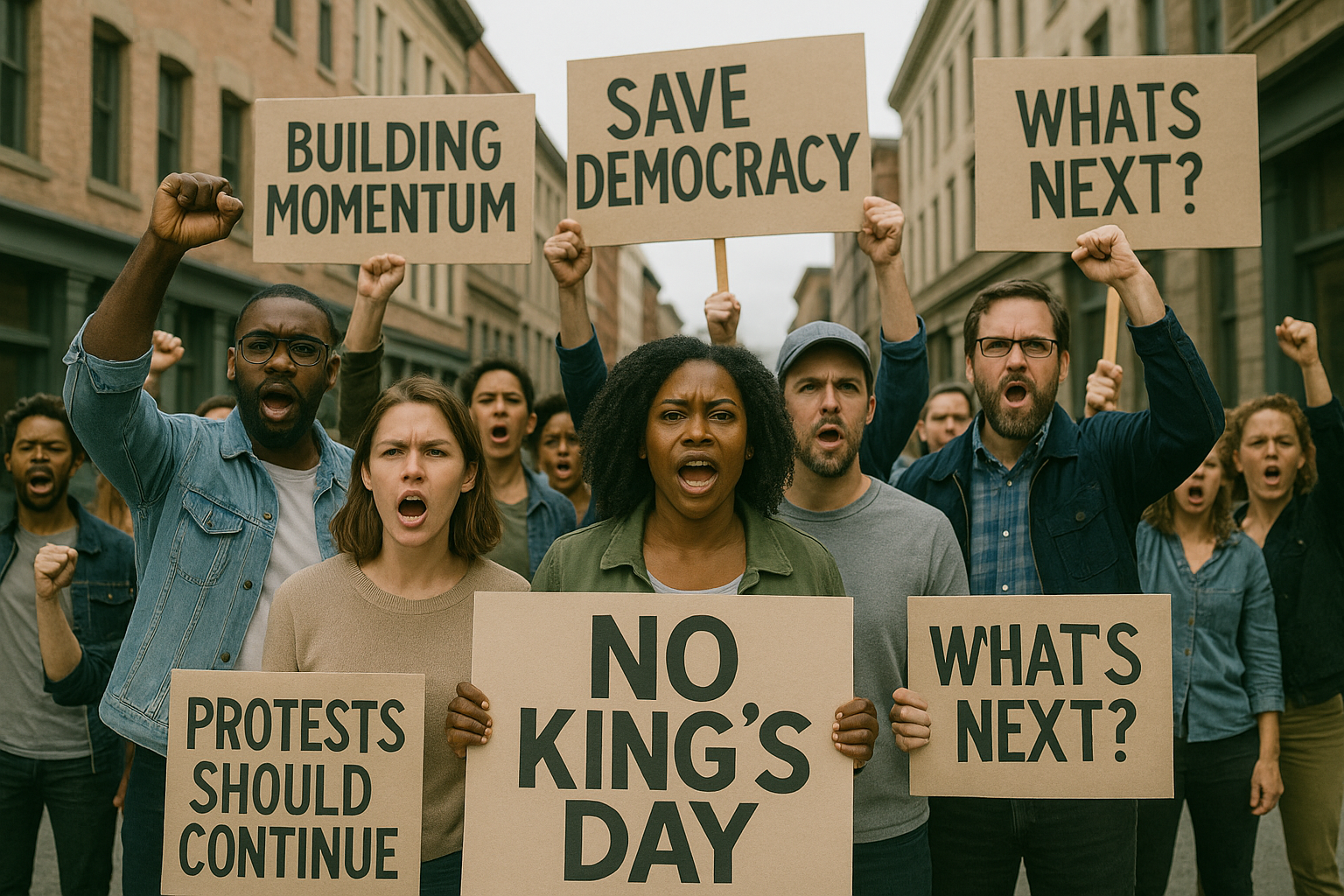
Seven million Americans on Oct. 18 peacefully and forcefully raised their voices against President Donald J. Trump’s authoritarian policies in “No King’s Day” protests held in big cities and small towns in all 50 states.
For organizers, advocates and journalists, the big question is what’s next? How can proponents build on the momentum generated on Oct. 18 and other recent demonstrations?
“They need to keep the narrative going in all media outlets,” said Ellen Ferrera, contributing writer for the Moultrie County (Illinois) News-Progress and founder and past president of the Illinois Association of Non-Profits.
She added, “We don’t hear enough from ordinary citizens about how drastic his chaos has affected their lives.”
Ferrera believes there need to be more interviews with farmers losing their farms, families going without food because of cuts to SNAP benefits, government employees with no paychecks, immigrant families attacked in the streets and terrorized by ICE, seniors facing sharp hikes in medical insurance, and election officials and county clerks who may have to call out the National Guard to protect local elections.
Elaborating on the critical role journalists can play, she cited French author Emile Zola, who wrote the famous letter “J’accuse,” accusing the French government of a miscarriage of justice in the notorious Dreyfus Affair.
“This was a powerful denunciation of the French government,” Ferrera said. “Journalists in all media today need to write their own ‘J’accuse’ articles accusing the government and Trump of every lawless act they commit against the American people.”
Richard Greb, a longtime reporter with The Associated Press, Reuters and the Chicago Tribune, agreed that the media must continue to showcase Trump’s abuses and the harmful consequences of his policies.
He also believes disaffected Americans need to channel their energy into the political process and vote for opposition candidates in upcoming elections.
“Voting is absolutely essential, and Americans need to become engaged in all elections at the local, state and federal levels,” he said.
In addition, Greb said “No King” protests should continue to be held around key dates such as the fifth anniversary of Jan. 6 next year or Jan. 20, the one-year anniversary of Trump’s inauguration.
“To sharpen their impact and galvanize potential new voters, organizers should also hold voter registration drives in conjunction with any marches and rallies,” he said.
Greb, who vividly recalls the anti-war protests during the Lyndon B. Johnson and Richard M. Nixon administrations, noted that those demonstrations helped hasten the end of U.S. involvement in Vietnam.
However, he doesn’t see Trump taking any positive action to address protesters’ concerns, no matter how widespread the discontent, according to recent polls.
“Instead, we saw him air a video depicting himself with a crown flying a fighter plane that dropped feces on the demonstrators,” Greb said, adding that Trump has shown a “callous disregard” for the plight of those severely affected by his policies.
To Ernest L. Wiggins, an independent scholar and professor emeritus at the University of South Carolina School of Journalism, that indifference might be strategic.
“It seems to me that the regime’s obliviousness to the tone deafness of everything they’re letting this guy do, despite the shutdown—the ballroom, the arch, the mobilization of troops in the cities, etc.—is strategic triggering,” Wiggins said.
He believes the Republican-controlled House’s unprecedented recess and refusal to hold negotiations is part of the same scheme.
“Push and push until there is open rebellion. It has to be about more than Epstein. Has to be,” he said.
Many political observers argue that Trump will use rebellion as an excuse to institute martial law, furthering his authoritarian rule.
Ferrera said Trump himself gives us an opportunity to keep the narrative going about how he will be remembered as the “worst president ever.”
“Through his disastrous tariffs that have cost jobs and driven up prices, his cruel immigration policies, and his attacks on fishing boats in international waters without a shred of proof they were smuggling drugs, he has created chaos at home and abroad,” Ferrera said.
People and organizations mentioned:
Tags: Trump protests, No King’s Day, media accountability, public relations, political communication, civic engagement, journalism, voter mobilization