
Could AI Make Us All Act Like Ants?
Editor’s Note: The following commentary by Tom Madden explores the rapid development of artificial intelligence through his distinctly playful lens. The views expressed are the author’s own.
While many of us are still getting our feet wet in adopting artificial intelligence, some Silicon Valley leaders are urging us to slow down its development and think carefully about where it could ultimately lead.
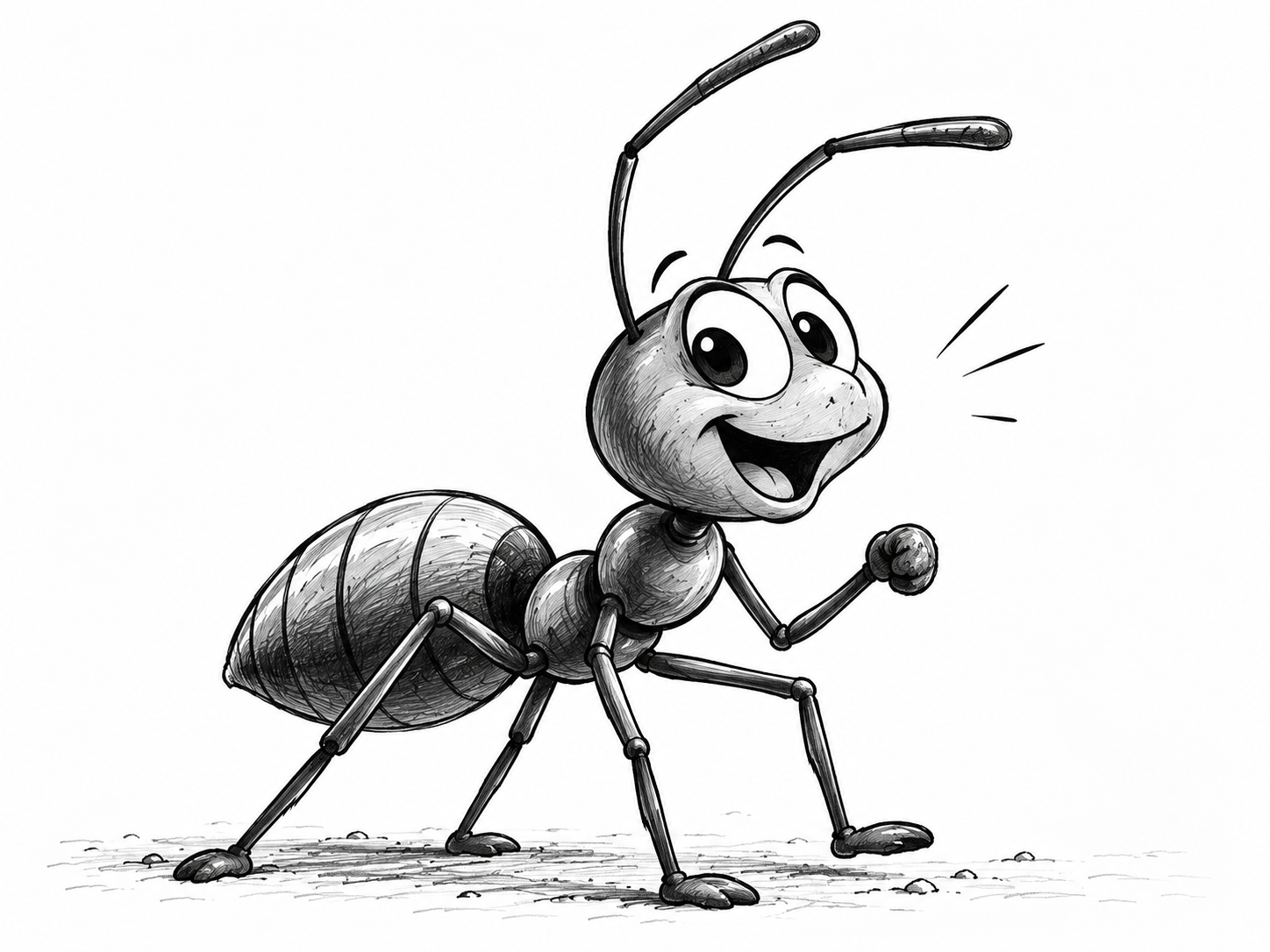
Could AI noticeably affect the routine daily lives and work schedules of human beings? Could one day AI make us all behave more like ants?
Consider for a moment that smallest creature on the planet, but without ants in your pants. Take your time to study ant behavior calmly and carefully. Observe how orchestrally they dispose of food particles we might drop on the floor.
Watch how a swarm of industrially busy ants go to town on those itsy-bitsy pieces, which they’ll break into even tinier parts, each one carried off to some sanctuary below, perhaps for a picnic.
What brought them out? Was it their acute sense of smell? But ants have no noses!
Do they have GPS systems flying over their anthills? I doubt it.
Or was it their antennae? Those are the multipurpose sensory tools they have developed to smell, taste, touch, navigate, communicate and detect even the slightest crumb droppings.
That’s probably the answer. Their AI is that astute antennae that tipped them off.
So, will our AI give us humans a much more advanced form of antenna? Will it propel us to spring immediately into action when we sense we’re near something sweet or enriching, opportunistic or disastrous?
Perhaps with AI we’ll get the incentive to act, to venture further out, to capture just as ants do after explosions of crumbs dropping stir their appetites.
Look how quickly ants assemble entire brigades to come right out into the open to begin orderly examining, collecting and then transporting what had so wonderfully dropped into their laps.
Could this be a primitive form of antificial intelligence that alerted them to spring so spritely into such concerted ant action?
As humans forge faster, further and more furiously into AI, could we be on a collision course on a much higher level by mimicking ants?
Besides a downside, I’m wondering if there could even be a political side to these ANTics.
Politically, ants certainly seem to operate in an orderly and purposeful fashion. They’re industrious, project-focused and remarkably committed to getting the job done.
But I’m not about to assign them to one political party or another. So, let’s just label them INDEPENDANTS.
One thing about ants that makes them seem so humanlike is that they’re such brave little critters.
Here I am standing tall, hovering over them, and they just continue about their business as if I’m not even there. Then, as soon as they’re done, they disappear.
This scenario makes me wonder whether we’ll be in full control of artificial intelligence or whether one day this masterful AI will begin taking charge of us.
Will it propel us all to robotically carry out whatever jobs we’re assigned before returning to our respective families, whom one day we might call our colonies?
Could one day AI make colonies of us humans, all acting ant-like as this? Will one day, thanks to AI, the only difference between us humans and ants be how much taller we all are?
Then there’s an even darker side to what some researchers believe could happen if AI keeps developing at its current lightning-fast pace. Surveys of AI researchers have found meaningful concern about extremely severe outcomes from advanced AI, including human extinction or similarly permanent human disempowerment. These are estimates, not predictions, but they underscore just how seriously some experts take the potential risks.
Yet I’m more worried that if we’re not careful, artificial intelligence could lead humans to one day having to work around the clock not for money or fame, but just for food. Just as ants do!
Still, AI is super powerful. And if we’re going to continue as one of the world’s leaders in technology and innovation, we’d better incorporate AI while learning all we can about its downsides, so it doesn’t lead us all off that ultimate, yet shiny cliff.
Knowing we’re in a race to develop AI, including intense competition between the United States and China, we should at least drive more carefully and keep testing and looking for trouble spots so it ultimately benefits, not bites us.
Still, I’m curious about how quickly ants respond and do whatever it is they come out to do, then just as quickly disappear.
There’s a story there, albeit one that’s ant-sized, yet hopefully not predictive.
