

What Two Years of Shift Browser Research Reveals
When I started in PR, we measured success in ad value equivalency and print readership. If a story ran in a magazine with 200,000 subscribers, you would take a percentage of viewership to look at the potential audience reached in that number.
Then RSS feeds let readers pull stories from dozens of sources, and loyalty to having a lobby or coffee table filled with publications started to erode. Then SEO turned every placement into a question of links and rankings. Now we’re learning AEO, or answer engine optimization, because a growing share of people get their information from an AI tool before they ever see a search results page.
Every couple of years, practitioners have had to rethink what a piece of content is actually worth. So when Shift Browser released a study on how Americans navigate their digital lives, I read it less as browser news and more as a preview of our next adjustment.
The 2027 State of Browsing Report, based on a survey of 1,005 U.S. internet users, builds on Shift’s inaugural 2026 study. Together they describe a contradiction we’ve seen with every new channel: people are adopting AI quickly, and they’re also tired, protective of their privacy, and wary of how much control they’re handing over.
AI is changing where discovery starts
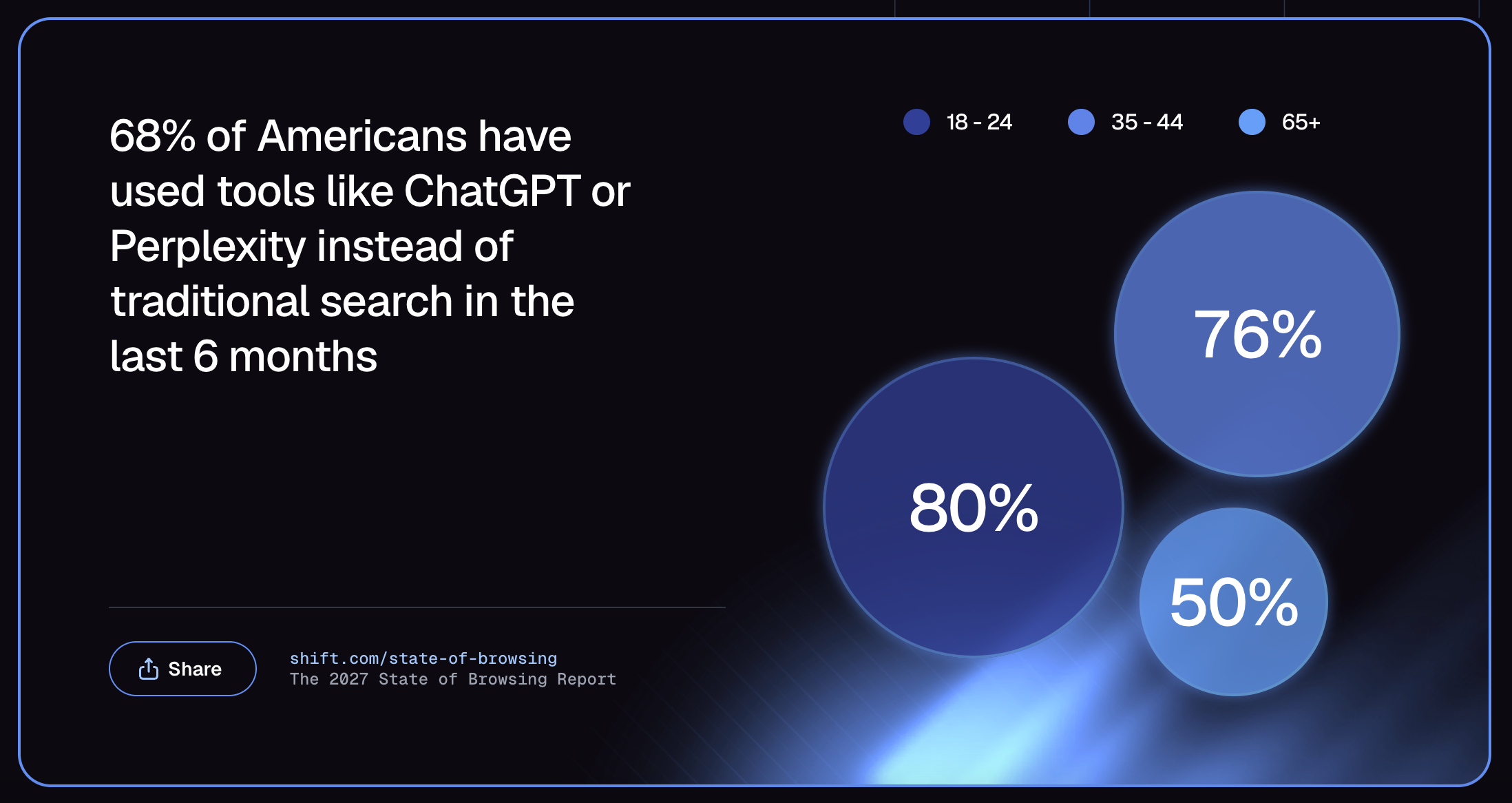
In Shift’s 2026 report, 68% of respondents preferred traditional search engines such as Google or Bing, and just 21% preferred AI tools like ChatGPT or Gemini. A year later, 68% of Americans say they’ve used AI tools like ChatGPT or Perplexity instead of traditional search in the past six months. Among 18- to 24-year-olds, it’s 80%.
The two studies asked different questions, so this isn’t a clean trend line. The direction is still hard to miss. Search remains familiar, and AI has become a regular alternative.
We’ve seen this pattern before. When SEO took hold, earned media picked up a second job. A placement still mattered to the people who read it, and it also mattered for the link and authority it passed to a client’s site. AEO is adding another layer. A credible story in a respected outlet may now matter as much for what AI tools draw from it as for who reads it the day it runs.
The media side has changed, too. Earlier in my career, a new company or a new technology was often a story on its own merits. Novelty opened doors. That’s far less true today. Newsrooms answer to clicks and shares, and increasingly to whether a story will surface in AI search, so editors lean toward the topics people are already looking for. A pitch built on “this is new” now competes with pitches that answer questions readers are actively asking, and it usually loses.
That moves our work upstream. Before we pitch, we need to know what our audiences are asking and whether our clients can answer credibly. Clear, factual messaging and independent coverage carry more weight when an AI tool is assembling the answer, and so does consistency. If a brand describes itself three different ways across its website, press materials and coverage, an AI summary will reflect that confusion.
The audience is tired
In the 2026 study, 62% of Americans reported recurring digital burnout, citing endless notifications, social media overload, news rabbit holes and constant switching between apps and tabs. The 2027 report finds that 63% experience digital fatigue at least sometimes.
The age breakdown surprised me. Among 25- to 34-year-olds, 20% report very frequent digital fatigue, while 43% of adults 65 and older say they rarely feel drained online. The people most fluent in digital channels are the ones most worn out by them.
Meanwhile, our industry is using AI to produce more. One announcement can become a dozen social posts, three blog variations and an email sequence in an afternoon. That’s efficient, but this research suggests the people on the receiving end have little patience left for it.
This is where our measurement history matters. Ad value rewarded volume, and so did raw impression counts. We spent years moving clients toward outcomes instead, and AI-scale production risks pulling us back. One credible story that answers a real question will usually do more than a stack of posts competing for the same worn-out attention.
People want personalization and control
In 2026, 92% of respondents said they wanted personalization from their browser, and 81% were willing to switch or considered switching browsers to get it. The 2027 study finds that 64% would prefer a browser that gives them more control, even if that means making more decisions themselves. Yet 54% haven’t seriously considered changing their primary browser in the past year.
Anyone who has run an awareness campaign knows that gap. People say they want better options, and habit usually wins anyway.
AI sharpens the concern. According to the 2027 report, 45% worry about AI accessing too much personal information, and 42% are concerned about AI taking actions they didn’t intend. Another 32% want to be asked before new AI features are enabled in their browser, and 22% want those features off unless they opt in. In 2026, 45% named online privacy as their primary barrier to AI adoption.
For years, we promoted frictionless experiences and products that anticipate what people need. This data draws a line between making someone’s life easier and deciding on their behalf. People can appreciate a recommendation and still want to know why they’re seeing it, how their data was used and how to opt out.
That puts transparency squarely in our lane. A privacy policy satisfies the lawyers. Explaining in plain language what a product does with someone’s information, before they have to ask, is communications work, and it’s how trust actually gets built.
Sell what the AI does, not the AI
Both years point the same way: people value AI when it solves a practical problem.
In 2026, research assistance was the most requested AI capability at 49%, followed by task automation (37%) and drafting written content (34%). In 2027, when asked which AI capabilities would make browsing easier, respondents chose researching topics (35%), finding previously viewed information (28%), comparing information or products (27%) and summarizing multiple tabs (25%). Nearly three in five say AI has made their online lives at least somewhat simpler.
Nothing on that list suggests people want AI to take over. They want help getting things done.
This connects back to the media point. A new AI feature is no longer news simply because it exists. First drafts of launch messaging still tend to lead with the model, the architecture and how much the product automates, but that rarely holds up with editors or customers. Does it save time? Make information easier to find? Help someone make a better decision? Those are the answers people are searching for, and the ones worth leading with.
What this means for PR in 2027
Taken together, the two reports describe an audience that has accepted AI as part of how it finds information without letting go of its concerns about overload, privacy and control. For communicators, three priorities follow.
Plan for answer engines, not just search engines. As people use AI to research, compare and find answers, visibility depends on authoritative content, credible earned media and messaging that stays consistent everywhere a brand appears. Pitch to the questions audiences are asking, because that’s increasingly what editors cover.
Measure outcomes, not output. We’ve walked away from volume metrics before, and AI makes it easy to drift back. With more than six in ten consumers reporting digital fatigue, more content is unlikely to mean more engagement.
Build transparency into the message. Consumers want the benefits of AI and personalization, and they want to understand how those tools use their data and what control they keep. Explaining that clearly belongs in the product story, not just the fine print.
I’ve changed how I value content more times than I can count: from ad value to readership, through RSS and SEO, and now AEO. Each shift changed the tactics. None changed the job, which is earning the attention of people who have plenty of other places to put it. Shift’s research suggests that job just got harder, and that the brands doing it well will offer technology that works for people rather than over them.
About the research
Shift Browser’s 2027 State of Browsing Report was conducted by MX8 Labs in September 2026 among 1,005 U.S. internet users. The inaugural 2026 report surveyed 1,000 U.S. adults in September 2025. Both studies were designed to be nationally representative. Because survey questions differ between years, the findings illustrate evolving consumer attitudes rather than directly comparable year-over-year changes.