

Trump or Tyrant? The Chilling Parallels Between MAGA and Dictatorships You Can’t Ignore
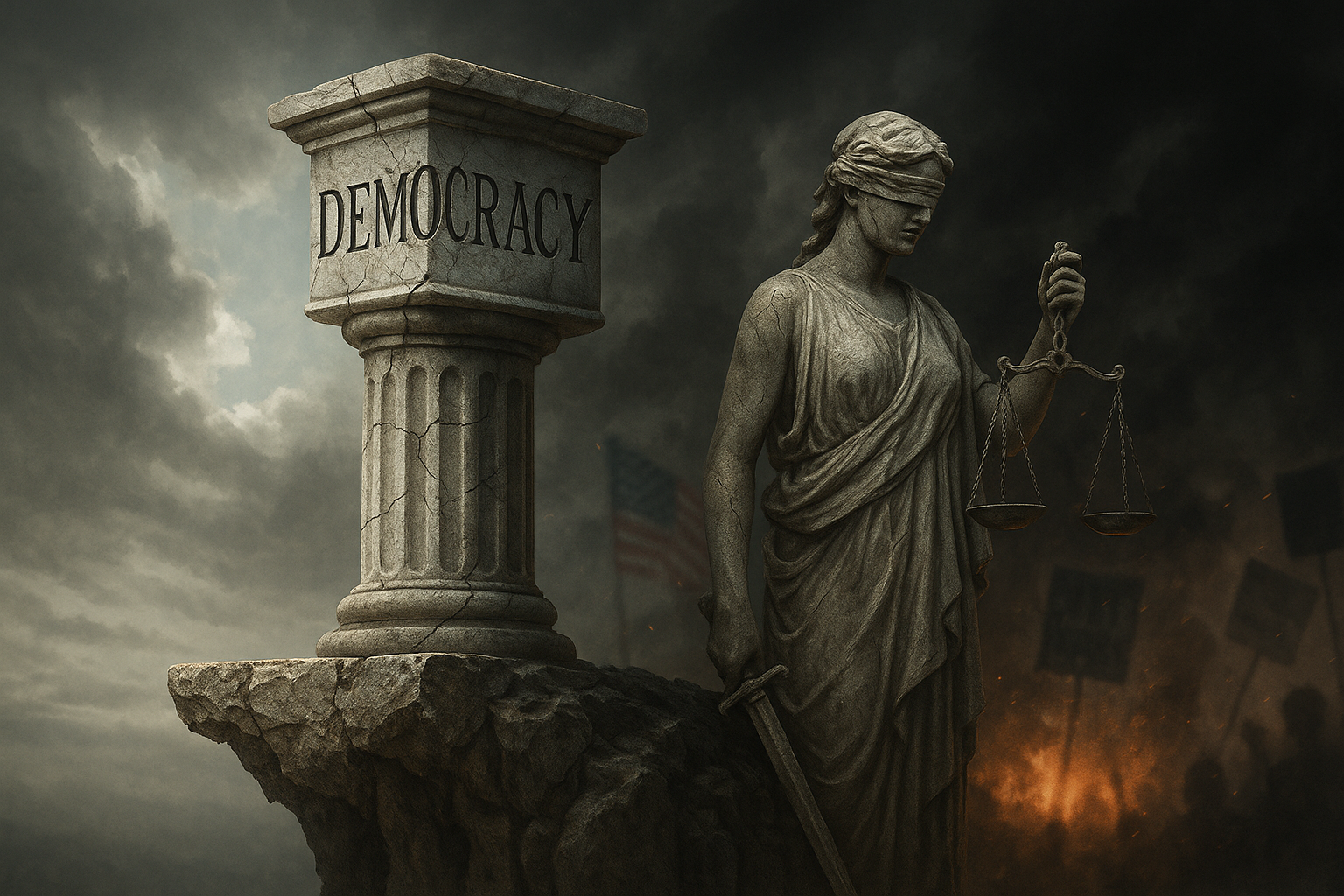
On April 29, the 100th day of President Trump’s term in office, I wrote an essay on this website outlining how the Democratic Party should approach key issues if it hopes to regain relevance. I also noted that President Trump had unintentionally offered the Democrats a roadmap to follow.
What was also evident during Mr. Trump’s first 100 days was the unsettling resemblance between many of the president’s MAGA initiatives and those of Adolf Hitler’s Nazism.
In this essay, I’ll examine how the president’s actions mirror the authoritarian playbooks of Nazi Germany, Argentina, and other regimes—based on several key issues and Mr. Trump’s promises.
The promise: President Trump said he would rid the U.S. of violent immigrants.
The result: Immigrants suspected of being violent criminals were arrested and deported without conviction.
The resemblance: This parallels the actions of Hitler and Argentine dictator Jorge Videla, under whose regime more than 30,000 Argentine citizens were killed or disappeared in the 1970s and ’80s.
The promise: Trump vowed to end the war between Russia and Ukraine in one day.
The result: That day has not arrived.
The resemblance: The empty confidence echoes the oft-repeated “Mexico will pay for the border wall.”
The promise: “Starting on Day One, we will end inflation and make America affordable again.”
The result: Food and energy costs remain high, while 401(k)s have taken a hit.
The resemblance: Again, the empty bravado recalls “Mexico will pay for the wall.”
The promise: Tariffs will bring back U.S. manufacturing jobs.
The result: Tariffs triggered trade wars, strained U.S. alliances, destabilized the bond market, and dragged down stocks.
The resemblance: Economic nationalism that echoes factors leading to the Great Depression and World War II.
The only promise President Trump fulfilled was closing the southern border—but that policy began under the Biden administration.
Of course, there are additional actions the president has taken that threaten democratic norms. His bullying of universities and law firms is deeply troubling. His removal of books he dislikes from military libraries is eerily reminiscent of Hitler’s book burnings.
Both Trump and Hitler launched failed coups—Hitler’s in the 1923 Beer Hall Putsch and Trump’s on Jan. 6, 2021, in his effort to stop the certification of electoral votes affirming President Biden’s victory.
Mr. Trump has expressed admiration, publicly or privately, for authoritarian leaders such as Hitler, Vladimir Putin, and Kim Jong Un.
Among his most dangerous actions is his refusal to respect judicial authority. The courts—many filled with judges appointed by Trump—have so far served as the only check against his overreach.
However, a troubling escalation occurred April 25 when Judge Hannah Dugan was arrested. FBI Director Christopher Wray said she was suspected of intentionally misdirecting agents away from an immigrant under pursuit. This event raises concerns about growing pressure on the judiciary.
Much has been written comparing Donald Trump to Adolf Hitler, but one tactic stands out: the use of the “Big Lie.” In Mein Kampf, Hitler wrote, “The great masses of the people will more easily fall victim to a big lie than to a small one.” Repetition of falsehoods, he claimed, leads to belief.
Mr. Trump has employed this propaganda technique repeatedly. Two standout lies include his claim that President Obama wasn’t born in the U.S., and that the 2020 election was stolen.
Another similarity lies in the staging of rallies—both Hitler and Trump limited attendance to supporters only.
An Oct. 22, 2024, article in The Hill, a nonpartisan outlet covering politics and policy, reported that former White House Chief of Staff Gen. John Kelly confirmed President Trump once praised Hitler’s generals. According to Kelly, Trump asked him, “Why can’t you be like the German generals?”—a claim the president denies. But, as history has shown, Mr. Trump has a tenuous relationship with the truth.
On April 28, for instance, while hosting the Super Bowl–winning Philadelphia Eagles at the White House, Mr. Trump claimed he had warned the New York Giants not to lose Saquon Barkley. Giants VP of communications Pat Hanlon refuted the story, saying “there were no conversations” between the team and the president about Barkley.
In a Jan. 20, 2025, Harvard Political Review article titled “Trump’s Rhetoric Echoes Hitler,” Alexandra Fierman wrote that Trump’s language contains echoes of Nazi rhetoric.
She noted Trump claimed multiple times in 2023 that immigrants were “poisoning the blood” of the U.S.—language Hitler used in Mein Kampf to promote racial purity. Both leaders weaponized racial fear to marginalize vulnerable groups and portrayed immigrants as threats to cultural identity.
Fierman also cited Trump’s repeated questioning of nonwhite leaders’ legitimacy, including comments about President Obama and Vice President Kamala Harris, whom Trump claimed “turned Black” and misled voters about her heritage.
Most disturbingly, Fierman argued that both Hitler and Trump engaged in the dehumanization of “out-groups.” Hitler called Jews “parasites,” while Trump labeled undocumented immigrants as “animals.”
These are only a few of the many parallels Fierman explored in her article, which should be read in full to grasp the extent of the comparisons.
A separate article in the New York Times on April 29 reported that Illinois Gov. J.B. Pritzker “has for years invoked the specter of Nazism to describe Mr. Trump”—a comparison I agree with.
There are two additional similarities worth noting:
There was an assassination attempt on Hitler; Trump survived one as well.
Hitler was a convicted felon. So is Trump.
Whether you are an “Always Trumper” or “Never Trumper,” one fact is indisputable: His actions are not democratic—neither with a capital “D” nor a lowercase one.
As I write this at 11:05 a.m. on April 30, there are 1,361 days until Trump’s term ends on Jan. 20, 2029, at noon Eastern. That’s enough time for him to do more damage to our democracy—or for democracy’s defenders to stand up and fight back. And since executive orders can be reversed by a future president, hope still exists.
There’s a key lesson here for public relations professionals
Often, PR practitioners are asked to defend clients or causes they fundamentally disagree with. Remember, we are not lawyers. If you feel uncomfortable working on an account—as I have in the past—raise your concerns. The response you receive will reveal how your leadership values your ethics.