

Jim Clyburn on the First Eight and a Defining Chapter in American Leadership
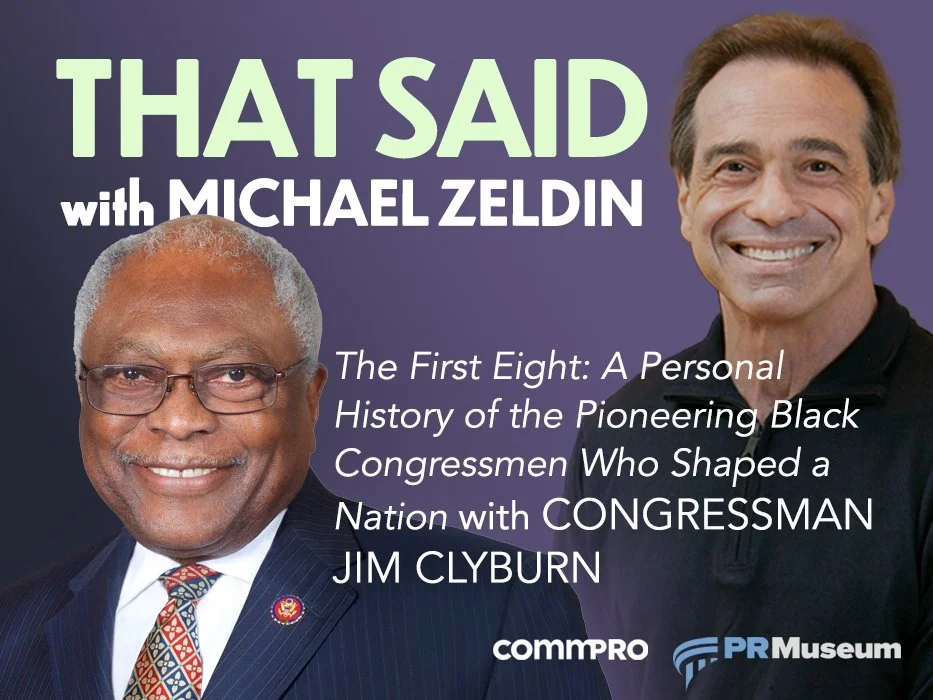
Long before he ever considered running for Congress, Jim Clyburn was being trained for leadership in quieter, more demanding ways. Growing up in a parsonage in Sumter, South Carolina, he learned discipline early. Faith, family, education, and public service were not abstract ideas in his household, they were daily practice. Every morning began with scripture. Every evening ended with a discussion of current events. Newspapers, not television, shaped his understanding of the world.
That grounding is the throughline of this episode of That Said, and of Clyburn’s new book, The First Eight. The book tells the story of the first eight Black members of Congress from South Carolina elected during Reconstruction, and just as importantly, explains why it took nearly a century for a ninth to follow. But the conversation makes clear that this history is not distant. It is personal. And it is unfinished.
Clyburn traces his own political awakening to the moment he began reading the newspaper closely as a child and watched Harry Truman defy expectations in the 1948 presidential election. He connects that curiosity to his teenage involvement with the NAACP Youth Council, his student activism at South Carolina State, his role in organizing early sit-ins, and his participation in the founding of SNCC. These experiences, he explains, were not about ideology alone. They were about responsibility, about understanding power, and about what happens when people fail to guard hard-won rights.
That perspective shapes how Clyburn approaches history. As a young high school teacher, he rejected textbooks that flattened or excluded the African American experience. Instead, he taught history through the lens of lived reality, using newspapers and nightly news to make events relevant to his students’ lives. The result was engagement, not compliance. It was a lesson he would carry into public office.
The First Eight grew out of that same instinct to correct the record. The idea began when visitors to Clyburn’s congressional office asked about the portraits on his wall and assumed he was the first Black member of Congress from South Carolina. “Before I was first,” he told them, “there were eight.” That realization, he says, made the book inevitable.
But as he was writing, the 2020 election unfolded. Watching attempts to overturn certified results, Clyburn recognized patterns he had seen before. The disputed election of 1876, the Compromise of 1877, and the single-vote decisions that ended Reconstruction and ushered in Jim Crow were not historical curiosities. They were warnings. The book shifted from biography alone to a broader examination of how democratic systems can be weakened, often quietly, and how quickly progress can be reversed.
Throughout the conversation, Clyburn returns to the importance of vigilance. He reflects on figures like Robert Smalls, Richard Cain, Robert Brown Elliott, and Thomas Miller, leaders who were highly educated, strategically minded, and deeply committed to public service, yet later written out of history or mischaracterized as corrupt or unqualified. Their real legacy, he argues, is not perfection, but persistence. Unity without unanimity. Progress without guarantees.
Clyburn also draws clear parallels between Reconstruction-era court decisions and today’s legal battles over voting rights, redistricting, and representation. One vote, he reminds listeners again and again, can change the trajectory of a nation. It has before.
As the episode closes, Clyburn reflects on the legacy he hopes to leave behind. Borrowing inspiration from the people he writes about, he says he wants to be remembered simply as someone who did his best to make America’s greatness accessible and affordable for all. Healthcare. Education. Energy. Opportunity. Not as abstractions, but as lived realities.
For communicators, leaders, and citizens alike, this conversation is a powerful reminder that history is not just something we inherit. It is something we interpret, protect, and extend. The First Eight is not only about who came before. It is about what we choose to do with what they made possible.
Listen to the full episode of That Said for a thoughtful and timely conversation about leadership, memory, and the enduring responsibility of democracy.