
Gloria Steinem Was About Much More Than Feminism
I became a follower and fan of Gloria Steinem 50 years ago, in August 1976. I was one of the thousands of people marching in favor of states ratifying the Equal Rights Amendment, which Congress had passed in 1972 and which New York State had ratified when it passed. Fifty years later it is still not ratified by a sufficient number of states to become part of the U.S. Constitution.
But it would be another 40 years before I met the person I so admired.
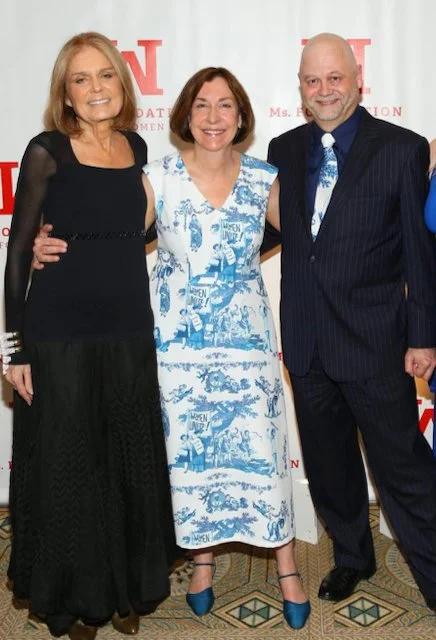
I met Ms. Steinem at an April 2016 gala for The Ms. Foundation. My wife, Laurel Garcia Colvin, is a visual artist, and for several years had a number of exhibitions of her series celebrating the pioneers in the feminist movement: in government, politics, entertainment, music, literature, sports, science, and activism. These pieces were drawn and then printed on fabric in a toile pattern. Some were fabric rectangles framed in glass. Some were in the form of Louis XVI chairs, and one was a dress that the artist wore at her events.
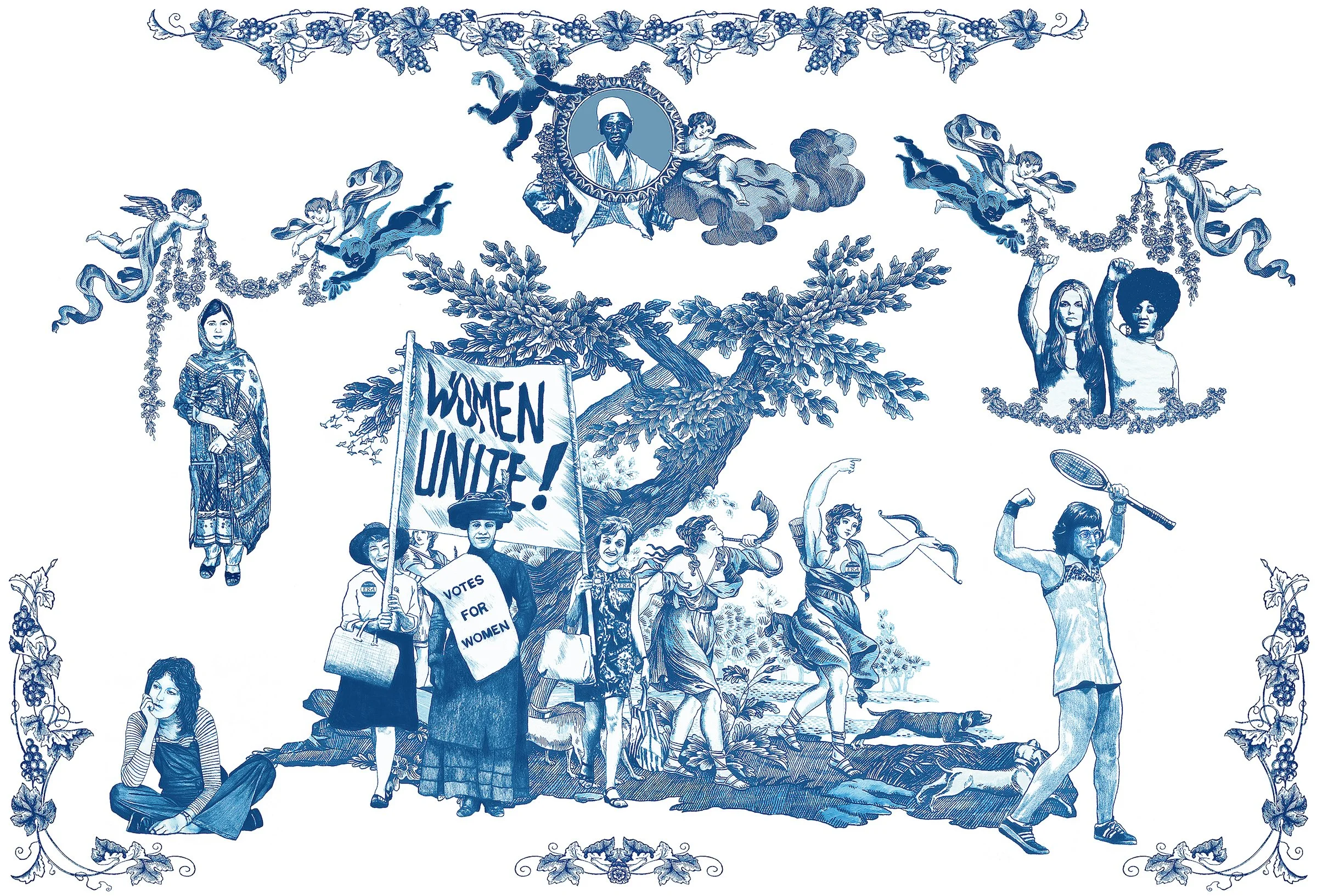
Women’s Rights Are Human Rights
By Laurel Garcia Colvin
Design on Printed Cotton Fabric, 2015
Sojourner Truth, top center, Gloria Steinem and Dorothy Pittman Hughes, upper right.
Laurel had been invited to donate a Louis XVI chair to be auctioned off at the gala. And she wore the dress. As the trailing spouse, I wore a tie of the same fabric. When we met Ms. Steinem, she was quite excited by the imagery on Laurel’s dress. I expected Ms. Steinem to be drawn to the image of her with her friend Dorothy Pitman Hughes, who was also at the gala, with upraised fists. But she instead searched diligently for the person she called her hero, the former enslaved person and abolitionist Sojourner Truth. She found that image just below Laurel’s left shoulder. And she smiled excitedly. My admiration for Ms. Steinem grew that day.
Injustice for Some is Injustice for All
Back in 1976 I had just finished my first year of college in New York City. I am an immigrant to the United States from a country that later became a military dictatorship. For many of my school years in the 1960s I was the only foreign kid in my school, and frequently got the crap beaten out of me just for being an immigrant. I assumed it was about just me and those kids.
For most of my schooling I had daily recited a pledge that included the phrase “with liberty and justice for all.” At the time I was very naïve; I believed that to be a normative statement, not an aspirational one. After all, it echoed the key sentiment from the original Declaration in 1776. But I later learned that my experience was not unique; that this promise is still a work in progress, and that there is meaningful opposition to the literal meaning of the phrase.
So when I was invited to join the 1976 march on Women’s Equality Day, I was all in. But I was surprised that the proposed constitutional amendment called, “The Equal Rights Amendment,” was specific to the rights of women. Still, that summer’s national mobilization opened my eyes to the disparate treatment some parts of our society experience simply because of their identity. And it set me on a path to advocate for equal treatment of all people regardless of their identity: gender, sexual orientation, skin color, religion, immigration status, disability, age, etc.
That march was my awakening; the beginning of my social activism. And I learned that the patterns of exclusion, oppression, and even of violence extend beyond any one of those identity categories. And it gets to the central question that this republic has been grappling with since even before its founding: Just who is entitled to full civic, economic, and political participation? Indeed, the Fourteenth Amendment to the U.S. Constitution reads that no state shall “deny to any person within its jurisdiction the equal protection of the laws.” But there are many in this country who ignore that prohibition and indeed try to deny those rights.
Passing the Torch to the New Generation
It turns out that Ms. Steinem was following in the footsteps of those who came before. As she said in 1994 in an address to the Feminist Family Values Forum,
“[M]any of our ideas about individual human dignity and democracy within families--about non-hierarchical forms of organization and balance with nature--came from cultures that were already on this continent millennia before Europeans arrived.”
She noted that the women of both the abolitionist and suffragist movements, including Sojourner Truth and Elizabeth Cady Stanton, “knew, visited with, learned from, and wrote about women in those Native American cultures, and held such cultures up as examples of the kind of society they were striving to create.”
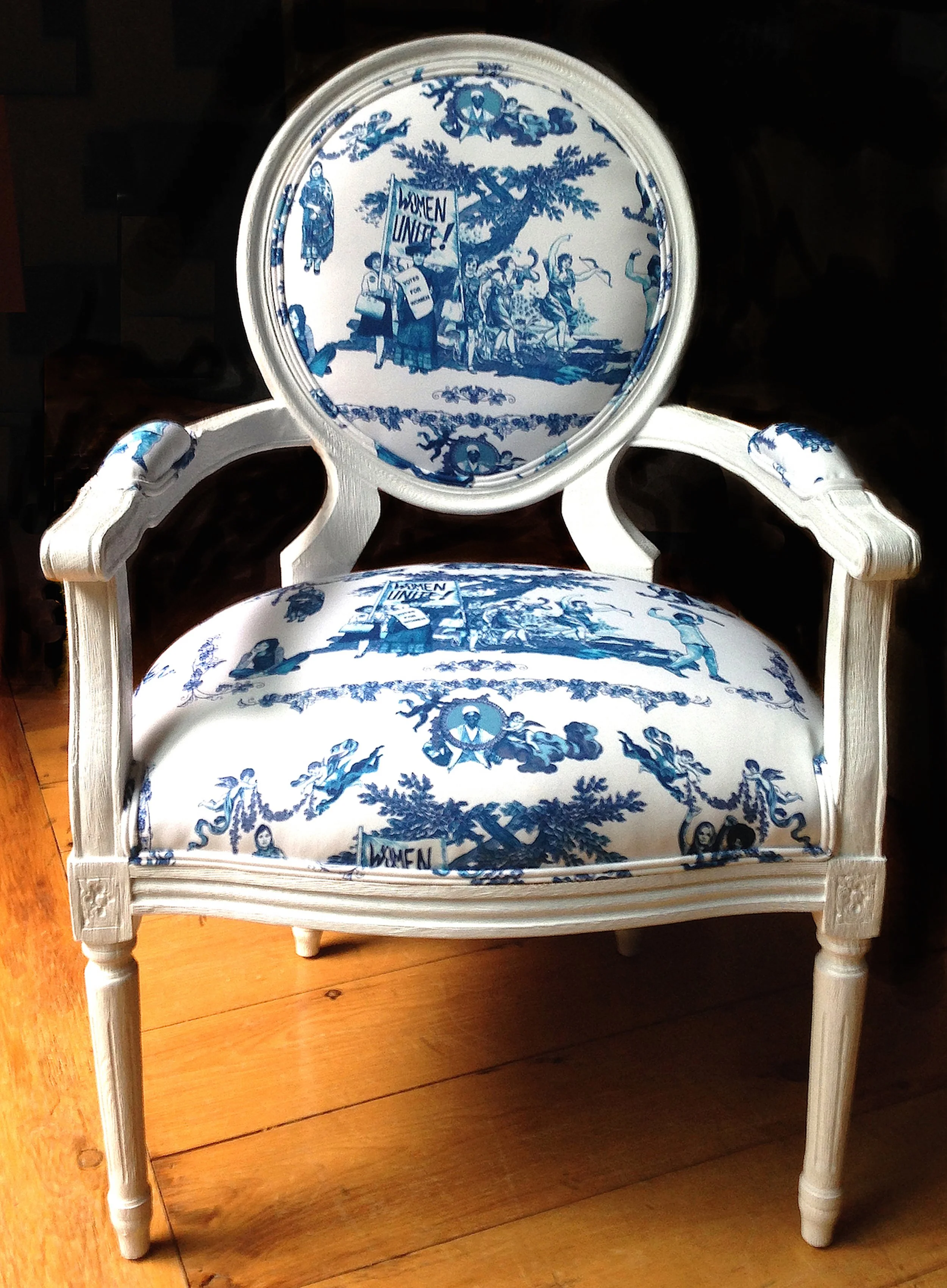
Women’s Rights Are Human Rights End Chair
By Laurel Garcia Colvin
White wood Louis XVI Chair With Printed Fabric, 2015
She admonished, “We must remember that what now is called ‘Women's History,’ ‘Native American History,’ ‘African American History,’ or ‘Asian American History’ really ought to be called ‘Remedial History.’
She closed her talk, “The patriarchal, nuclear family that we are supposed to think is the normal and only one, that kind of family is really only about one-hundred-and-fifty-years-old… The idea that there is only one family form is really pure bullshit.”
I have since found that Ms. Steinem’s life-long advocacy is itself a role model for activists for justice for other oppressed or marginalized communities. She picked up the torch from those who came before and honored their memories. Indeed, when she turned 80 and was to be honored with a bench in Central Park celebrating her life, she asked that the commemorative plaque be about not only her, but also her hero who had died 131 years earlier. It reads:
“In celebration of the 80th birthday of Women’s Movement organizer, the great Gloria Steinem and in honor of her hero, Sojourner Truth (1797-1883) who understood that equality includes everyone or no one.”
And just as Ms. Steinem picked up from those who came before, future generations will look back at Ms. Steinem – and her heroes – as their inspiration for the still hard work that is yet to be done.