

Sustainability Enters a Pragmatic Era, Raising the Stakes for Investor Relations Teams
Sustainability is moving into a more disciplined, financially grounded phase, and investor relations officers are becoming central to how companies navigate it. New research from Corbin Advisors highlights how sustainability has shifted from broad messaging to a strategic management focus shaped by materiality, governance and long-term value creation.
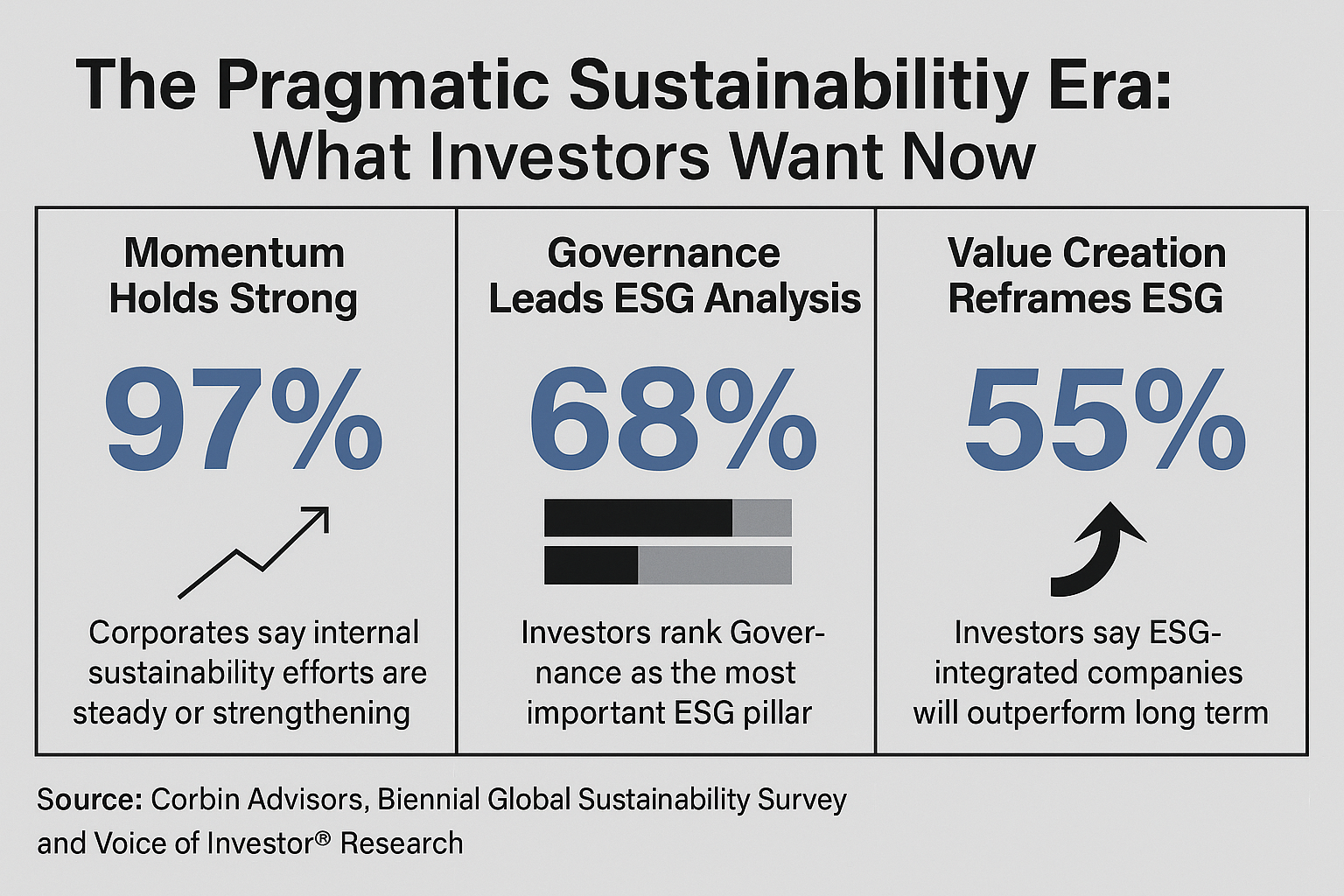
According to the findings, internal sustainability efforts remain strong even as companies become more measured in how they communicate externally. Ninety-seven percent of corporates say their sustainability momentum is holding or increasing. Investors are sharpening their priorities as well, with governance ranking as the most important ESG pillar and a growing emphasis on higher-quality environmental data as new reporting requirements take effect.
The investment community is also showing increased conviction in the link between ESG integration and performance. Fifty-five percent of investors believe companies that embed ESG into strategy will outperform over the long term, a notable increase from 39 percent in 2023. A gap is emerging between investor sentiment and corporate perception. Fifty-one percent of investors now view ESG as a contributor to alpha and total shareholder return, while only 16 percent of corporates share that view. For investor relations teams, this disconnect signals the need for clearer communication around what is financially material and how sustainability initiatives support strategy.
The report points to an evolution similar to other investment factors that gained influence as capital markets became more data-driven. As expectations mature, companies are embedding sustainability into governance structures, risk assessments and internal decision-making, even if external messaging has become more precise. The shift reflects a more pragmatic era in which investors and corporates look for evidence, specificity and measurable impact rather than broad commitments.
The research identifies several priorities that will shape the next stage of sustainability work, including stronger data systems, greater alignment between sustainability and enterprise value, and emerging expectations around technology governance. Each of these areas directly involves the investor relations function, which must translate complex initiatives into clear explanations of performance, risk and long-term value.
For IR leaders, the message is clear. Sustainability is no longer a parallel narrative. It is becoming a core part of investor dialogue. The companies that communicate with precision about materiality and impact will be best positioned as expectations continue to rise.