

Are CCOs Ready to Answer the CEO’s AI Search Questions?
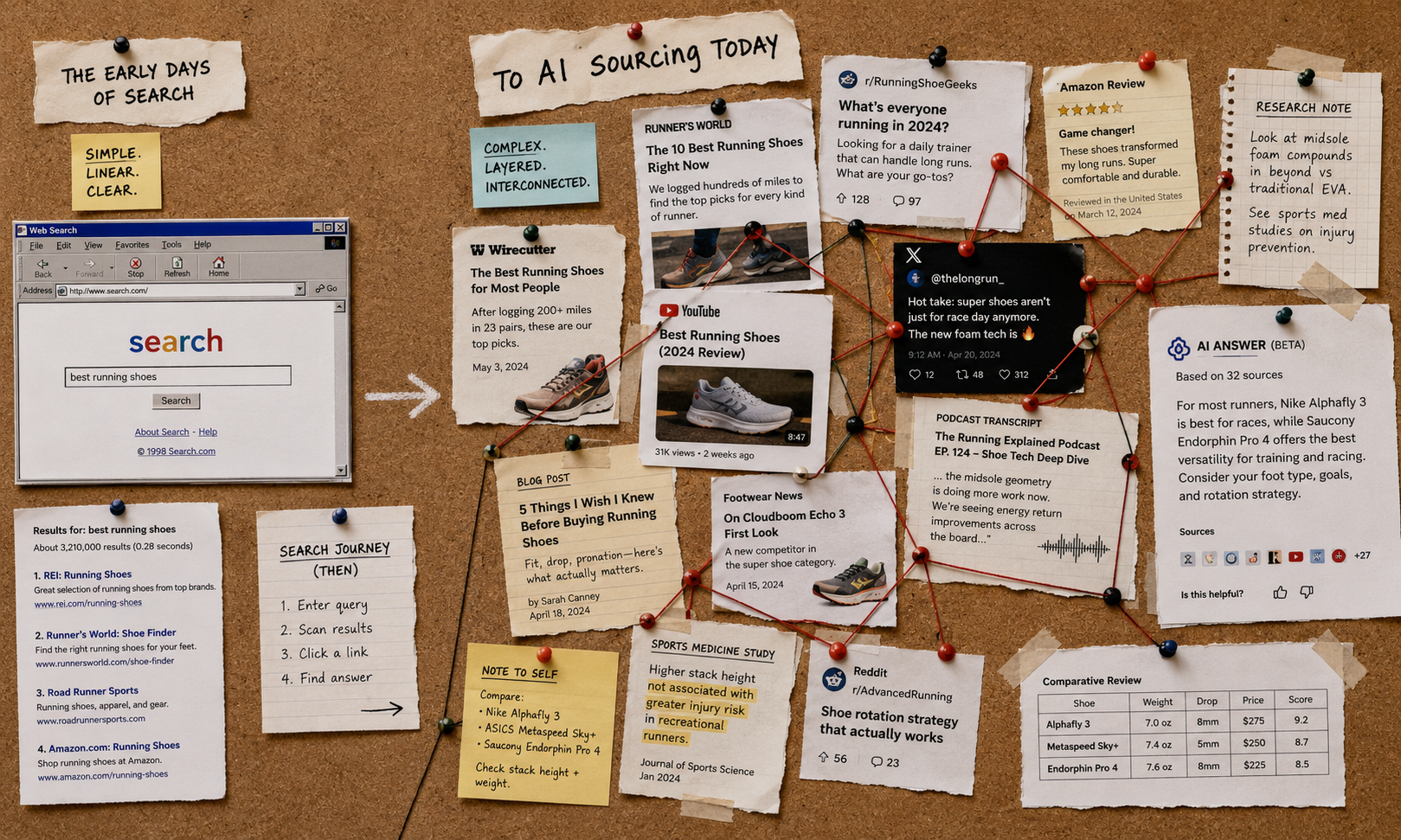
In less than four years, AI search has become non-negotiable. The problem is that CEOs are overwhelmed by how to approach it in a world where the value changes by the day, the tools change by the hour, and the number of vendors grows by the minute.
To make matters worse, AI search is one of the least controllable applications of AI. Companies cannot simply find a great vendor or build their own system. They have to respond to what people outside the business are saying.
Communicators know those sources include earned media and platforms like Reddit and LinkedIn, with support from owned media such as blogs. But we need to explain that to the C-suite in a way that calms the noise and gets leaders looking back toward the horizon, rather than becoming overwhelmed by options that are often bolt-ons instead of the solutions they need.
What 25 million AI Citations Shows
Every company has full control over its internal content strategy, but even the best companies only control a quarter - at best - of the AI search equation. A Muck Rack Generative Pulse analysis of more than 25 million AI citations shows that about 84% of AI citations come from earned media, including journalism, academic research, government sources, and third-party content. Journalism alone accounts for roughly 27% of all citations, making it one of the single largest source categories across AI assistants.
But even that doesn’t tell the whole story. If you ask about breaking industry developments, AI is more than twice as likely to cite journalism as it is for a how-to question. Gemini leans heavily on Reddit, Claude favors scientific literature, and ChatGPT frequently turns to Wikipedia and journalism.
This means that companies can’t just rely on a single content channel, no matter how much the CEO loves LinkedIn or thinks his podcast is amazing. The AI systems simply won’t reward it until you know where your customers and their influencers consume content - and even that will change tomorrow, next week, or next year.
Which brings us back to the Muck Rack study. Its most important takeaway is that since we can’t control consumers, we have to learn to control the systems and processes we put into place so we can see trends before everyone else does.
Three questions every CCO should be answering
We’ve already partially answered question #1 - is the third-party credibility you’re earning actually the kind that AI systems provide to buyers? And what is your PR strategy to keep getting that credibility?For example, if journalism is driving your audience consumption, double down on it. But don’t do it alone. Create alliances with regulators, partners, outside advocates, customers, and employees so that you’re getting op-eds, statements, interviews, and everything in between placed each month in your key trade and regional media.
If science literature is more important, then you need to be getting into the top-tier trades only - no local or regional media for you. Conference partnerships, panels, and speaking opportunities might be the way to go, especially since they create downstream marketing collateral. Likewise for roundtables with regulators if you’re in a heavily regulated industry.
The second question looks at the prompts different audience segments are using. Prospective customers, investors, and employees will ask different questions and seek different answers. Your communications team should use the right AI-monitoring tools and human processes to test realistic, audience-specific prompts and look for patterns over time.
Finally - is your narrative consistent? This is the most basic question of all, but also the most important. You want the engineer CTO, finance geek CFO, and visionary CEO providing messages that are unique but also fit under the same narrative umbrella. If the CEO is a great conference speaker but struggles to stay on topic in live interviews, and the CFO talks about war stories instead of client case studies, the LLMs won’t see how any of that applies to buyer’s prompts.
This is where you as the communications leader can really step up, even where doing so might risk friction with the rest of the executive team. You have the data to prove what buyers want and where they are getting the information you want them to consume. You’re armed and ready to tell your CEO to stick to keynote speeches and let the CFO stick to mentoring new team members - and have them both walk away grateful that you stuck to your guns.
Partnering with marketing
Comms is the company evangelizer: Through the beauty of earned media, we’re bringing outside people (hopefully customers-to-be) to home base. But here’s where AI is surprisingly human - if your website veers off in messaging from your earned media, then the robot won’t care about it, and nobody will see it. You’re now defined solely by what other people are saying about you — and worse, you have AI telling consumers something different from what you’re saying about yourself!
As we said, AI doesn’t care as much about owned as earned. But it still matters. And this is where partnering with marketing comes in so that your website:
Has factual, clear, and complete information about your company, products or services, and expertise. Comms can provide a lot of key data that will help marketing shape your company’s digital home.
Answers your customers’ most important questions. The AI answered one buyer question for you, but now that he is on your website, he’ll have more. You can help marketing create case studies and client journeys so that the buyer sees how your product will improve his life.
This is where the CCO has yet another job: ending the frequent silos that happen between comms and marketing. The two work best as part of a Venn Diagram team where earned media is repurposed across your website, social media, newsletters, and sales materials, adapting it to each channel while keeping the central message consistent. This means you’re reaching all audiences with minimal effort, creating the surround-sound marketing and branding effect that puts a name on the LLM’s radar.
Working from the same AI visibility strategy
Marketing controls the company's owned digital presence and, in many cases, its customer stories. Communications influences the broader ecosystem of information that AI retrieves, including earned media, executive thought leadership, partner content, and social and community conversations. AI does not separate those sources into departments, so the story and the strategy need to be in sync. Get that balance right and AI search will prove to be just as much of an asset as SEO was over the past 15 years.