
Students Back in the Classroom Sound Alarm About AI
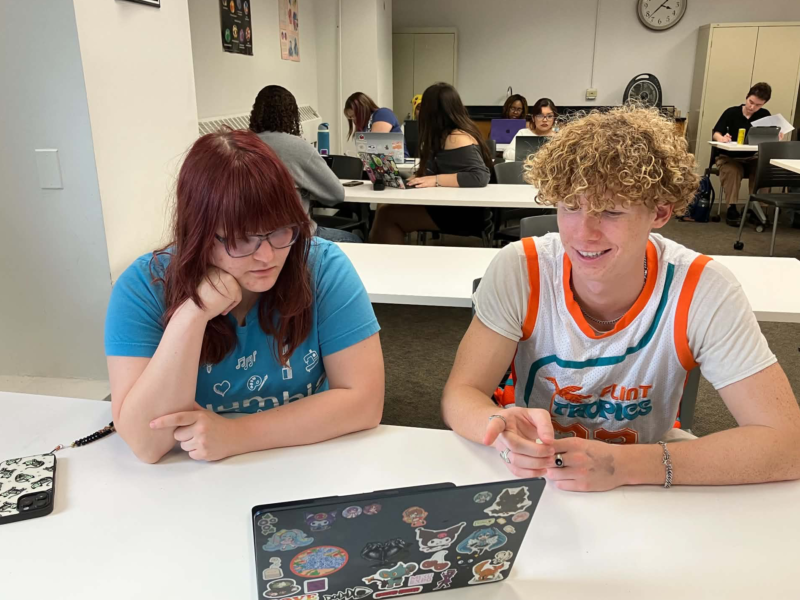
Columbia College Chicago students Jayla Griggs (left) and Austin Youker examine an AI generated post. (Photo Credit: Dominic Calabrese)
With the fall 2026 semester in full swing and communications majors back in the classroom, CommPRO thought it would be timely to speak with soon-to-be journalists, PR professionals and other creatives to get their perspectives on the increasing role AI is playing in reshaping American life.
Given recent warnings from tech executives that the technology may pose a threat to humanity, it should come as no surprise that artificial intelligence is front and center on students' minds.
"Overall, AI has been a very useful tool in my upbringing as a student," says Austin Youker, a freshman at Columbia College Chicago who hails from San Diego, California. "Whether it be as a study partner, a way to brainstorm, or a way to find the cheapest items on eBay, AI has certainly helped me."
Youker acknowledges, however, that while there are many benefits, he also has legitimate concerns about the way this technology is reshaping American life, especially how young people his age are engaging in intimate relationships with AI chatbots and other devices.
"When I initially heard about people engaging in these type of relationships with machines, I thought that I was living in a movie, but crazily enough, this is the world we live in now," he confesses.
Still, Youker feels that as a student navigating the learning process, he must take a more balanced approach.
"To the progressive eye, there should be nothing wrong with someone developing a relationship with a new form of technology," he says. "A lot of people enjoy the validation and consistency found in a robot designed to appease them."
He adds that it's become clear that some people would gladly give up having a physical partner in exchange for a system programmed to agree with them.
On the other hand, Youker can plainly see the downside to this kind of intimacy between humans and machines.
"One of the biggest problems is that people are becoming more socially distant, and failing to include themselves in social settings," he says.
He points out that it's a reasonable concern. When someone's love interest exists within a computer, there's less reason to go out for a nice dinner, take a walk in the park or enjoy an activity like ice skating together.
As a member of Gen Z, a generation that will one day be charged with overseeing AI, Youker worries about the long-term consequences of normalizing AI relationships. These include declining social interaction among future generations, falling birth rates and even potential questions surrounding marriage rights for those who hope to legalize their relationships with AI partners.
For Jayla Griggs, another Columbia student who hails from downstate Illinois, concerns about AI prompted her to reconsider her interest in studying communications, specifically journalism.
"In fact, when I first came to Columbia College Chicago," she recalls, "I debated on taking on a Journalism minor on top of my Illustration major."
Griggs notes that she has always been politically active. During her senior year of high school, she began writing about politics and continued pursuing journalism into her freshman year of college.
Then AI changed her plans.
"It is solely because of AI that I ended up taking on an animation minor instead," Griggs says.
She explains that illustration was already a difficult field to enter, and she believed a minor in a related or more advanced discipline would make her a stronger candidate for jobs in the creative industry.
"It was my fear that with how prevalent AI is becoming in both artistry and journalism, I could not have a foot in both worlds. I needed a leg up in the creative industry and without a minor in animation I knew that in the future, with the rise of AI, I could very well become un-hireable."
Griggs believes that if the current administration took stronger steps to regulate AI and protect creative jobs, she would still be pursuing a communications minor.
"But now I am angry, scared, and uncertain about the future of both fields," she acknowledges. "If I put all of my eggs in the Creative basket, perhaps I’ll give myself a chance."
Columbia student Alejandra Stack also has a strong interest in the creative arts but expresses concern that AI is transforming nearly every facet of her world.
"It can write scripts, generate paintings, produce music and create videos in a matter of seconds," she observes.
Stack acknowledges that for some people, AI can be a useful tool for experimenting and developing ideas. For others, like her, it raises some profound questions.
"For example, is the art created using this tool considered original? Is the information I'm requesting accurate? And how will this affect my future and the environment?"
Stack also asks whether she can call an AI-generated image her own if she provides the exact details through a prompt. And if an algorithm can replicate an artist's style, what happens to the value of developing that style independently?
"If AI is being trained by being fed enormous amounts of real human-created work, what responsibilities should exist to compensate and credit the people who made those systems possible?" she ponders.
Stack also wonders whether students' biggest competitor will be a system capable of performing parts of their jobs at "insane" rates.
While acknowledging that students may have a "common enemy" in AI, she cautions that it would be foolish to completely condemn the technology and ignore a tool that is becoming increasingly common in workplaces, schools and society.
"Rather than asking if we should be for or against AI, we need to decide where we individually believe the line should be drawn between us using this technology creatively and selectively or allowing it to do the creating."
Despite these challenges, Stack emphasizes that students should accept that AI is here to stay and face the future with confidence.
"As students, we will inherit whatever comes next," she points out. "As creatives, along the way, we will be the filmmakers documenting it, the designers shaping how it looks, the writers deciding how it's remembered and the artists proposing questions that may not always get answers."
She acknowledges that while AI may change our tools, politics may change our classrooms and governments may change their relationships with the press, the responsibility of a creative professional remains the same.
"Pay attention to the world around you, question everything, and continue to create!"