

Six Leaders Who Show Us What Communication Leadership Really Means
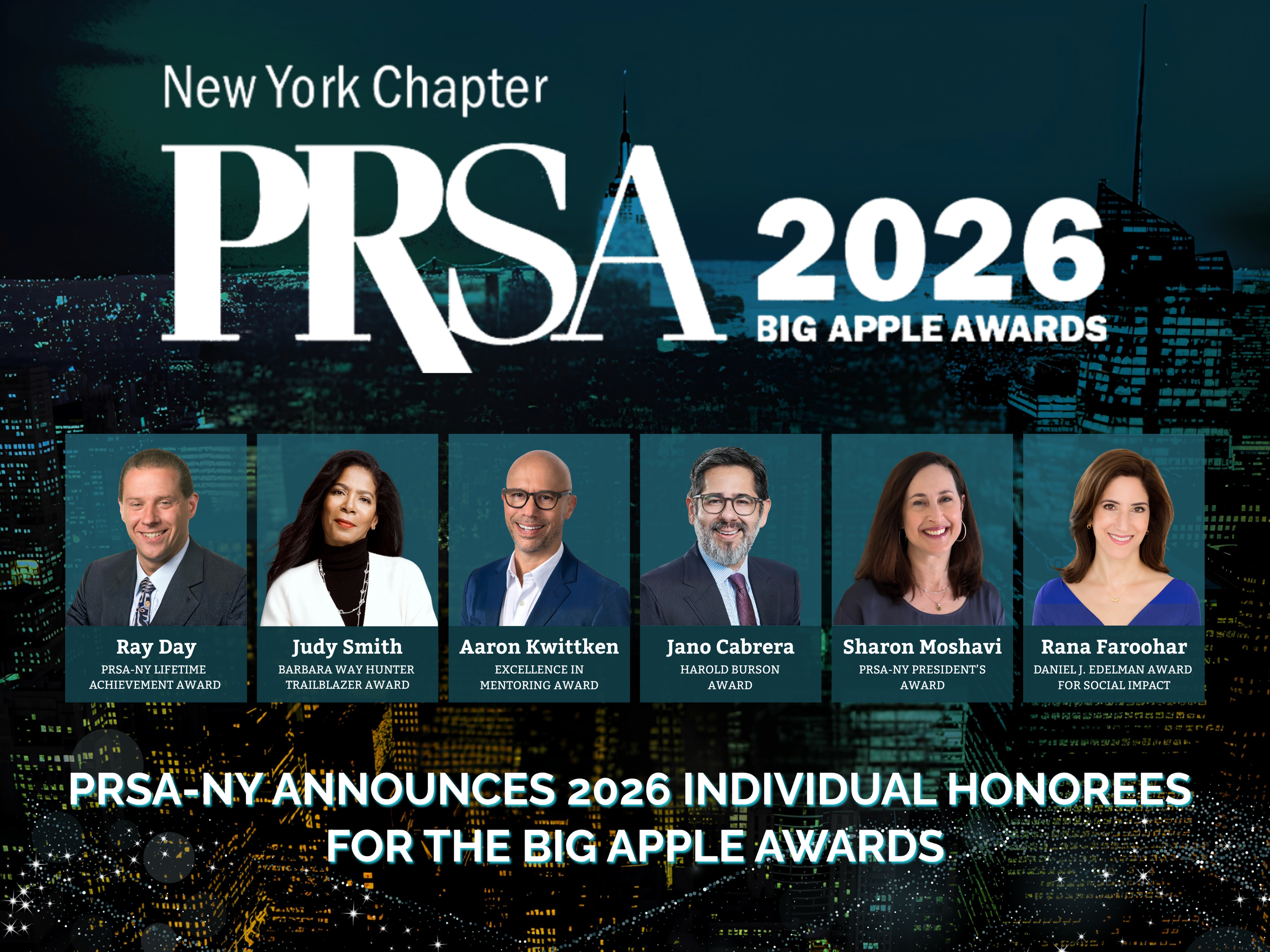
There are people in our business who build impressive careers, and then there are people who, along the way, help shape the business itself. They mentor people, challenge conventional thinking, open doors, counsel leaders through difficult moments and, sometimes without even realizing it, influence how the rest of us think about what we do.
That is what I see when I look at the six leaders PRSA-NY will honor at the 39th Annual Big Apple Awards Gala on September 17 at Sony Hall.
They come from very different places and have built very different careers, which is part of what makes this year’s group so special. Together, Aaron Kwittken, Ray Day, Rana Foroohar, Judy Smith, Jano Cabrera and Sharon Moshavi represent so much of what matters in communication today, from mentorship and innovation to business leadership, journalism, crisis counsel and, running through all of it, trust.
I have known Aaron Kwittken for a long time, and I can't think of a better person to begin with.
Aaron, Partner and Global Head of AI and Innovation at FGS Global, will receive the PRSA-NY Mentoring Award. He has always been one of those people who is looking ahead, whether he was building an agency, starting a new business, teaching at NYU or, more recently, pushing our industry to think seriously about AI and what it means for the future of communication.
But there is another side of Aaron that this award recognizes, and it may ultimately be one of the most important parts of his legacy. He makes time for people.
Throughout his career, Aaron has mentored young professionals, shared what he has learned and created opportunities for people coming into the business. He established the Kwittken Fund for Strategic Communication Internships and Mentoring at George Washington University to help students get the experience, connections and guidance that can make all the difference when someone is starting out.
Our industry talks a lot about developing the next generation, but that only happens when established leaders are willing to invest their own time in doing it. Aaron has.
Ray Day, Vice Chair of Stagwell and Executive Chair of Allison Worldwide, will receive the PRSA-NY Lifetime Achievement Award, and his career tells another important part of the story of how our profession has changed.
For years, communication professionals talked about wanting a seat at the table. Ray spent more than three decades demonstrating what you do once you get there.
Through senior leadership roles at Ford Motor Company and IBM and now at Stagwell and Allison Worldwide, Ray has helped make the case that communication isn't something that comes in after the business strategy has been decided. The best communication leaders understand the business, the employees, the customers, the reputation and the outside world, and they bring all of that perspective into the decisions an organization makes.
That seems obvious today, but it wasn't always. People like Ray helped change it.
Rana Foroohar, Global Business Columnist and Associate Editor at the Financial Times and CNN Global Economic Analyst, will receive The Daniel J. Edelman Award for Social Impact, sponsored by Edelman, and I think her inclusion in this group is especially important.
Rana has spent her career looking at business and power from the outside, asking questions about markets, technology, globalization, politics and the decisions institutions make that affect all of us. She isn't there to help companies tell their stories. She is there to examine those stories, challenge assumptions and help the rest of us understand what is really happening underneath them.
We need that perspective in communication. We can become so focused on the organizations and people we represent that it is easy to forget there is a much bigger conversation taking place around us. Understanding that conversation, including the uncomfortable parts of it, makes us better counselors and ultimately better communicators.
There are few people in our profession with a career quite like Judy Smith, Founder and CEO of Smith & Company, who will receive The Barbara Way Hunter Trailblazer Award, sponsored by HUNTER.
Judy has advised presidents, world leaders, CEOs and some of the most recognizable people in the world when they were facing moments most of us would never want to experience. Earlier in her career, she served as Deputy Press Secretary and Special Assistant to President George H.W. Bush and became the first Black woman to brief the White House press corps. Her work eventually helped inspire Scandal, which brought the world of crisis communication into millions of living rooms.
All of that makes for a fascinating career story, but I think what matters most about Judy is something much simpler. People trust her when things are going wrong.
Anyone can give advice when the answer is obvious. Crisis counseling is different. The facts may be changing, emotions are running high, reputations may be at risk and there is rarely as much time as you would like to figure out what to do. Being the person someone trusts in that moment requires experience, judgment and the willingness to say what needs to be said, even when it isn't what someone wants to hear.
That is a very special kind of leadership.
Jano Cabrera, Chief Communications Officer of General Mills, will receive The Harold Burson Award, sponsored by Burson, and I love the connection between the award and the career.
Harold Burson believed deeply that the real value of a communication professional was not simply in communicating decisions but in helping leaders make them. Jano's career, from presidential politics and the White House to Burson-Marsteller, McDonald's and now General Mills, reflects that idea of the communicator as counselor.
Becoming a trusted advisor isn't a title someone gives you. You earn it over time by understanding the business, listening carefully, knowing when to push, knowing when to question and being willing to tell a leader something they may not particularly want to hear. Most importantly, you earn it by being right often enough, thoughtful enough and trustworthy enough that they keep asking you back into the room.
Jano has built that kind of career.
And then there is Sharon Moshavi, President of the International Center for Journalists and Co-CEO of the Plus alliance, who will receive the PRSA-NY President’s Award.
I wanted to end with Sharon because her work brings us back to something that sits at the center of everything we do: the need for information people can trust.
Before joining ICFJ, Sharon spent more than 15 years as a journalist, including more than a decade as an international correspondent based in Delhi, Jerusalem and Tokyo. Today, she leads an organization working to strengthen journalism around the world at a time when journalists are facing extraordinary pressures and technology is changing almost every part of how information is created, distributed and consumed.
For those of us in communication, the health of journalism is not someone else's issue. We depend on a strong, independent media ecosystem, just as society does. We can talk about misinformation, disinformation, AI, declining trust and fragmented audiences all we want, but none of those problems gets easier if credible journalism becomes weaker.
Sharon's work is a reminder that supporting journalism and access to reliable information isn't just about protecting an industry. It is about protecting something all of us need.
When I look at Aaron, Ray, Rana, Judy, Jano and Sharon together, I don't see six people who fit neatly into one definition of leadership, and I think that is exactly the point.
One has spent decades bringing people along with him. Another helped elevate communication inside some of the world's largest companies. One challenges business and institutions from the journalist's chair. Another is the person leaders call when everything is on the line. One represents the counselor at his best, and another has devoted her career to making journalism stronger.
Their careers are different, but the things that made those careers matter are remarkably similar: curiosity, judgment, courage, generosity, credibility and the ability to earn people's trust over time.
We are living through one of the biggest periods of change our profession has ever seen. AI is changing how we work, the media business is being reinvented in real time, organizations are struggling to reach increasingly fragmented audiences and trust has become one of the most valuable and difficult things any institution can earn.
Technology will continue to change. Our jobs will change with it. But when you look at the careers being honored at this year's Big Apple Awards, there is a pretty powerful reminder that the qualities that make someone a great communication leader haven't changed nearly as much.
And that's something worth celebrating on September 17.
The 39th Annual PRSA-NY Big Apple Awards Gala will take place September 17 at Sony Hall in New York City under this year's theme, “Where Stories Move Hearts, Minds and Markets.” The evening will honor these six Individual Award recipients, celebrate the outstanding campaigns and work receiving 2026 Big Apple Awards and recognize the next generation of our profession.
Tickets and tables are available for the September 17 celebration at Sony Hall.
