

Pete Rose, Donald Trump, and the Ethics of American Sports Culture
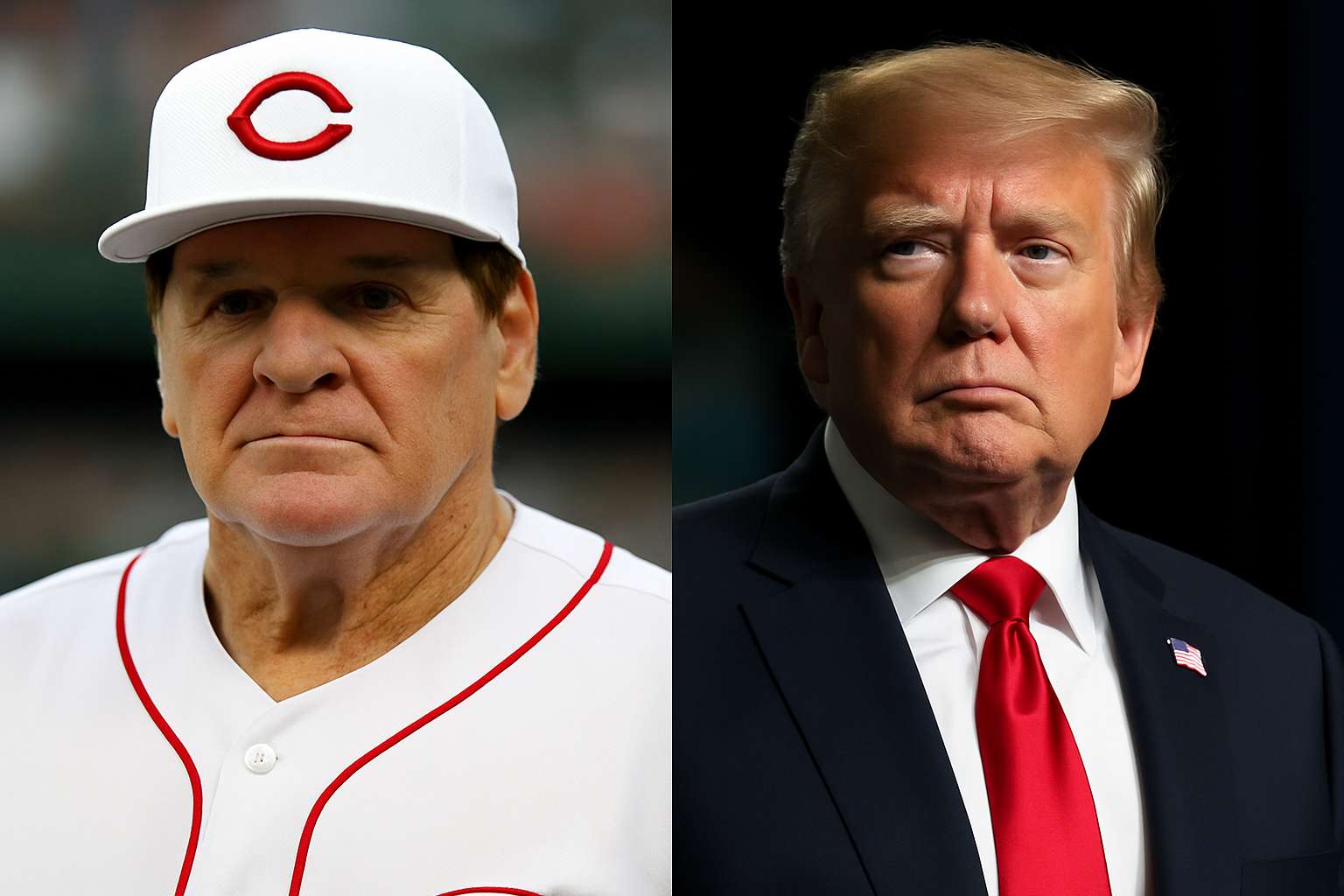
Of course, President Donald Trump campaigned for Major League Baseball to pardon Pete Rose so he could be eligible for induction into the Baseball Hall of Fame.
Of course, President Trump wanted MLB to pardon Rose for breaking the sport’s rule prohibiting participants from betting on games. The former president is well known for pardoning felons and lawbreakers in general—as long as they’re not Democrats or disagree with him.
And, of course, Trump believed that a convicted felon like Rose—who pleaded guilty to tax evasion and served time in prison, and who was accused of having sex with a minor, an allegation Rose said was “entirely false in every respect”—should be pardoned by the baseball establishment.
Like Rose, Trump also declared his innocence. A jury verdict in May 2023 found him liable for sexually abusing and defaming a woman.
And, of course, like Rose, Trump is a convicted felon.
Birds of a feather flock together, indeed. (Not that the other professional sports leagues are any better.)
As someone who has spent a good portion of his working life in the sports business—first as a sports reporter, then as a sports marketing professional—it’s no surprise to me that MLB Commissioner Rob Manfred lifted the ban on Rose and other players who had been on baseball’s ineligible list, which barred them from Hall of Fame voting.
After all, the moguls who control what used to be America’s most popular sport are now in bed with legalized betting companies, shamelessly allowing them—like other leagues do—to advertise during hours when young children and teenagers are watching. Alongside those ads are promotions for alcoholic beverages. “Place a bet and wash down your losses with an alcoholic drink” seems to be the motto of today’s sports business.
Sports coverage has highlighted numerous current and former players who supported the commissioner’s move. But not everyone did. Boston Red Sox pitcher Robert Stock said on X, formerly Twitter, “Pete Rose’s reinstatement brought to you by FanDuel!” Some called the comment controversial. I call it courageous.
Stock wasn’t alone in speaking out.
An article in The Athletic on May 15 quoted several Hall of Famers with varying views on the commissioner’s decision. The article also appeared in The New York Times that day.
Tony La Russa, a former player and manager inducted into the Hall of Fame in 2014, said:
“In Pete’s case, the statistics are undeniable. But from being in Chicago with [Tom] Seaver, and once I got to St. Louis, with Stan [Musial] and Red [Schoendienst], [Bob] Gibson and [Lou] Brock—iconic, legendary Hall of Famers—they were very upset at Pete for a couple of reasons: One, he made the mistake. Two, he wasn’t honest about it. And three, they never really felt like he was contrite or ashamed by it or had a big regret until he wasn’t put in the Hall of Fame. Speaking for them, I can just convey their opinion. I know how upset they were to the point where they were very unforgiving.”
“There was always a big sign on the board in the clubhouse about gambling, and an official had to read the gambling issue to the team before the season started. It was a little tough to miss it.”
Pat Gillick, a Hall of Fame executive inducted in 2011, said:
“Based on performance, it’s a no-brainer, right? I mean it’s absolutely a no-brainer—the guy should be in the Hall of Fame. But then again, the guy, maybe he served his debt to society by going to jail for a while. But again, you have to consider, I think there’s more to it than the on-the-field thing. The character means a lot, and I’d have to question that. It’s going to be a tough subject.”
Jim Leyland, inducted into the Hall of Fame in 2024, said:
“If somebody asked me today, would you vote for Pete Rose to go in the Hall of Fame, I really don’t know the answer. I’d have to think long and hard about that. You know, it’s something that everybody knows—that playing-wise, Pete Rose is a Hall of Famer.”
Reggie Jackson, inducted in 1993, was more direct:
“There is no doubt: Pete Rose gets in. There’s already steroid users in the Hall of Fame. They should be put in the Hall of Fame. And just like Pete—when Pete goes in the Hall of Fame, his ban is over. And if you want to tell his story, and you have a true story, then tell it and put them in the Hall of Fame.”
But a May 14 Boston Herald commentary by Gabrielle Starr looked at Rose’s reinstatement from a different angle. The article, titled “Pete Rose Reinstatement Sends Terrible Message to Women,” argued:
“Neither camp is focusing enough on what really matters in a discussion about Rose’s Hall of Fame eligibility—something far worse than betting on baseball while playing and managing the Cincinnati Reds.”
“In 2017, a woman testified about a sexual relationship with Rose in the 1970s, when he was a married, 30-something father of two, and a star player. She said she had been 14 or 15 years old when it began and that they had been together out of state, where the age of consent was higher than Ohio’s 16.”
“In court filings, Rose admitted to the sexual relationship but claimed he believed she was 16 and denied traveling with her out of state. He was never charged, as the statute of limitations had expired.”
“Not enough people know about this, in part because not enough media members include it in their coverage of Rose. Not enough people care. It’s already the norm for sports fans to excuse any wrongdoing by their favorite players as ‘off-field’ issues.”
The article concluded: “Pete Rose got himself banned from baseball. Dying isn’t a good enough reason to let him back in.”
Manfred’s action doesn’t surprise me. The history of the sports business is full of examples of behavior that would get someone banned from most other industries—but in sports, if you can win games or generate revenue, a slap on the wrist often suffices.
Another example of “anything goes” in sports is the NFL’s decision to honor Brent Musburger with the 2025 Pete Rozelle Radio-Television Award. Musburger may be a well-known broadcaster, but in my view, his record should disqualify him from recognition.
Here’s why.
On Oct. 16, 1968, U.S. Olympic medalists Tommie Smith and John Carlos raised black-gloved fists during the national anthem to protest racial injustice. Instead of focusing on their courage or the context of Avery Brundage’s overt antisemitism and alignment with Hitler’s Olympics in 1936, Musburger wrote a scathing editorial, calling the athletes “black-skinned stormtroopers.”
Stormtroopers, for those unfamiliar, were Hitler’s paramilitary brownshirts.
Because of Musburger’s column, Smith and Carlos were vilified in the U.S. They struggled to find jobs and support, when they should have been honored as heroes.
A June 4, 2012, column in The Nation quoted Carlos:
“We are talking about someone who compared us to Nazis. Think about that. Here we are standing up to apartheid and to a man in Avery Brundage who delivered the Olympics to Hitler’s Germany. And here’s Musburger calling us Nazis. That got around. It followed us. It hurt us. It hurt my wife, my kids. I’ve never been able to confront him about why he did this. Every time I’ve been at a function or an event with Brent Musburger and I walk towards him, he heads the other way.”
Over time, others recognized their bravery. Peter Ueberroth hired Carlos as a consultant for the 1984 Olympics in Los Angeles. ESPN awarded Smith and Carlos the Arthur Ashe Courage Award in 2008, stating: “They were right.”
But the damage was done.
That Musburger will be honored and Rose is eligible for enshrinement says a lot about the values of U.S. sports culture. If you’re talented, your past can be ignored—as long as the moguls believe you can help their business.
As the Trump administration had books removed from military academies, it seems the baseball and football commissioners have removed the words “ethics” and “morality” from their lexicon.
I’ve heard PR agency leaders excuse their representation of reprehensible clients by saying, “Everyone deserves to have representation.” But we’re not in the law business. We’re in the propaganda business.
In my opinion, there should be a Sports Hall of Shame for people like Rose and Musburger—and a PR Hall of Shame for agencies that represent totalitarian regimes or help harmful industries appear reputable.