

AI Usage in America: A Generational Divide

We've reduced AI adoption to a simple story: you're either all in or completely against it. It's an easy narrative to tell. It's also wrong.
We just ran a nationally representative survey of 1,448 U.S. adults to figure out what's actually going on with AI adoption, and the picture that came back was messier, and honestly more interesting, than the "young people love it, old people don't" narrative we keep hearing. The people using AI the most aren't necessarily its biggest fans. The audience getting the least attention might be the one with the most room to grow. And a lot of older adults aren't rejecting AI at all. They just don't know where to start.
If AI adoption isn't a simple story, your messaging shouldn't be either. Rather than assuming everyone needs the same pitch, marketers should understand what each audience values, what they're skeptical of, and how AI can earn a place in their daily lives.
Gen Z is all in, and sounding the alarm at the same time
Gen Z is often treated as the obvious audience for new technology. The data tells a more nuanced story.
Among 18- to 24-year-olds, 47% now reach for an AI tool first when they're looking something up, more than the 42% who still start with a traditional search engine. When you zoom out, the broader population still chooses traditional search first, at 58%. But this younger group has already crossed a line most of the population hasn't: for a lot of them, AI isn't a layer on top of Google, it is actually replacing it.
Here's what surprised me: the generation using AI the most is also one of the most skeptical of it. Thirty-four percent of 18- to 24-year-olds told us AI is already "far too dominant" - nearly double the 19% we saw across the general population. Sixty-seven percent worry about AI's energy consumption, and more than one in four are very concerned about its environmental footprint.
This isn't a generation opting out. It's a generation embracing AI while asking harder questions about where it's taking us.
That makes Gen Z a tougher audience than a lot of brands realize. They'll absolutely use a product that saves them time, but they're also clocking what it costs them in privacy, in energy, in how much control they're handing over. Usage numbers alone won't tell you whether people actually trust what you're building. You have to ask.
The real power users? Millennials.
If you had to guess who's using AI the most, you'd probably say Gen Z. Our research says otherwise.
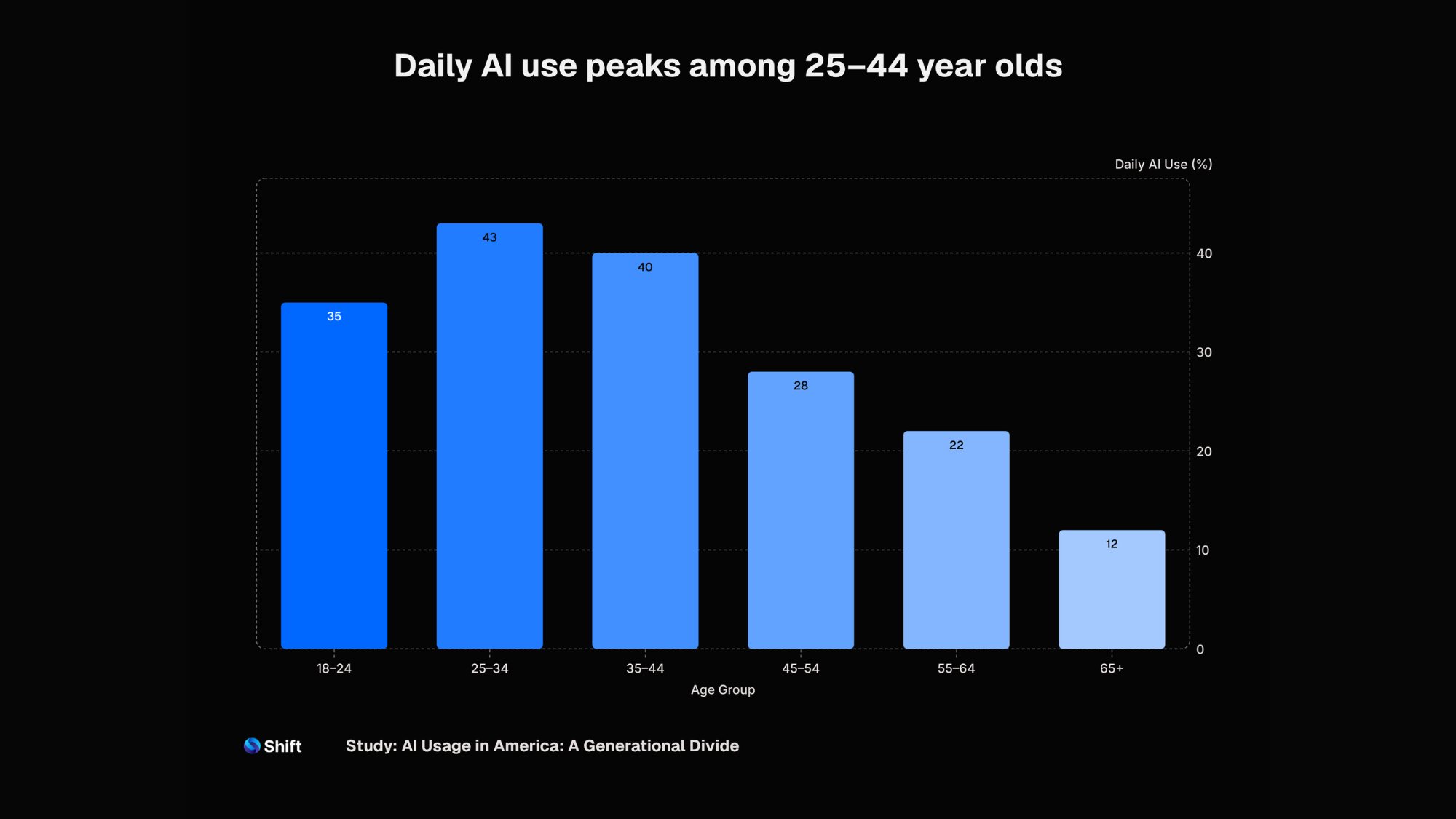
Daily AI use actually peaks with 25- to 34-year-olds: 43% use it every single day, compared to 35% of 18- to 24-year-olds and 32% of the general population. This group also reports the most enthusiasm about it by a wide margin: 62% say AI is genuinely improving their day-to-day digital experience.
It makes sense when you think about who's in that stage of life: people building careers, raising young families, juggling side hustles, and trying to stay on top of it all. They're not turning to AI because it's exciting. They're turning to it because it helps them get through the day.
For marketers, there's a clear lesson here. The people adopting AI the fastest aren't buying into a vision of the future—they're solving today's problems. The winning message isn't "look what AI can do." It's "here's what you no longer have to do.”
The Next Growth Market May Be Hiding in Plain Sight.
The industry's attention is fixed on younger audiences. But if you look at the data, the next wave of AI adoption may come from a group that's been hiding in plain sight.
Forty-six percent of adults aged 35 to 54 say they expect to use AI more over the next year, ahead of the 41% average across all adults. They may not be the ones posting about the latest model release, but they're looking for tools that make everyday work and life easier. If AI adds friction instead of removing it, they'll move on.
Winning this audience isn't about sounding visionary. It's about being useful. They want to know what the product does, how it fits into their day, and whether they can trust it with their information. If you can't answer those questions clearly, no amount of AI buzzwords will make up for it.
Older Adults Don't Have An Interest Problem. They Have An Access Problem.
The most striking finding in the study comes from adults over 65. Forty percent say they never use AI. Another 44% say they simply don't know when or how they'd use it.
It's easy to mistake that for resistance. I don't think that's what we're seeing. Not knowing how to use something is very different from not wanting it. Too often, we treat those as the same thing.
The AI industry hasn't made it easy. Features appear overnight, products assume a level of familiarity that many people don't have, and new capabilities are quietly folded into software with little explanation. If someone doesn't know where to start, they're likely to conclude AI isn't for them—not because they've rejected it, but because nobody showed them why it matters.
Fixing that isn't about pushing harder. It's about building interfaces that don't assume confidence nobody's earned yet, explaining things in plain language, and giving people an actual choice about when AI shows up in their experience. Nobody should have to become a power user just to keep up with everyday digital life.
There's No Single Ai Audience. It's Time We Stopped Talking Like There Is.
Here's what I took away from the research: no generation has AI completely figured out. Every age group is approaching it with its own mix of curiosity, caution, and practical needs.
That's why treating AI adoption as a single story is a mistake. The fastest adopters aren't necessarily the biggest believers. The most hesitant users aren't necessarily opposed. And the people who seem "behind" may simply need better guidance, not better technology.
For anyone building or marketing AI, that's the real opportunity. Stop assuming people will adopt your product because the technology is impressive. Show them why it's useful, be transparent about how it works, and give them confidence that they're in control.
The next wave of AI adoption won't be won with bigger promises about the future. It'll be won by helping people solve real problems today.