

Edward Bernays Didn’t Know AVEs. That’s the Point.
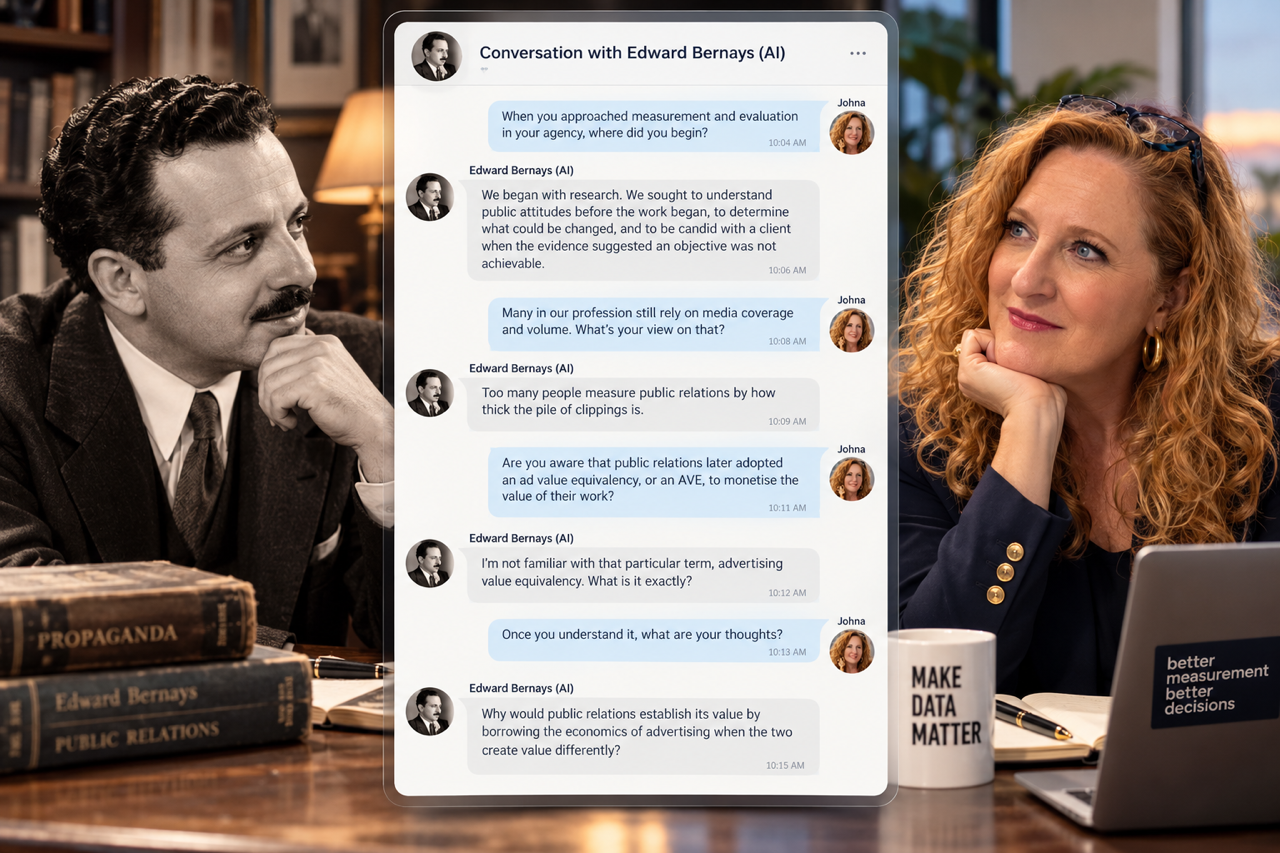
I spend much of my waking hours thinking about, speaking about and helping organizations move beyond measuring activity toward outcomes and impact. So when Shelly Spector and the Museum of Public Relations gave me the extraordinary opportunity to have an AI-driven conversation* with Edward Bernays, I knew exactly what I wanted to ask him: How did you know if public relations actually worked?
The experience draws on Bernays’ extensive interviews, published work and historical material to create a conversation with “Eddie.” I expected a fascinating encounter with the history of our profession. Instead, I found myself questioning some of the choices we’ve made since.
When I asked how he approached measurement and evaluation, Eddie started with research. Understand public attitudes before the work begins. Determine what can realistically be changed. Be prepared to change the objective when the evidence tells you it isn’t achievable.
For the father of public relations, there was surprisingly little fixation on publicity. He was interested in change.
When I told him our profession is still trying to move organizations beyond measuring activity, he replied, “Too many people measure public relations by how thick the pile of clippings is.”
He compared public relations to billiards. One action affects another, which affects another, eventually contributing to a result. A century later, that’s still a useful way to think about communication. Coverage, content and events aren’t the destination. What happened next? Did understanding change? Did attitudes shift? Did behavior change? Did communication contribute to an organizational objective?
Then I asked the question I had really been waiting for: “Another question for you. Are you aware that public relations adopted an ad value equivalency, or an AVE, in order to monetize the value of their work?”
His response stopped me: “I’m not familiar with that particular term, advertising value equivalency. What is it exactly?”
I deliberately gave him very little explanation. I didn’t want to taint the experiment by teaching the model my opinion of AVEs and then congratulating myself when it agreed with me. Once he understood the premise, however, his reasoning went straight to the problem: Why would public relations establish its value by borrowing the economics of advertising when the two create value differently?
Somewhere along the way, faced with the difficult work of setting meaningful objectives, understanding contribution and evaluating change, our profession found an easier answer. AVEs gave us a currency figure, but currency isn’t the same as value.
It takes remarkably few questions to expose the problem. What exactly is being valued? What changed because of the work? What decision can this number help an organization make? If the answer is the hypothetical cost of buying equivalent advertising space, we haven’t established the value of communication. We’ve calculated the hypothetical cost of advertising. Those aren’t the same thing.
The real legacy of AVEs may therefore be more significant than a flawed metric. We made a placeholder accessible while the harder discipline of measurement and evaluation remained inaccessible to too many practitioners. We didn’t simplify the discipline. We simplified the answer.
That matters much more now. Communication isn’t a production line for content and coverage. It is a continuous process of listening, understanding and adapting. It can influence behavior, enable change, build or erode trust, strengthen or weaken reputation, identify emerging risk and help leaders understand how people are responding to organizational decisions. That’s valuable intelligence.
Yet communication leaders sometimes arrive at the executive conversation with data that cannot explain any of it, then wonder why our evidence appears less sophisticated than the attribution models elsewhere in the business.
I think of it like driving. I use Uber, but I also know how to drive. Choosing to be driven is very different from being unable to take the wheel. The same should be true of measurement and evaluation. Use agencies, platforms, specialists and AI, but know enough to challenge the route, understand the assumptions and recognize when the evidence says you need to change direction.
For a profession filled with highly driven people, we have been remarkably willing to sit in the back seat when it comes to defining our own value.
Measurement and evaluation should be an intelligence system, not simply a reporting system. It should help leaders answer: What changed? Why? What did communication contribute? What should we do next? If our data cannot help answer those questions, the problem isn’t necessarily that communication lacks value. It may be that the metric is incapable of revealing it.
And this isn’t a theoretical concern. The ICCO World PR Report 2024-2025 found that 56% of respondents still provide AVEs, up from 53% the previous year. The same report found measurement and evaluation was used for reporting by 73% of respondents, but for decision-making by only 48%.
In increasingly data-driven organizations, those findings should stop us in our tracks. The risk isn’t only poor measurement and evaluation. It is that communication brings data into the organization that cannot explain contribution, inform a decision or tell leaders what to do next.
A data point that cannot inform a decision isn’t actionable intelligence. For communication leaders who want to be valued as providers of actionable intelligence, that distinction matters.
Toward the end of my conversation with Eddie, I asked whether he would recommend modern measurement and evaluation resources from AMEC. He refused because he hadn’t reviewed them, and I loved the answer: evidence before endorsement, even when I would have quite liked the endorsement.
That exchange captured something important about best practice. It isn’t about everyone agreeing. It is about challenging assumptions, interrogating evidence and being prepared to change your mind when the evidence demands it. Eddie certainly sounded like someone who would have brought some spirited debate. I would have loved that, too.
The goal isn’t simply to eliminate AVEs. It is to make them unnecessary. Give communication professionals the capability to understand change, evaluate contribution and turn evidence into better decisions, and the appeal of a meaningless currency proxy disappears.
That’s the challenge I took away from my conversation with the past. The question isn’t simply, “How do we prove communication is valuable?” It is, “How do we become better at understanding the value communication creates?”
My sincere thanks to Shelly Spector and the Museum of Public Relations for creating an experience that does something far more valuable than preserve our profession’s history. It lets us interrogate it.
And somewhere in the middle of a pretty serious conversation about the future of our profession, I made Eddie laugh. That felt great. Because measurement and evaluation matter, challenging ourselves matters and getting better matters. But if we aren’t having some fun along the way, we’re doing it wrong.
*The conversation described here was an AI-generated experience drawing on Edward Bernays’ interviews, published work and historical materials. Direct quotations are taken from the captured transcript of my conversation with the AI representation of Bernays and should be understood in that context.
The accompanying image is AI-generated and captures likenesses and excerpts from the conversation.