
Charles Whitaker Honored With Media Impact Award for Transformative Journalism and Education
What you will learn from this article:
Why Charles Whitaker believes public relations and journalism professionals are facing nearly identical challenges in today’s fragmented media environment
How trust, honesty and shared responsibility can rebuild effective relationships between PR practitioners and journalists
What journalists and communicators must do to protect press freedom and public understanding amid rising censorship and media distrust
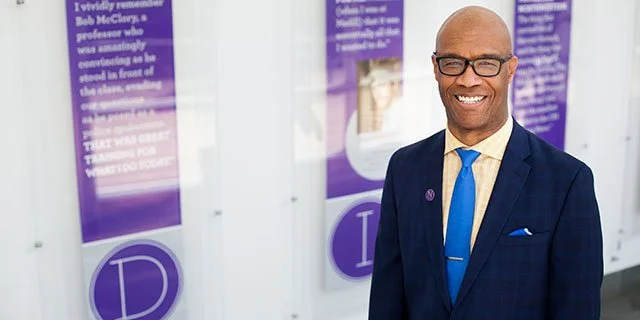
In recognition of his considerable accomplishments as a reporter, scholar and educator, Charles Whitaker, dean and professor at Northwestern University’s Medill School of Journalism, is the recipient of the Media Impact Award from the Publicity Club of Chicago.
Dean Whitaker was honored during the club’s annual Golden Trumpet Awards ceremony on Sept. 18.
“It is a tremendous honor to be recognized with the Impact Award by the Publicity Club of Chicago,” he said. “Throughout my career in journalism and journalism education, I have been devoted to providing opportunities for individuals from a variety of backgrounds to tell stories that illuminate the human condition in communities that rarely gain media attention.”
Whitaker added that he has not done that to garner attention for himself, maintaining that he was mainly toiling away in the shadows, but still finds it “extremely gratifying and humbling” to know that others have taken note of his work.
Whitaker, who holds bachelor’s and master’s degrees from Medill, is the first alumnus of the school to serve as dean. He previously served as the Helen Gurley Brown Professor and associate dean of journalism for the school. Since joining the Medill faculty in 1992, he has taught courses in news writing, magazine writing, magazine editing and blogging. Whitaker has also taught in Northwestern’s School of Professional Studies and the Medill-Northwestern Journalism Institute (also known as the Cherub program).
Before joining the Medill faculty, Whitaker was a senior editor at Ebony magazine, where he covered a wide range of cultural, social and political issues and events on four continents, including two U.S. presidential campaigns and the installation of the first Black members of the British Parliament.
As a longtime observer and participant in the media scene, Whitaker noted that the current landscape is so “fractured and fragmented that both public relations professionals and journalists are scrambling to figure out how to craft messages that break through the clutter and the silos and gain traction.”
He observed that this situation puts the two groups in the same boat in terms of trying to develop content that gets their messages across, adding: “I don’t think we fully appreciate how similar our circumstances are at the moment.”
Given their nearly identical predicament, Whitaker believes that there has to be a level of communication and trust between the two.
“Of course, we often have different outcomes in mind for the content we produce. But in order to work effectively, we have to be honest with one another, even if it means confessing what we can and cannot disclose about the topic at hand,” he said, emphasizing that both journalists and public relations professionals will have to commit to being fair to each other and to their audiences.
“Duplicity and double-dealing are the death of these relationships,” he said.
Asked how reporters can ensure their autonomy during a time in which they are under attack from the current administration, Whitaker pointed out that journalists at many outlets are either at the mercy of their corporate overlords or their outlets are struggling to survive.
“This makes it very difficult for members of the media to push back on the administration’s assault on a free and unfettered press as forcefully as we might like them to.”
He pointed instead to the need for the general public to raise its collective voice.
“Frankly, I think what’s more important than having journalists push back is to have the general public raise their voices to object to this level of governmental overreach,” he said. “We have not done a good job of explaining to the public what’s at stake when we turn a blind eye to the kind of censorship and undermining of the media that is currently taking place.”
Drawing on his study of history, Whitaker observed that losing the power of the press to hold government and policymakers to account is one of the first steps toward the establishment of an authoritarian regime.
“Too few of our fellow citizens understand how dire those circumstances could be. And we, in our own arrogance, have not done nearly enough to explain this to them in clear terms,” he said.
Despite the current turmoil, Whitaker said he is optimistic about the future of communications.
“Humans will always need two things: accurate information and good storytelling,” he said. “The former helps us navigate the world, the latter feeds our soul. These two needs are eternal and enduring, so for that reason, I am optimistic that we will continue to need individuals to be involved in the gathering and production of information and stories. I am not sure what roles humans will play in that process, but I am confident that we will continue to play some role.”
When asked what the mass media will be like 10 or 15 years from now, Whitaker laughed.
“If I had a crystal ball that could predict that, I would retire as a billionaire.”
He maintained that the term “mass media” is not adequate for describing the media environment that currently exists.
“Our current environment is splintered into a million pieces, giving individuals the ability to curate their own media ecosystem — one that becomes an echo chamber, allowing them to filter out any messages that do not align with their worldview or media tastes. I think this will continue to be the case for the next five or 10 years, and I’m not sure what it will take to bring us all together under a big media tent again. So in this media environment, ‘influencers’ and ‘brands’ will continue to have tremendous impact on people and policy.”
Whitaker advised aspiring journalists just entering the profession to be flexible, curious and passionate about what they are doing, pointing out that those qualities will hold them in good stead no matter what changes may come.
Whitaker began his journalism career as a newspaper reporter at the Miami Herald, where he covered education in Dade County and municipal government in Palm Beach County. From the Herald, he went to the Louisville Times, where he worked as a deputy feature editor and enterprise feature and arts writer.
He has contributed articles to the Chicago Tribune, Chicago Sun-Times, Chicago Magazine, Jet, Essence, The Philadelphia Inquirer, The Saturday Evening Post, Chicago Parent and Folio, the magazine of the magazine industry. In addition, he served as an editorial consultant to Catalyst, a publication dedicated to coverage of the Chicago Public Schools, and as president of the editorial board of the Chicago Reporter, an acclaimed investigative publication that covers issues of race and class.
He currently serves on the board of directors for numerous professional organizations, including the American Society of Magazine Editors and the Center for Public Integrity. He also serves on the advisory boards for the Prison Journalism Project, The Evanston RoundTable and Block Club Chicago.
Whitaker is the co-author of Magazine Writing, a textbook that examines the magazine industry and deconstructs the art of feature writing for consumer and business-to-business publications, and co-editor of Curating Culture, a textbook that examines 20th century magazines as niche-factories. He is also the author of four statistical analyses of the hiring of women and minorities in the magazine industry and has served as an adviser on diversity issues for the Magazine Publishers of America. He was the co-director of Project Masthead, a program designed to encourage students of color to consider careers in magazines on both the editorial and business side of the industry, and he was one of the co-curators of the Ida B. Wells Award, presented by both Medill and the National Association of Black Journalists to individuals who are working to increase newsroom diversity and improve the coverage of communities of color.
Whitaker has received commendations for his work from a number of journalism societies, including the National Association of Black Journalists, Society of Professional Journalists and the National Education Writers Association, and has served as a judge for the National Magazine Awards and the International Regional Magazine Awards Association.
Established in 1941, the Publicity Club of Chicago is one of the nation’s largest independent public relations membership organizations.