

The Big Apple Conversation: CommPRO Talks With Jano Cabrera
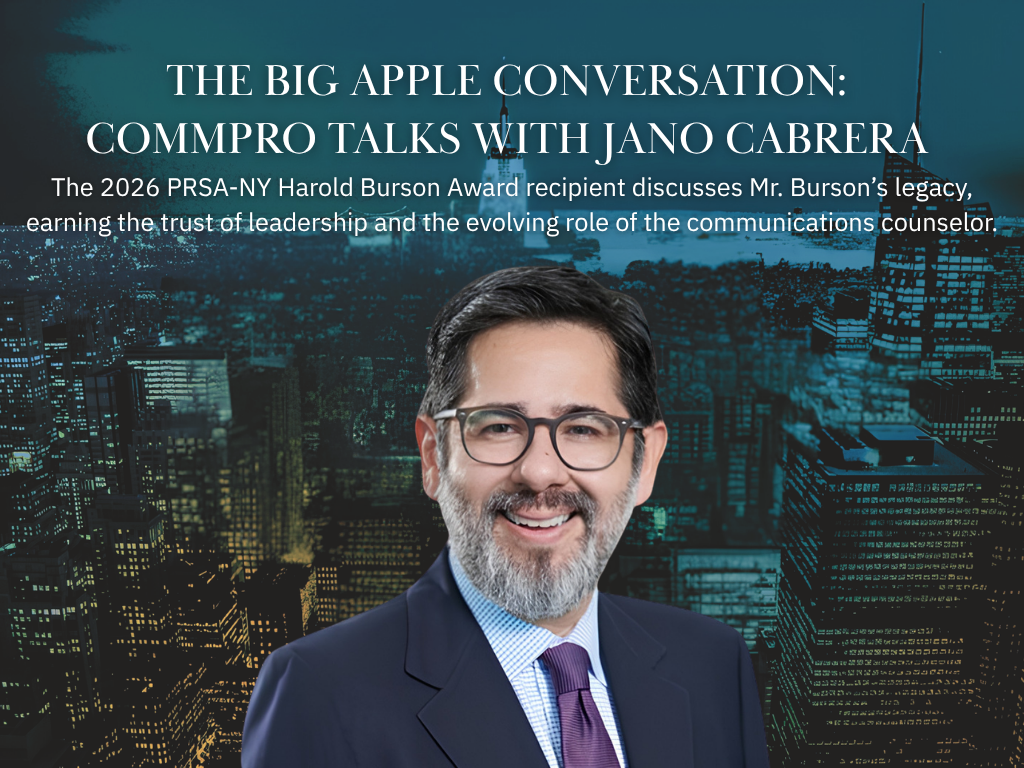
When I sat down with Jano Cabrera, the 2026 recipient of the PRSA-NY Harold Burson Award, there was only one place I wanted to begin. With Mr. Burson himself. Harold meant so much to our profession, and I was especially interested in hearing from someone who had the opportunity to know him, work with him and learn from him personally.
"Harold isn't a historical figure for me," Jano told me. "I met him, I worked with him, I learned from him, and most importantly, I would say I was inspired by Harold."
Jano remembers recognizing something special about Harold from the moment they met. He described it as a little bit of magic. Harold was an extraordinary counselor, but what stayed with Jano was how much he cared about people and the culture he created. "He cared about the profession without any doubt," Jano said. "But it was also clear that he, first and foremost, cared about culture." For Harold, that meant building genuine connections with people. It was something you could feel when you were around him, and Jano believes it inspired others to approach their own relationships in much the same way. It's a lesson he continues to carry with him.
I couldn't resist asking what Harold might think about our profession today, especially with AI changing so much of how we work and communicate. Jano believes Harold would have been interested in the new tools and the opportunities they present, but he would also have reminded us not to lose sight of the fundamentals. Harold understood that communications would continue to evolve. New technologies, new channels and new expectations would always be part of the profession. What mattered was understanding those changes while staying focused on the principles that make communications effective. "A lot of things are changing, but a lot of things aren't," Jano said, imagining what Harold might tell communicators today.
When I asked Jano what had shaped him most as a communications leader, his answer was immediate: "My mom."
I loved where this part of our conversation went. Growing up, Jano's mother taught him to think about life through three simple words: good, better, best. Whether he had a difficult day or something wonderful happened, she would ask him the same questions. What would have been good? What would have been better? What would have been best?
He remembered earning an A on a difficult exam. Naturally, he was proud of himself. But his mother encouraged him to think beyond his own accomplishment. Getting the A was good. Helping a friend study for that same exam would have been better. And the best response was to take that lesson to heart and make a commitment to help his friend prepare for future tests.
It's a philosophy Jano still uses in his work. When faced with a communications challenge, it's often possible to identify a reasonable strategy and move forward. But what happens when you ask whether that strategy could be better? What other perspectives should you consider? What might you be missing? "It pushes you to benchmark, it pushes you to reflect, it pushes you to seek different viewpoints," he explained. I thought that was a wonderful lesson, not just for communications professionals, but for all of us.
From there, we talked about something that's always interested me: What does it really take to earn the trust of a CEO? Jano believes one of the most important things a communications leader can do is arrive with a point of view. Think about the pressures facing CEOs today. They're making decisions about technology, employees, markets, reputation and so many other issues, often at the same time. And they're surrounded by people asking what they should do next.
Jano believes a trusted counselor needs to bring something more to that relationship. Rather than waiting for direction, communications leaders should be thinking ahead, understanding what's happening across the business and offering recommendations about what the organization should do. He used AI as an example. How is it affecting employees? What concerns are emerging? Where are the opportunities to communicate more effectively? Those are conversations communications leaders should be initiating, not waiting to be asked about. As Jano reminded me, quoting Denzel Washington, "The game is chess, not checkers."
But there's another side to earning trust that Jano feels is just as important. We often think about the value of a chief communications officer during a crisis. The CEO remembers who was there, who provided sound advice and who helped the organization get through a difficult moment. But Jano pointed out that how you manage that crisis matters, too. You may successfully navigate a difficult situation, but if you refuse to listen to other senior leaders or damage relationships along the way, you've created another problem for yourself.
His point is that having the right answer doesn't mean much if you damage relationships along the way. The ability to listen, collaborate and work with other leaders, particularly under pressure, is part of what makes someone a trusted advisor.
Toward the end of our conversation, I asked Jano one of my favorite questions: What am I not asking you that I should? He brought up something he believes our profession isn't talking about enough. We're spending a great deal of time discussing AI and the technologies that will change communications. But Jano believes another major shift deserves our attention: the growing intersection of business, politics and public policy.
Organizations are operating in increasingly complicated environments. Business decisions are affected by legislation, regulation, political developments and public expectations. And communications leaders need to understand how all of those pieces fit together. For years, we've talked about the importance of business acumen. Jano agrees that's essential, but he believes understanding politics and policy is becoming equally important. In fact, he suggested that preparing for an earnings announcement can be easier than navigating today's political and regulatory environment. If a communications leader doesn't understand how legislation moves through Congress or where an organization can influence regulatory discussions, how effective can that person really be as a counselor?
It's a good question, particularly as we look toward 2027 and think about how the role of the communications leader continues to expand. That led naturally to my final question about his advice for the next generation. "Lean into what makes you the most uncomfortable."
Jano explained that everyone comes into this profession with different strengths. Someone who has worked in government may understand politics and policy but have little experience with financial statements or running a business. Someone with a corporate background may be comfortable with earnings but know much less about sustainability or nongovernmental organizations. His advice is to identify the areas where you're least comfortable and make a commitment to learn. "Accept that that's a muscle you need to work," he said. With all the tools and resources available today, Jano believes there's no excuse not to keep learning.
What I enjoyed most about my conversation with Jano was hearing how much Harold Burson and his own mother influenced the way he thinks about leadership. Two very different people, but lessons that have stayed with him throughout his career. As we talked about AI, the pressures facing CEOs and what the next generation of communicators needs to learn, we kept coming back to the importance of people, relationships and trust. I think Mr. Burson would have appreciated that.
