

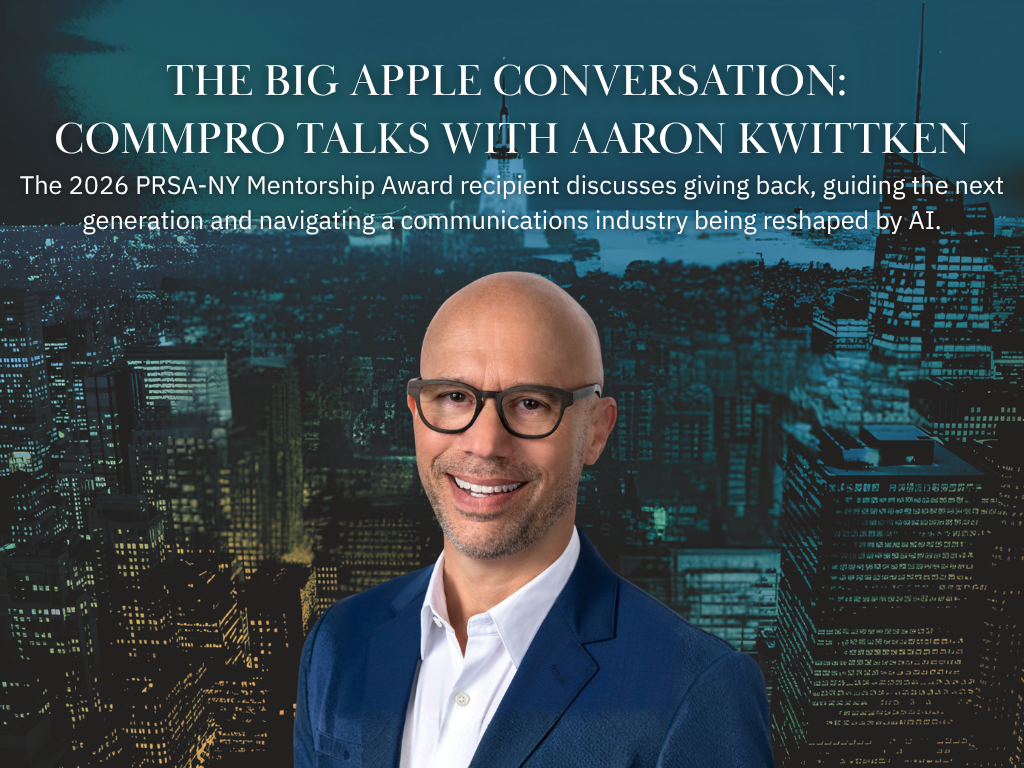
One of the things I love about Aaron Kwittken is that he's always thinking about what's next. Over the years, I've come to appreciate his willingness to challenge the way we do things, embrace new ideas and push our industry forward. He's a wonderful friend, a true industry innovator and someone I always enjoy exchanging ideas with.
I was thrilled to see Aaron receive the Mentoring Award at this year's PRSA-NY Big Apple Awards. We all know him as an entrepreneur and industry innovator, but what makes this recognition so special is his commitment to helping others grow and succeed.
Now an independent consultant and senior advisor at FGS Global, Aaron continues to explore how AI, data and technology are reshaping the communications business. When we caught up for the latest installment of CommPRO's Big Apple Conversations series, our discussion ranged from the personal meaning of his award to the future of agencies, corporate communications and the young professionals entering our industry.
I began by asking Aaron what receiving the Mentoring Award meant to him at this point in his career. His answer was personal and heartfelt.
"It felt like a warm blanket," he told me, explaining that the recognition gave him an opportunity to stop and reflect on the people who helped him along the way, those who "kept the ladder down" so he could climb it.
For Aaron, mentoring is also about the people he's had the privilege of helping throughout his career. He believes that the greatest measure of someone's success and legacy is reflected in the accomplishments and contributions of those they've worked with and helped develop.
I think that says a lot about Aaron. We're always so busy looking ahead that we sometimes forget the people who helped us along the way. Aaron hasn't forgotten, and that's what makes this award so meaningful.
Of course, I couldn't have a conversation with Aaron without talking about AI. He's been encouraging communications professionals to embrace technology for years, so I wanted to know whether he believes we've finally reached a turning point.
His answer surprised me a little. He thinks we're only just getting started.
"We're at the beginning of the ramp," he said. "I wouldn't call it a turning point. I'd say we're on the on-ramp."
Aaron believes the conversation has moved beyond whether communications professionals should adopt AI. The real challenge now is integrating it into how we work, using data and technology to improve performance, expand our responsibilities and demonstrate the value we bring to organizations.
He’s concerned that too many companies are approaching AI primarily as a way to reduce costs or increase efficiency. In his view, that misses the much bigger opportunity to strengthen the communications function and make it more valuable to the business.
"AI is not the boogeyman. It's a boost," he said, emphasizing that technology will change roles and create opportunities for communications professionals to demonstrate their impact in ways that weren't previously possible.
For agency leaders, Aaron believes the challenge is especially significant. He suggests they ask themselves a simple but provocative question: If you had to rebuild your agency tomorrow, knowing what you know today and having access to today's technology, what would it look like?
It's a question worth considering, especially as agencies face pressure to rethink their business models, talent structures and investments. Aaron argues that the focus should be on building for the future, with meaningful investments in data, technology and new ways of working, rather than simply using AI to cut expenses. Agencies that view this transformation primarily as a contraction exercise, he warns, risk becoming obsolete.
On the corporate side, he sees an equally important shift in how communications teams work with other departments. AI integration requires closer collaboration with legal, HR, finance and IT, particularly around training, cybersecurity, acceptable use and technology decisions. Communications teams, he believes, need tools designed for their specific responsibilities rather than simply accepting the same systems used throughout an organization.
I was also interested in Aaron's thoughts about the changing role of the chief communications officer and investor relations officer. With so much attention on AI and the transformation of business, will these jobs look dramatically different a year or two from now? Interestingly, Aaron doesn't believe their fundamental responsibilities will change at all.
Communications leaders will still be responsible for building and protecting trust, managing reputation, shaping narratives and reaching stakeholders in credible ways. What is changing, he explained, is the complexity of accomplishing those goals in a world increasingly shaped by algorithms, large language models, video and rapidly changing sources of influence.
The work may be getting harder, but the purpose remains the same. As someone who has always looked around the corner, Aaron had plenty to say when I asked what else we should be paying attention to as we approach 2027.
He's thinking about the future value of agencies, the resurgence of live events and experiences, and the emergence of autonomous communications systems in which AI agents will increasingly interact with other AI agents on behalf of organizations and stakeholders.
His guiding principle is one I particularly like: "Humans are in the lead, AI is in the loop."
Aaron believes these new forms of communication are coming sooner than many people realize, but he is equally clear that humans must remain responsible for directing and overseeing them.
He's also watching how AI could affect the relationship between chief communications officers and chief marketing officers. As technology changes workflows, he worries that some executives may begin to view the two functions as interchangeable, even though they have different responsibilities and bring distinct value to organizations.
Another issue on his radar is how companies measure the value of communications. Aaron sees an opportunity to move beyond traditional metrics such as share of voice toward a clearer understanding of how communications contributes to business results. As data and technology systems become more connected, he believes it will become increasingly possible to link communications activities to outcomes such as sales and other organizational objectives.
And then Aaron raised a subject that deserves much more attention: Why aren't more communications professionals serving on corporate boards?
Companies regularly recruit former CEOs, financial executives, lawyers and regulatory experts to their boards. Yet professionals who understand reputation, stakeholder relationships, narrative and crisis management remain underrepresented.
"It is astounding to me that in 2026 going to 2027, we don't have as much board representation as we should," he said.
It's an important observation, particularly at a time when reputation and stakeholder trust can have such a direct impact on business performance.
Just when I thought we'd covered everything, Aaron had one more subject he wanted to discuss, and it brought our conversation right back to mentorship.
How do we prepare the next generation of communications professionals for a business that is changing so quickly?
Aaron worries that young people entering the profession have access to extraordinary AI tools for research and content creation, but may not have the same opportunities to develop the judgment, experience and skills that come from doing the work themselves.
"Knowledge is not expertise," he said, reminding me that clients and organizations ultimately depend on communications professionals for their expertise and lived experience, not simply their ability to produce information.
He's particularly concerned about the generation of young professionals whose education and early career development were disrupted by COVID and who may have missed the opportunity to learn both traditional communications skills and the newer capabilities required in an AI-driven workplace.
Aaron would like to see industry organizations, including Page, IPR, PRSA, ICCO and the PR Council, work together to address this challenge. He doesn't pretend to have all the answers, but he believes our profession needs to move beyond talking about the problem and begin developing meaningful solutions.
I think that's a fitting place to end our conversation.
Aaron has spent much of his career encouraging our industry to embrace change and look ahead. Yet what clearly matters to him is making sure the people coming up behind us have the knowledge, experience and support they need to succeed.
For someone who has always been ahead of the curve, it's a wonderful reminder that innovation and mentorship belong together.
And it's one of the many reasons I was so delighted to see my friend recognized at this year's Big Apple Awards.
Editor’s Note: This conversation is part of CommPRO's Big Apple Conversations series, featuring the individual honorees of the 2026 PRSA-NY Big Apple Awards.
